
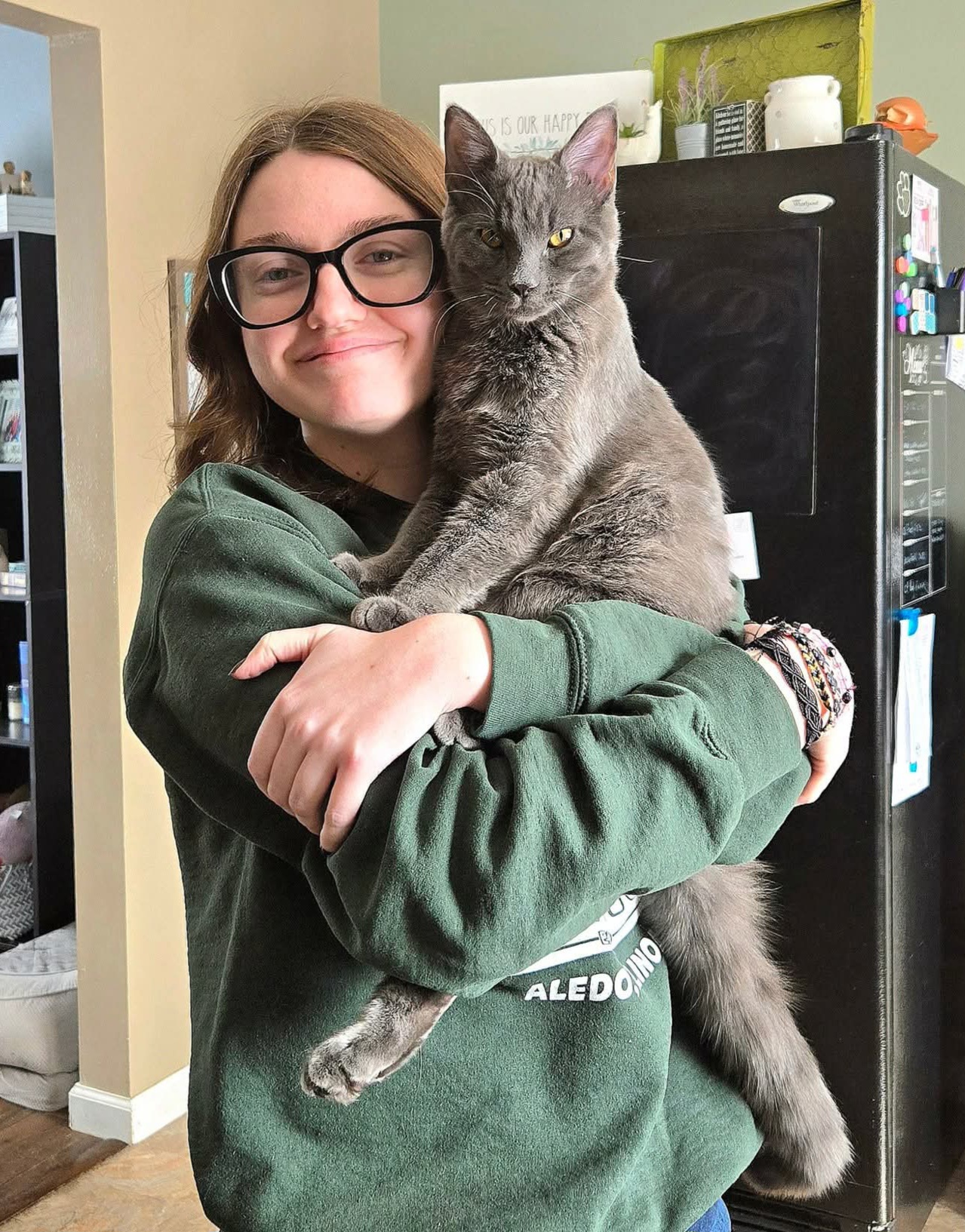
Karissa Geisinger is a senior English major at Western Illinois University (WIU), pursuing a degree in English Literature and Language and a minor in Creative Writing. Geisinger lives in Aledo, IL, an hour distant from WIU’s main campus in Macomb, IL, and forty-five minutes distant from WIU’s former sister campus in the Quad Cities. Living closer to the Quad Cities, Geisinger spent her first three years at Western primarily taking classes hosted in Moline. As of August, 2025, however, (due to the reduction of in-person classes taught in the WIU QC campus) she started making the one-hour commute four days a week to Macomb’s campus to attend in-person English classes and extracurricular events.
Geisinger is currently a series editor for The Mirror & the Lamp, leading the “My Life in Four Books” series; Geisinger also works as Treasurer for The Mirror & the Lamp magazine. Geisinger’s work for The Mirror & the Lamp can be found on the magazine’s website. Some of her work can also be found within the 2024 edition of Elements where her short fiction piece “The Amorato Estate” won third place for the Cordell Larner Award in Fiction. After finishing her undergraduate degree at WIU, Geisinger plans to achieve a Master’s Degree in English, further enriching her knowledge of writing. Geisinger enjoys writing fiction inspired by the world around her; she likes, too, drawing from her surroundings and herself to create art.
On November 25, 2025, I spent a day with Karissa Geisinger, and learned what shaped her as an artist. The following edited interview, conducted later on November 28, 2025 is structured based upon what I learned on my day spent with Geisinger:
Carter L. Myers: Good evening. How are you?
Karissa Geisinger: Good. How are you?
CLM: [I’m] Good. Thank you for asking! I’d like to talk to you this evening about writing as a student and student life in general. I want to first build upon your writing style and body of work (published and unpublished) at Western Illinois University. But to start, I want to ground us specifically in one of your written published works. In spring of 2024, your piece, “The Amorato Estate,” published in Elements, won third place for the Cordell Larner Award in Fiction. Where do you see it fitting within your oeuvre?
Geisinger: How does it fit within? Oh! That’s a really good question! My creative work is much different than my academic work. I love to – I think I wrote this several times in my Creative Writing class this semester – write about grief and I like to write ghost stories and I like to write stories about secret worlds in closets. Because I don’t know. That’s what I’ve always been drawn to writing about. And I think this piece discusses two of those topics. So I think it fits rather well into those kinds of things into my oeuvre. It’s very on brand.
CLM: You mentioned that you’ve always liked to write about ‘secret worlds in closets’ and spooky things [‘ghost stories’], but does this piece have a specific origin? Where did the thought for this specific short story come from?
KG: Uhh… sort of a fanfiction. Not really… but one of my favorite bands [My Chemical Romance] recorded their third album [The Black Parade] in a haunted mansion and I thought that was really cool. And the band has two brothers in it. And one of them really struggled with like nightmares and addiction. They both did, actually. And I just thought that was such an… it’s just so cool – the concept of like recording this album in a haunted house and like you can leave, but they didn’t leave.
And I think it, like, I love the concept of people haunting a house, not like ghosts, but like you. You are affecting the atmosphere of that house. So I just thought that was really interesting and I just, it just sort of manifested into this story about grief and trauma and you haunting yourself and the people around you.
CLM: Are the brothers Wilder and Will [from “The Amorato Estate”] inspired by members of the band?
KG: Not closely, but a little!
CLM: I think that’s pretty cool! Expanding from there, I wanted to ask… do you have a specific process for where your works originate? Could you tell me a little bit about your formative writing experiences (whether at WIU [in the Quad Cities, or in Macomb] or tethered in the times before University)?
KG: It’s a really good question. I don’t really know. I have a very large folder in my Notes app just full of ideas that go back years. When I have to write things for Creative Writing classes, I often just – unless there’s a certain prompt in that class that really catches my eye […] – refer back to the ideas that I already have. I don’t know where they came from usually because I don’t commit very well. And so I just have this half baked idea. And I’m like, well, I could probably string that out. And then I usually do. I don’t often know where they [my ideas] come from. I think I draw a lot of inspiration from bands. [I] also [draw inspiration from] like music, television, movies, but I also like to write about myself a lot… like a lot. […]
CLM: I wanted to ask also, when did you know that you wanted to write? When did this idea start bubbling inside of you? Were there specific moments or activities that informed your decision to enroll in an undergraduate degree here [at Western Illinois University]?
KG: […] In first grade, we had this little project, like throughout the whole year where we all could write itty-bitty little books. I got an award at the end of the year for writing the most amount of books. I think I wrote like thirty within the entire school year. And so I don’t know if it’s so much like a ‘I wanted to do this,’ but like I guess I did. My little seven-year-old me wanted to write that many books. But the answer that always comes to mind first is my high school, junior year, Creative Writing class. There were three students in that class, including me, then there was our teacher. And it was very laid back. We had a different prompt every week. It was just… it was a lot of fun. And I hadn’t ever had that much fun writing before. I mean, it was just high school and you’re not supposed to have too much fun writing. But I just remember thinking like, ‘oh, I could do this forever.’ Like, I enjoyed it so much and it wasn’t even for [a lot of] people to read, really. It was for three other people to read.
CLM: What made the writing so fun?
KG: It’s just different. I don’t think I’d ever, like, written creatively for something. Like, I think I did it for myself now and then. I think a lot of people come up with ideas in their heads and they’re like, ‘that would be cool.’ But it was writing for other people to see. Again, only like, only three other people [saw my writing]. But it was for a purpose. I liked that.
CLM: You’ve spoken about the curriculum (and the environment) in the class being incredible. Did the instructor help elevate that?
KG: I think so. Because, well, you know, there were only four of us in there… including him. And so it was very much like a collaborative thing. We got to choose what we would want to write about that week. Or every two weeks, (depending on how long we wanted this story to be). And he would often write things with us, which I think creative writing professors even do, but like, he would share it with us. And I think, it was very like, it wasn’t even him teaching us so much as it was just like a workshop between these four people.
CLM: What made the different facets of the class come together?: [i.e.,] the environment, the three different people that were so unique and the professor?
KG: I don’t know. I think I’ve always been drawn to smaller classes, and not that my high school was large by any means, but I really enjoyed that [class size]. You really get to know the people in small classes, which I enjoyed! I hadn’t ever experienced that before and we were all very very different. We all wanted to write about different things, but I think we made it work. I mean, we all took this class for fun. It wasn’t a necessary English credit, so I think we were all there because we wanted to be, which always helps.
CLM: I think that’s a good segue into one of the next questions; I really appreciate you saying that! Looking back at your seven nearly completed semesters of college at Western Illinois University, how do you feel? How do you feel about your time here? How do you feel about the environments that have been created? What do you feel like you’ve gained so far? I know that’s a large [set of] question[s] so feel free to take it and run how you’d like!
KG: No, but it’s a good question. I think it’s a really good question because I’m a very reflective person. I’m formulating my answer:
What have I gained? Well, first of all, I’ve gained a lot of confidence purely because I have to. I was very very shy. I’m an introverted person. There’s nothing I can do about that. But I feel like I know what I’m doing for the most part. Like, you never know fully what’s going to happen. But I know myself very well. And I don’t think I would know myself as well if it weren’t for college. And not even just the classes, but the people I’ve met along the way have helped. I’ve made friends. I have mentors that help. And I just feel like it’s opened a lot of doorways to find things that I like and find things that I didn’t think I would like, but I do. I’ve changed a lot, which is good. It’s good to change.
CLM: I think change is necessary! Having been here at Western–represented in quite a couple different ways–how do you feel? How do you feel your time in the Quad Cities is different from your time in Macomb? And what do you feel like you[‘ve] gain[ed] from both of them?
KG: Oh! That’s a really good question. And I’ve been thinking about it a lot lately as I am close to completing my first semester in Macomb. I don’t know. In the Quad Cities, obviously, I spent three years there. My freshman year, I was barely there, though. So it was really only two. I don’t want to rag on any of them, but, like, they’re very different. I think in the Quad Cities, it was kind of like my little high school Creative Writing class. There’s so few of us. But we kind of just had to band together and make the best out of it. Especially junior year when we knew that it was our last year and we were all going to have to disperse. Like it was very much like a ‘this is it.’ So we might as well have fun with it. And I think that’s very nice. I felt very close to a lot of people there. I miss them very much.
Macomb is so much different, but it’s not like a bad difference. I don’t feel out of place so much… I just feel like I’ve missed things. Because there’s a lot more going on. So that’s the main difference. I knew the people up there [in the Quad Cities] more, but like there was way less to do. Like, you would go to campus and you would go home. At Macomb, you can hang around and do things and go to lunch. [You can] go to student hours or hang out on campus. [The campuses have] very different vibes. I don’t think I have any more to add. I don’t want to say anything mean about either of them.
CLM: No, you still have time and you still have to go to school there for [five] months. Talking about going to school there. Where do you plan to go from here? You have [five] months left at Western Illinois University. What are your current aspirations continuing on in the writing world?
KG: Well, I want to go to grad school. Hopefully at Western. I hope to get an assistantship. Hopefully in the Writing Center. It’s more my speed. I’m a very one-on-one person. I think I function much better that way. I just want to get an English M.A.. That was never my goal when I entered college, but I hit junior year, and I realized that I hadn’t spent enough time thinking about the future because it scared me. And I’m like, well, ‘that’s not very good’ so I should probably give myself this time to do that. That’s what I’m hoping to do. We shall see.
CLM: What changed between entering your first day at undergrad and now wanting to get an English M.A.?
KG: I was always a nerd, and I loved going to school. Like, no one likes going to high school, but I loved going to school. It was like my favorite part of the day. And so, like, obviously, I was going to probably like college. Some people should not go to college. It was like the only option for me. It was just perfect. I love college. I love learning. And so I like, I obviously knew that. But I always was just like, well, I can’t possibly do more than four years. That’s outrageous. Like, that’s ridiculous. But… I don’t know. I don’t really know what changed. I think I just enjoyed it [college] more than I thought I would. And I like learning. I like changing. I like growing. [I like college] enough to put myself through two more years.
CLM: This may seem like the obvious next question, but where do you plan to go after the two more years?
KG: That I do not know. And I’m hoping to figure that out. I’ve considered jobs in the writing sphere. I don’t want to write for a living. I want to write for fun. Maybe I can get money out of it occasionally. I’ve never wanted it to be my job. Not even like being a journalist. That’s not something I’ve ever been interested in.
CLM: We spoke earlier about when you first knew you wanted to write. What do you think makes it [writing] so interesting? What do you think makes it ‘the thing’ that you want[ed] to grab onto when you were looking for these jobs. [The thing] that you also want to protect that makes you want to keep this hobby safe.
KG: I don’t know. I think it’s always been for me, not for other people. Publishing in Elements was like a big thing for me. I don’t know how many people actually read Elements. I don’t want to know, because it’s like, ‘I don’t want to know how many people have read that [Elements] because that scares me.’ I struggle turning in papers and asking for help on essays because it’s like my writing is deep down just for me. It’s just that sometimes I have to share it with other people. And so I think keeping writing as a hobby protects that. If I want to share it I will. But most of the time, it’s just for myself. It’s like an outpour.
CLM: Shifting tones completely. I want to ask about your current writing endeavors. You currently spearhead the “My Life in Four Books” series at The Mirror and the Lamp and you remain on staff there as the treasurer. Could you tell me a little bit about that?
KG: Yes. I mean, I don’t write too terribly much. I mostly just conduct interviews. I edit things, and I rewrite things. But I think I like The Mirror and the Lamp a lot, and I liked helping a little bit with Elements. I didn’t do too terribly much, but I liked the idea of putting other people’s work out because that’s something they want to do. I think that’s very important. And I enjoy that a lot.
Again, I don’t share too much. I don’t put too much writing out myself in those two [spaces] but I help other people do it. And I love doing that. Because they love to do it.
CLM: What do you think differentiates a journal like The Mirror and the Lamp from creative writing like that which you’ve deposited into Elements? What makes you more comfortable writing something like an “Everyday English Major” article or “My Life in Four Books?”
KG: That’s a really good question. I’ve said that about like all of the questions, so I’m just gonna stop saying it but, um… I don’t know. It seems like it would be the opposite but when I wrote my “Everyday English Major” article, […] I didn’t struggle with that as much because it’s not deeply personal information and it’s not like reaching from my soul. But the fiction that I write, I’m like… that’s very reflective of the stuff that I don’t want to give away to most people. Like, the “Everyday English Major” is not that serious. It’s like, ‘what do you do in a day?’ Like, I don’t care if anyone knows that. It doesn’t matter. I don’t do that much. But like, someone reading my creative writing, even if it’s not true at all… they could analyze that and they’re like, ‘why did this person write it?’ That’s very, like, it’s not invasive, but it’s like, it feels it because I’m very private. So I think that’s the difference. […]
CLM: This final question is something I’ve stolen from Professor Barbara Lawhorn. It’s something that she asks all of her English 295 students to answer. And it’s one of the two themes, I think, which have been circling through the center of this interview. Why do you write?
KG: She’s asked me that too, and I never have an answer. I never have an answer. I keep saying, ‘I write for myself,’ but I don’t have to do that. I have other outlets for creativity. I was an art student. I still do art on occasion. I can read. I can do anything else. I don’t know why I write. It feels… I don’t know.
I write because I’m good at it. I like when I’m good at things. And I don’t like to say that, because it feels like bragging and I hate bragging, but I know it’s something I’m good at. So I like to do it. And I like to get things out by writing. I’m much more articulate over text or over an email or through a story than I am through an interview or just speaking out loud. And I feel like it [writing] helps. It feels like I have to. [It’s] not something I want to do, but like I have to do it. Like it just helps me.
CLM: I really appreciate you talking with me tonight. Thank you so much.
KG: For sure.



Leave a Reply