
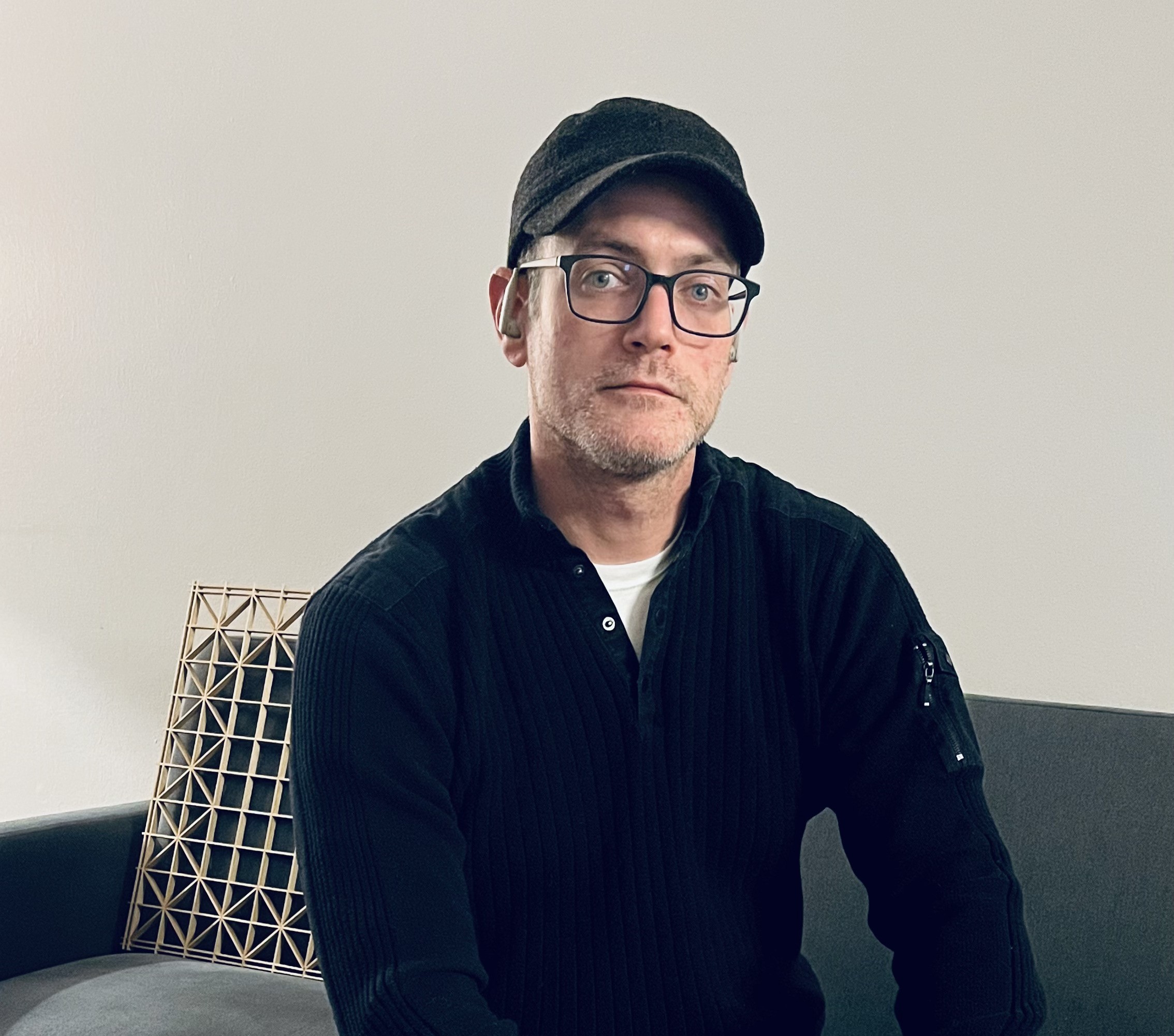
Daniel Baugh is a graduate student pursuing a second bachelor’s degree in mathematics while remaining actively involved in the English Department’s writing community. His work with The Mirror & the Lamp reflects his broader interest in interdisciplinary thinking, where analysis and literary expression inform one another rather than exist in isolation.
Outside the classroom, he writes poetry and creative nonfiction that explore memory, perception, and the structure of emotional experience, often drawing on his background in music and audio engineering. He is particularly interested in how rhythm, pattern, and constraint operate across forms—from verse to mathematics to handcrafted design—and how these systems shape the way we understand meaning.
In addition to his academic work, he practices traditional Japanese Kumiko woodworking, a craft that mirrors his investment in precision, patience, and formal structure. He approaches both writing and making as methods of attentiveness: ways of documenting lived experience while also examining the frameworks that give that experience shape.
M&L: Our first question […] is, what is your weekday routine like as someone associated with the English department?
DB: So, like, how does my current work associate with the English department?
M&L: Sure. Even your […] work as a math major; just how […] do you find yourself correlated with the English department?
DB: […] this semester is kind of different. Um, but last semester, it was much more involved because I was taking English 232 with Professor Lawhorn. And I was attending all of the Poetry Garden [Parties], [and] started coming to work with The Mirror & the Lamp, and so I was doing a lot of, kind of, assignment sort of things, like going and tracking down Craig Finley and finding him at Chick’s and […] then going to his talks later that evening. Um, he was very gracious to give me copies—some of the remaining copies—of his punk rock, printed books. […]
M&L: How intensive was your 232 work?
DB: I made it a lot more intensive on myself because I do poetry on my own. Um, and I have been doing that for a few years now, and I was like, “You know, I really want to take the chance to sort of formalize that, because I hadn’t had an English class.” […] I won’t talk about how long it’s been since I had an English class. 2004, perhaps? Yeah. So, it was a while ago.
[…] I always enjoyed writing, and […] when you’re passionate about something, and you haven’t had any formal training in it, you end up sort of learning bits and pieces here and there without necessarily having a very broad, foundational introduction to it. You kind of just pick and choose what it is that you want to take from it. And so, I did that with poetry, where it was like, “I want to write poetry, but I don’t want to just write poetry, like the way I see it presented online. I want to do it more formally. I wanna do it more traditionally.” And so, I need to understand the tradition, and I need to understand […] what […] the tools and mechanisms [are] that I can use to write better poetry, or at least to write poetry at what I consider to be an elevated level. Um, so part of that process was saying, “You know what? I’m going to take the time and go through a really simple creative writing class.” And it was a very interesting experience because, like, the first day […] I already know what all these terms are, and, you know, Professor Lawhorn is [saying], “And this is what rhyme is, and this is what meter is.” “Oh, oh, I know.” Um, and […] one of the kids in the class looks at me, and she’s like, “Are you sure you’re supposed to be in here? Are you … are you sure you’re not supposed to be teaching this class?”
And so, I felt bad, and […] I tried to really dial that back. And then we [got] into workshops for stuff, and that’s when I was like, “I don’t care, I’m going full bore. These kids don’t know what they’re gonna get hit with!” And I asked Professor Lawhorn […], “Um, you know, is that okay?” and she was like, “Go for it.”
M&L: That’s great! […] Our next question is, what book are all of your […] peers, reading that lies beyond assigned texts for class?
DB: Ooh, that’s a good question, because I first have to kind of consider who my peers are. Because, like, that’s […] a tough one. I don’t really have a ton of traditional peers, per se. And the ones that I do, don’t read the way that I do. […] I have Audible. I do Audible a lot. I looked at my most recent stats, and in December, I listened to something like four hundred ninety-one hours’ worth of audiobooks. So […] I don’t know what my peers are reading. I don’t know if they’re reading at all. I know that most of my peers in the math department are reading math books. Um, you know, some of those texts are written by the faculty, and […] they don’t really have a lot of narrative or plot to them. Mostly just problems.
M&L: What are your weekends like?
DB: Well, right now, my weekends are pretty open. I spend time mostly just catching up and making sure that my online work is done. Um, in my spare time […], I do a little bit of woodworking, as well. […] I have several little projects that I’ve been working on, and I’ll do some of those here […] at my place, and then my folks are up in the Quad Cities area, where they’ve got kind of a larger space where I’ve said, “I’m gonna put a shop here.” They’re like, “Yeah, sure, go ahead.” And so, I have a little shop up there that I’ll go and use. Probably gonna be going and doing that, not this weekend, but next week, because all of my classes are currently online, so I don’t technically have to be here. And there are things that have come up where they’ll say, “Hey, we need you to come up to the farm and babysit the animals for a while.” “Okay, fine … that means I get to do woodwork!”
M&L: Yeah. That’s great! What kind of […] things do you like to make? In woodworking?
DB: Um, a lot of what I do is this really old art form called Kumiko, which is something that […] was brought about in Japan in like the 4 or 500s. Um, essentially, you make … you know what a shoji door is? So, it’s a sliding door that has paper, right? And they usually have […] panels that will have a decorative design put on them. Um, and so there are several formal patterns that you can use to fill those with. And so, I’ve kind of adapted some of those to make decorative panels that are much smaller, because […] I don’t need to make a whole door. […] I’ll make a bunch of stuff. I actually gave Professor Lawhorn a very small version of one of the ones that I make as a thank-you after the end of last semester. But it is incredibly exacting. It doesn’t use glue or nails or anything like that. So, you have to cut pieces to very precise lengths, very specific angles, so that they slide into place, and then are friction-fit so that they don’t […] move.
M&L: That’s really cool. Where do you hang out on campus? […]
DB: This semester, this is where I am: in 326 of Simpkins. Um, I literally live not even […] two hundred yards away from campus. So, like, if I ever really want to come and hang out, I can, but I like having, kind of, my own space and my own, you know, sort of area. It’s never as quiet as I want it to be because where I live, the walls are super thin, and my neighbors are super … let’s just say they think they live in a bigger space with fewer people around them, and they don’t. So, like, you know, if they sneeze in the other room, I hear it. And so, I’ve usually got a pair of headphones in with noise canceling on all the time.
M&L: Well, that sort of answers your next question. But where do you hang out off campus? [Or] where else do you hang out off campus?
DB: I like to go to […] either Argyle or Spring Lake to kind of walk around. Um, the other thing that I like to do is—and it actually helped to kind of select my senior project for my math capstone, or however they want to call it—[use] a very old iPhone in time-lapse mode to shoot […] video of stuff. So, like, if I’m woodworking, if I’m driving, if the sun’s rising or setting, you know. But Apple doesn’t tell you what their compression settings are, and so you can record something for an hour and get back a clip that’s twenty-five seconds long. Or you can record something for six hours, and you’ll get something back that’s thirty seconds long. I’m looking at the proportion of that. I’m like, “That doesn’t work really well.” Because, if I’m doing a woodworking project and I’ve got my phone or the old phone, you know, recording that in time-lapse mode, I need to know what kind of video [I’m] gonna get back and is it watchable?
[…] Because, like, the first time I ever drove down to Macomb, I was like, “I’m just gonna hit record and let it go, and see how it turns out.” And then I got here and pressed stop, and I looked back at the video … I’m like, “I can’t tell what that is.” It’s like, “This must be what The Flash sees when he’s going. And I’m not The Flash. So, I don’t know what this is.” So, I figured out you have to break it up into different chunks—you know, record for ten or fifteen minutes—and then you have to stitch them together. So, I’ve been doing that now for a long time, or what feels like, to me, is a long time. Um, so one of the things I like to do is to go and drive around the lake, because at Argyle, there’s a road that you can take all the way around, whereas you go to Spring Lake and […] there’s no road.
[…] So, you know, I enjoy doing that. I enjoy going and hanging out up at my folks’ place, at their farm […], hanging out with the animals and, you know, in the shop, being able, again, just to kind of have my own sort of space where […] I can make the people go away. The animals are fine. They don’t try … they do try to talk to you, but not the way that people do. They just whine at you for more treats.
M&L: […] what book has changed your life?
DB: Oh, there are a few. There are a few. I used to practice a certain faith. Um, and then I read a book by Robert Wright called The Evolution of God, and I was like, “I can’t practice this faith anymore because I can’t reconcile what I’ve learned and long suspected in this book.” Taken into, you know, combination with a lot of the textual criticism I was doing at the time for school, that I was doing way back when. And, you know, [I] had to kind of make a decision about that. And so that was like a pivotal, life-changing book. The Discourses by Epictetus: definitely top ten, just like, life-changing books. Um, [The Discourses are] kind of an introduction to the philosophy of stoicism […]. I had half a mind to bring it because I literally just got a new copy of it today, because anytime I have one and someone’s like, “Man, my life is really hard,” [I say], “Read this book! Epictetus will solve your problems,” and then I don’t have a copy of it anymore. So, I got a new copy today. And on the back, they summarize it as, “I know I have to die, but do I have to die bawling?” […] it’s kind of like learning to accept things, learning the limits of your own control, your own agency, and developing a sort of resilient mindset […] to approach life and any of the challenges that you might have. Um, Gregory David Roberts’s book, Shantaram, love it. Absolutely love it. Um, there’s the entire Dune series … but maybe not the entire Dune series. Shogun. Uh, so many great books. But [these are] the ones that were truly […] practically life-changing:
Uh, so, The Evolution of God, The Discourses […], and even one that’s by a cyberneticist named Norbert Wiener, called The Human Use of Human Beings, which is a really complex read, but very great, if you can get over the fact that his last name is Wiener.
M&L: That’s a really good list […], it’s very impressive. What brought you to the English department at WIU?
DB: Uh, specifically, [I] just really wanted to refine my own writing, [and] to get more involved because, you know, I’m a very non-traditional student […], it’s very difficult to have sort of peer relationships, especially in the math department […]. It’s a very diverse place, but you have people there that are essentially really anxious all the time about doing well, [and] about, you know, sort of the geopolitical climate. And they’re always very busy. However, I do also serve as Vice President of the Mathematics Club here on campus. And so we try to put on events and, you know, we were at the student organization fair. We got one person to put their name on our list.
[…] usually we got at least four or five in years past, but like, it’s just so interesting to me that there is such a phobia about mathematics. And it’s like, “Eh, […] you guys realize you’re gonna have to use numbers at some point in your life? You probably used numbers today. If you go and buy something, you know, if you think about going somewhere, even like what time it is, you’re going to use numbers. You don’t have to use all the math things. You don’t even have to be good at math.” I’m not. I wouldn’t even consider myself to be particularly good at math. I have to look things up. I use a calculator, you know. It’s a discipline that teaches you how to think and how to solve problems rather than something that’s exclusively reserved for Einstein-level geniuses.
[…] and that’s one of the things that I constantly see anytime I’m going around. And if people ask me, “Hey, what’s your major? What are you working on? Um, oh, you’re the VP of what club again? Yeah, I wouldn’t touch that with a ten-foot pole.” You know, and it’s like, “We’re not gonna make you do math homework.” […] We do this for fun. It’s like, we’ll bring people in from an industry, just about any industry. Like here, we have someone from chemistry coming in and saying, “This is how I use math in my job.” Here’s someone who’s an accountant: “This is how I use math in my job.” […] The members of the […] governing board also have to give presentations on little research projects that they’ve done. So, I presented a very brief sort of analysis of metadata that I’d collected from my time lapse shoots, where it’s like, “I’ve got latitude and longitude, date and time, and I can use that and some computer programming to make a map and show, you know, here’s a trip I took, where I shot with my phone. Here’s how you can see where I’m at on the map.” And […] there are questions that you can then ask about that, like, “Well, how long did it take for you to get from here to here? What was your average shooting time? When you compare that to what you got as footage, how much of it was playable, and how much of it […] met your […] criteria or standard?” My big goal in the role that I’m in [in the Mathematics Club] is to try and make math a little bit more accessible and, you know, to try and at least help people get over that initial fear of approaching math and becoming a little bit more fluent, because we’ll have to use it at some point and people approach math kicking and screaming, and it’s like, it’s really unnecessary. “Here, here’s The Discourses by Epictetus! You don’t have to come to math kicking and screaming!”
M&L: The last question I have for you: what has been or will be your biggest adventure, I suppose, as an undergraduate, or […] correlated with the English department?
DB: Um … The Mirror & the Lamp is definitely on the list of […] big adventures. You know, I’ve really struggled even […] coming down [to Macomb] to live, never having even really heard of the place before, not knowing anybody down here. And, you know, not having lived alone for a very, very long time. So, it was a huge adventure just to get here, and then, like, I hadn’t been in a classroom in twelve or fifteen years, and then getting in and realizing, “Oh, right, I’m surrounded by people that are half my age, that’s fantastic…” And, you know, showing up at events and being like, “No, I’m not one of your professors. I’m one of your fellow students.” Yeah, that doesn’t make me feel awkward or weird at all.
You know, so it’s been a process of doing that. Even the first day, going and getting my ID, and they look at me, and they’re like, “Faculty … or student?” “… student. I know I look like I could work here, but I don’t. I pay to be here.” […] it’s been a huge transition […]—having come from Phoenix, where you have, you know, millions of people and a whole different culture—to come down here and it’s like, “Oh … the deer just walked through the streets? Oh … and no one … no one, like, does anything about that? Oh … okay. Okay … great.” […] You know, […] it’s a very different culture. […] I go up where my folks live. They have neighbors [say], “Oh, the city kid’s here.” I’m like, “City kid?! No, I’m not … okay, yeah, I’m totally a city kid.” I have no idea what I’m doing. You know, I have no idea what to do with four separate seasons. Snow, you know, all that stuff. I love the cold, though. […] everyone’s like, “I hate this!” I’m like, “This is fantastic!” It’s better than being burned alive every day. I can put on more layers. I can’t do that in Phoenix.
[…] it’s such a novelty. You know, I grew up in Phoenix. I, you know, I hadn’t even seen snow until I was in my mid-20s, when we would drive up north. I’m like, “Oh, that’s what that stuff is.” […] Amazing. I was telling Professor Lawhorn, I feel like […] Scout in To Kill A Mockingbird, where she goes out and says, “The world’s endin’, Atticus!” […] but I did live with my folks for a year once I had moved from Arizona to Illinois, and being up at the farm [gave me] kind of a precursor to what “farm life” and all that stuff is like. […] But, you know, it’s been a really great learning experience. […] I want […] someone to tell me, “Here’s your degree in Illinois-ology. […] You’ve passed. Now you may return to the desert or wherever.” You know, and I really don’t know what the future is going to bring once I finish my degree, because getting a degree in mathematics, with a minor in business, I could go and do just about anything, anywhere. And as long as I find something steady that meets my needs, and allows me to keep doing some of the things that I’m passionate about, like writing and woodworking, […] then it really doesn’t matter a whole lot. You know, I have […] some things that are a huge draw to try and get me back to Arizona, but I have been trying to get away from there since I was eight. Because […] you grow up there, you spend any time there, and you’re like, “Humans aren’t supposed to be here. We shouldn’t have a city here.” To quote Peggy Hill, “This place is an abomination. It is a testament to man’s arrogance.” It’s like, “yeah…truth.” […]





Leave a Reply