
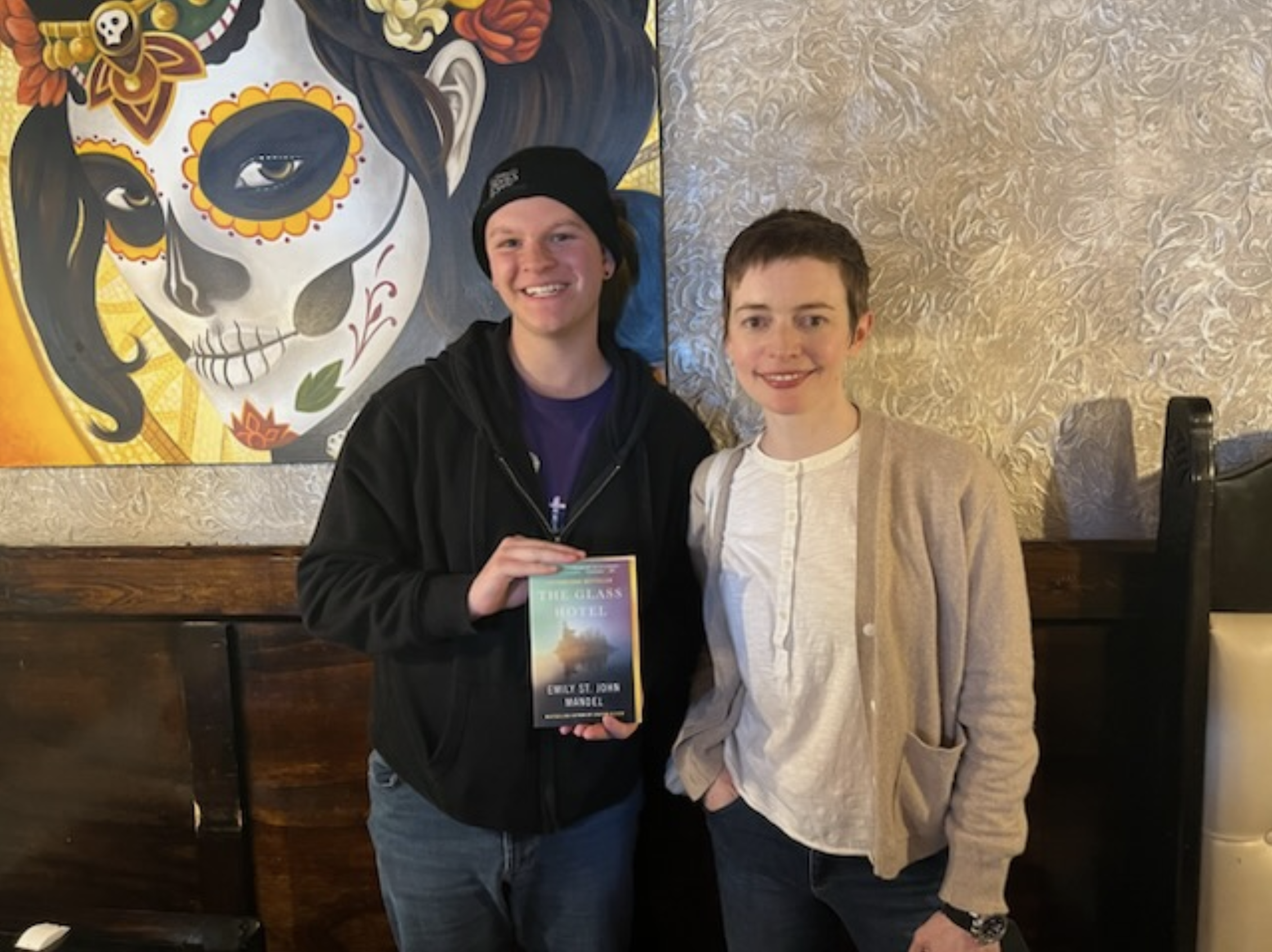
“A novel is a time capsule in a way” by Emily Mandel
During Emily St. John Mandel’s Book Reading, she read us two chapters from Station Eleven–chapters 6 and 11. This novel is her most successful one, and it is the one that jump-started her career as a writer. Up until this point, she was working a full-time job and writing in her free time, but after the release of Station Eleven, she quit her job about a year later and became a full-time author and mother. For Mandel, Station Eleven was her gateway into the world of Best-Selling Authors, and she frequently mentioned that this novel changed her life.
Mandel gave us insight into her experience writing Station Eleven, claiming that the story she published is not the same as the original idea she had in her head. Originally, her story was supposed to be set in modern-day Canada, and while it is still set in Canada, it takes place in a post-apocalyptic future where all of our current technologies no longer work. She claimed that this decision was meant to help illustrate our society’s dependence on technology. I found this to be interesting when it came to something she said about her novel Sea of Tranquility. This was to “ground future sections in the present”, which I think can translate into Station Eleven in the sense that even though it is set in the future, the story still hints back to the present to help the readers follow along with the story.
One of the most notable lines, and the driving force behind the entire story of Station Eleven is “survival is insufficient”. I find this line to be ironic because to be sufficient is to be enough for survival. So, if surviving is not enough to meet the needs of survival, the entire idea contradicts itself. This phrase is enough to explain many of the things inside the novel, such as the troop that presents Shakespeare’s plays. The plays are not a crucial part of survival, but they make it more enjoyable. Additionally, the museum is not a crucial part of survival either, but its presence helps the society to learn, long, remember, etc. Without the museum, there’s a chance that society could collapse. It is interesting to think about this when she makes metaphors such as “a novel is a time capsule”. This novel, in particular, encapsulates what the fall of technology could look like, which forces the human race to turn back to unplugged forms of entertainment, such as books.
So, after the success of Station Eleven as a novel, it was picked up to be an HBO show. Mandel disclosed to us that she did not participate in the writing process, but did mention that “as a writer, you spend so much time imagining what your world would look like”, so it was wonderful to hear that she was impressed with the show, despite the numerous ways it strayed from the novel, such as the setting change, the difference in the Prophet character, and even the “child suicide bombers”, as she put it.
Overall, Mandel expressed consistently that she writes about the topics she does because it demonstrates the ways the world can change. She enjoys her futuristic stories because she enjoys the world-building aspect, even if these stories are grounded in the present. In the words of Mandel, “The world is always ending and a new world is always forming around us”. Change is good. Mandel’s life was changed by this novel, this novel was changed by the screenwriters of the show, and my outlook on life has been changed by the inspiring words of Emily St. John Mandel.






Leave a Reply