
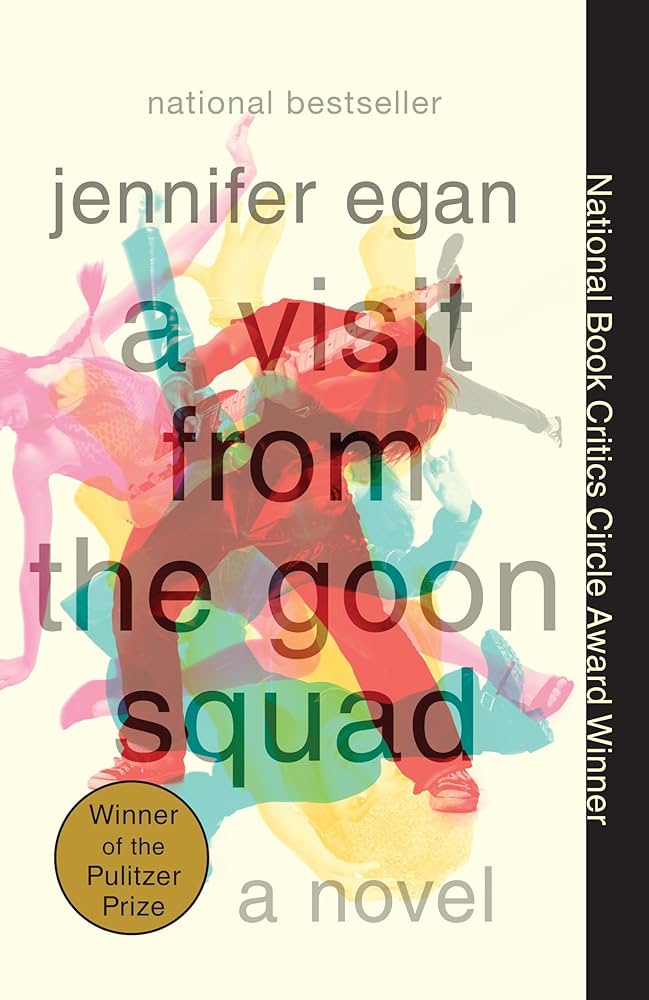
A review of A Visit from the Goon Squad, by Jennifer Egan. Vintage Books, 2010.
Jennifer Egan’s 2010 novel, A Visit from the Goon Squad, is one of the most authentic books I’ve read this year. This book is alive and intense; Egan’s novel is, at every turn, full of profoundly real characters in absurd situations (and doesn’t that just define the best kind of literature?). Egan’s characters are multifaceted: full of intense, unkempt grief and explosive joy. ‘Character’ is at the core of this novel, and that is so refreshing in a modern world defined by plot. A Visit from the Goon Squad does something special with character, theme, and craft.
A Visit from the Goon Squad is split up into thirteen ‘chapters.’ Each chapter, though, may be better defined as a section, a segment, or a snapshot. A unique character commandeers each snapshot and offers a tale to the reader. These snapshots are not directly connected, but they intertwine through time using theme to make up the novel. The major themes defining A Visit from the Goon Squad are left as utterances within these snapshots, and that is glorious. This book is smart, and it assumes the world of its audience. Theme is not thrown in the face of the audience. Each snapshot within this book, instead, slyly offers contrasting character opinions and dialogue revolving around several integral, profoundly human themes: grief, memory, and the passage of time.
“‘I feel like everything is ending,’ [Stephanie] said,” in one snapshot (Egan 131). Alex types in another, “if thr r childrn thr mst b a fUtr, rt” (331)? These two utterances present the sly brilliance of A Visit from the Goon Squad. Omniscient narration is not putting forth an opinion here, nor are the lines plot-related; these lines are human. Emotion: “I feel […]” (131). Indecisiveness: “rt [right]” (331)? These lines represent humanity. These lines could be read right over, but they are the core of the novel.
In a longer segment, tackling grief, memory, and the passage of time, Ted, the protagonist of snapshot eleven, “Goodbye, My Love,” recalls, in tandem with an omniscient narrator, a trip to New York with his wife, Susan:
On a trip to New York, riding the Staten Island Ferry for fun, because neither one of them had ever done it, Susan turned to him suddenly and said, ‘Let’s make sure it’s always like this.’ And so entwined were their thoughts at that point that Ted knew exactly why she’d said it: not because they’d made love that morning or drunk a bottle of Pouilly-Fuissé at lunch – because she’d felt the passage of time. And then Ted felt it, too, in the leaping brown water, the scudding boats and wind – motion, chaos everywhere and he’d held Susan’s hand and said, ‘Always. It will always be like this.’
Recently, he’d mentioned that trip in some other context, and Susan had looked him in the face and chimed, in her sunny new voice, ‘Are you sure that was me? I don’t remember a thing about it! (231)
I offer this excerpt to demonstrate a bit of Egan’s incredible craft and scene work, but to also demonstrate a progression: an utterance – “Let’s make sure it’s always like this” – a response – “Always. It will always be like this […]” – and later – “Are you sure that was me? I don’t remember a thing about it!” This is memory, this is grief, this is the passage of time. This is humanity. This is Jennifer Egan’s A Visit from the Goon Squad.
This novel, published in 2010, feels incredibly relevant in 2025. Humanity in literature is an ever-necessary facet of media. It has never been more necessary, though, than now. In a world full of media created by artificial intelligence (artificial media, if you will), A Visit from the Goon Squad is real. The characters held within it are real, the dialogue is real, and most importantly, the themes are real. Every human has experienced grief. Every human has lost a memory. Everyone moves through time. Egan’s novel hinges on those emotions. Some of the situations held within this book are absurd; this book is smart, and it requires a smart reader to understand it. There are moments, too, where the narrators held within A Visit from the Goon Squad fall a bit flat, and where certain details are left desired, but Egan’s novel is always intensely relatable on an emotional level. A Visit from the Goon Squad is a text that may move on to define snapshot characters in literature. This is not a collection of short stories; this collection of snapshots ties together thirteen characters and their stories (acting independently of one another) into a novel of themes. This novel is modern, yet steeped in history, necessary and needed. I wholeheartedly recommend this deeply human novel!





Leave a Reply