
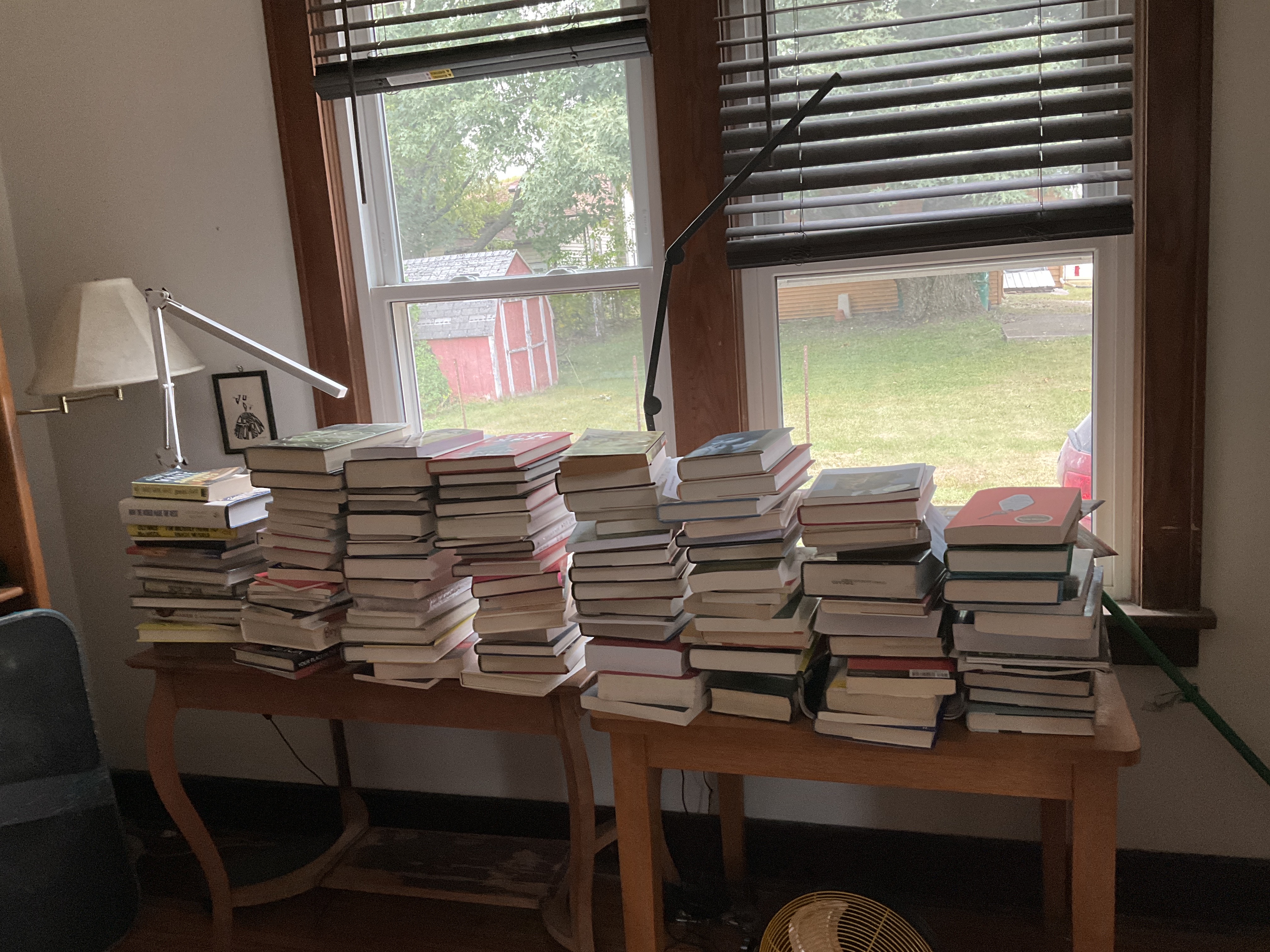
Dr. William Thompson is an Emeritus Professor of the English Department at Western Illinois University. As you might assume of someone with Thompson’s academic passions, he maintains a proclivity for devouring the printed word. His collection of books grew so vast that he had to purchase a second home to make space for them.
“Every passion borders on the chaotic, but the collector’s passion borders on the chaos of memories”
—Walter Benjamin “Unpacking My Library: A Talk about Collecting”
M&L: What genre makes up most of your collection?
WT: No particular genre. If you saw the collection you’d see fiction, poetry, theory of various kinds, belles-lettres, a bookcase devoted to texts in ancient Greek. Probably what is most distinctive about my collection is the large amount of poetry and the Greek stuff. That said, there are many, many novels. I also have a largeish collection of ghost stories, gothic novels, noir, books about language including a bookcase of dictionaries—I went through a phase of dictionary collecting. I have the new Lakota dictionary, which is quite interesting, though I can’t pronounce the words.

M&L: Which book is your favorite?
WT: I don’t have a favorite. I have books I reread. Perhaps the most re-read book for me is Andrew Holleran’s Dancer from the Dance, a novel about gay life in the late sixties and 1970s. It’s beautifully written, funny, and wise. It’s not about the gay experience as such, but as it existed among a few hyper-literate and pleasure-seeking people. I also admire the works of Oscar Wilde. Every English major should have a close acquaintance with The Importance of Being Earnest but also his theoretical essays (The Decay of Lying, The Truth of Masks, etc.) and his fairy tales.
M&L: How long have you been building this collection?
WT: Since I was able to read. I have always loved to read. Numbers are not my strong point—though I like to read about math and physics. I like to read about anything if it is well done.
M&L: Which book have you had the longest?
WT: I’m not sure. My Tarzan paperbacks go back to eighth grade. I don’t think I have touched them since then except to throw away the ones that have fallen to shreds. My Lovecraft paperbacks go back to high school. I still enjoy dipping into Lovecraft now and then—but now mostly as camp. I’ve been listening to At the Mountains of Madness lately (I listen to audiobooks before going to bed the way other people watch TV) and it’s so camp. On the other hand, I recently read a pretty good novel in the Lovecraftian tradition with a strong dose of James M. Cain, Mask of Flies, that was quite effective. Imagine Reservoir Dogs meets The Shadow Over Innsmouth.
M&L: Which book have you gotten most recently?
WT: Dear Dickhead by Virginie Despontes. It is supposed to be a brilliant satire on social media.

M&L: Which is your favorite fiction book?
WT: See above. I try to read old novels, then new novels, then genre fiction of some kind, then experimental works, translated works. It’s important to read widely up and down the canon and far outside it. Low and high. Right now I am on British 1920s to 1940s village fiction kick. These are funny novels mostly by women about daily life in small towns outside London—Jane Austen but comically jaded. Also, adore Borges, fiction and poetry. You must read Borges to understand our world. He was among those who saw it first. Everything by Raymond Chandler is on my shelves. Start with The Big Sleep, then watch the Bogart/Bacall version. William Faulkner (!!!) is credited with the screenplay. And Vanity Fair and War and Peace are also multiple reads, both amazing works, epics, and possibly worth reading one after another. They are set roughly contemporaneously but with vastly different sensibilities powering the prose. And have I mentioned Mrs. Oliphant? She wrote a zillion novels, not a few of which are quite good. I also enjoy Tennessee Williams’s short stories. Truman Capote’s first novel, Other Voices Other Rooms. John Cheever’s stories and novels. David Markham’s work. Jennifer Eagan’s A Visit from the Goon Squad. I’ll stop blathering.
M&L: Which is your favorite nonfiction book?
WT: Any work of psychogeography or nonfiction by Iain Sinclair, one of the greatest prose stylists of our time. London Orbital is a good place to start. After that it is probably Leslie Stephen’s History of English Thought in the 18th century, a brilliant, beautifully written, and slyly funny book. I also like his daughter, Virginia Woolf’s Essays as well as those of her friend, Lytton Strachey. Eminent Victorians is one of my favorite rereads, particularly the chapter on General Gordon. I’m also a big fan of Craig Dworkin’s experimental criticism and poetry. I own everything Susan Sontag wrote. I am not a fan of her fiction, but her essay collections I still reread, most recently Under the Sign of Saturn. Joan Didion, the same.
M&L: Which is your favorite poetry book?
WT: The Rae Dalven translation of Cavafy’s Complete Poems. I have a number of other translations of Cavafy’s work, but I always come back to Dalven. After Cavafy, Baudelaire, Sappho, Adrienne Rich, and many others. Right now I am reading Arthur Sze’s work. I believe it is important to read all over the map, old and new, traditional and experimental. I recently reread Beowulf with David Banash’s class—what a great poem! I also like L*A*N*G*U*A*G*E* poetry. Ron Silliman is a favorite there.

M&L: What makes your library/bookshelf unique to you?
WT: Probably the sheer size of the collection. It is a kind of madness. I’ll never read all these books. But I love the idea of having them at my beck and call.



Leave a Reply