
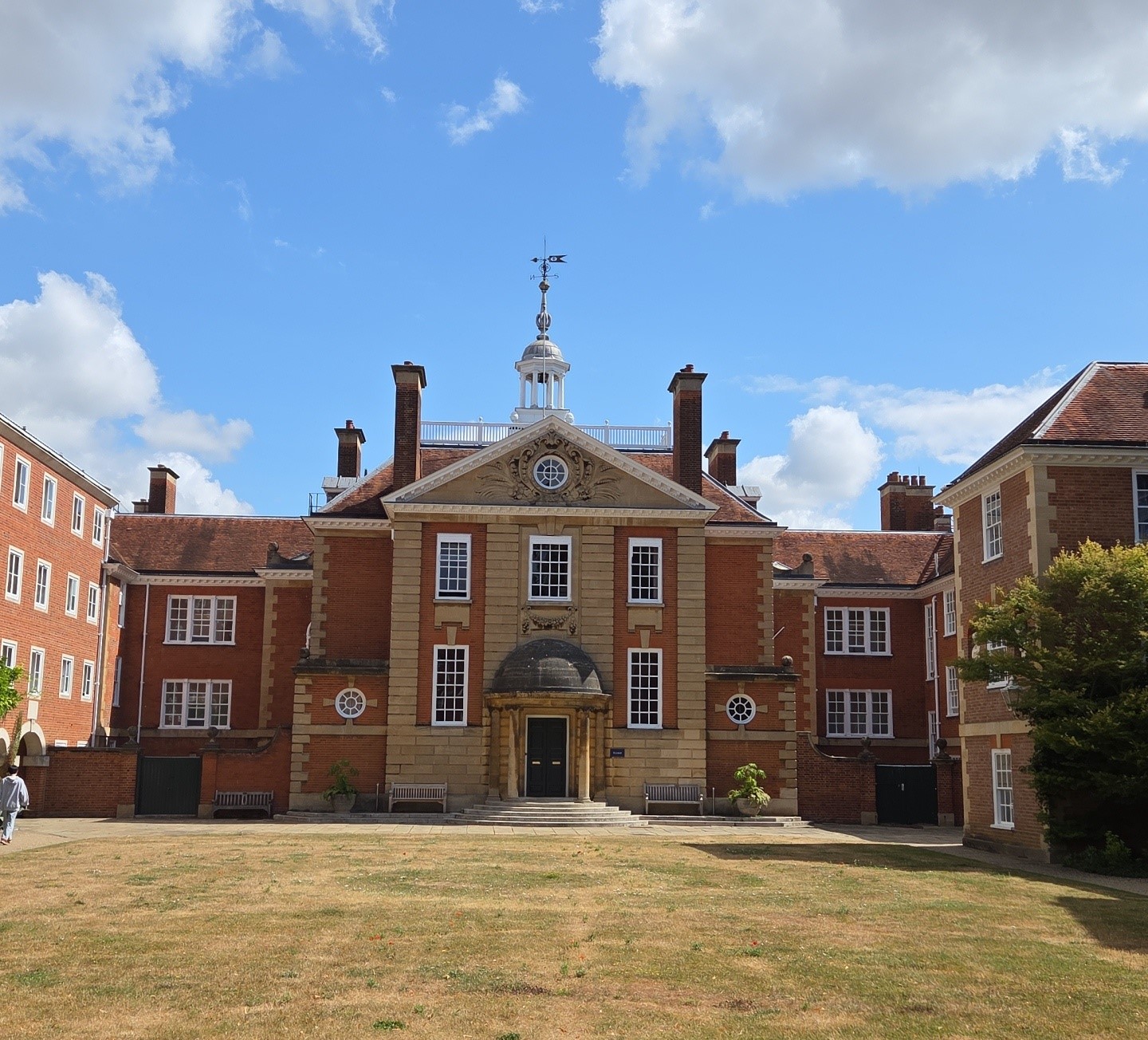
Over the summer of 2025, I had the amazing opportunity to study abroad in Oxford, England. Studying abroad had been a plan of mine since high school. It was originally my intention to do a semester abroad in the spring of 2025, but plans changed, and I decided a summer program would be a better fit for me. I wanted to do a longer stretch than a guided, faculty-led program, but I felt that a semester might be too long, as I had never lived away from home. While researching programs, I came across Lady Margaret Hall through the Institute for Study Abroad (IFSA). It didn’t take long for me to know that it was the place for me. Lady Margaret Hall was the first college in the University of Oxford to allow women; the college also has beautiful gardens and grounds. The English classes that the program offered also fit my interests. I sent in my application, and on February 24th, 2025, I was accepted.
On June 28th, I got on a plane that carried me to London’s Heathrow Airport, and by the end of the day, I was in Oxford at Lady Margaret Hall. I was shown to my room in Wolfson North, attended two orientations, and had my first real meal in England. My program lasted six weeks, and was broken into two sessions. For the first session, I took the course, “Gender and Sexuality in British Literature.” I had lectures Monday through Thursday from 9:00 A.M. to 10:30 A.M., which were followed by seminars from 10:30 A.M. to 11:30 A.M..
Each week, we were given three possible questions we could answer and use as essay topics; these papers were due on Wednesdays. On Fridays, the class was broken into tutorial groups, where the smaller groups we had previously been put in would meet with a tutor. In the tutorials, we would go over the essays we had written for the week and discuss different ideas. My tutorials during session one were on Fridays from 10:00 A.M. to 11:00 A.M.


The first week, we covered The Wife of Bath’s “Prologue” and “Tale” from The Canterbury Tales by Geoffrey Chaucer, The Book of Margery Kempe by Margery Kempe, Revelations of Divine Love by Julian of Norwich, and Twelfth Night by William Shakespeare. For my essay, I answered the question, “Were women allowed enough agency to speak about the issues of love in pre-modern British literature?” On July 2nd, our class went to see the play The Tempest, performed at Oxford Castle. As someone who doesn’t fully care for Shakespeare, it was a lot of fun and was one of the best live acting performances I had ever seen! On July 3rd, some classmates and I went out to explore some of the other colleges in Oxford. We visited Magdalen College and Christ Church, where some scenes from the Harry Potter films were shot.


The University of Oxford is the second-oldest university in the world and is an academic and historic icon. It is divided into forty-three colleges. Each college functions on its own, but is under the umbrella of the University of Oxford. In Oxford, you can’t just wander onto campuses. They are gated and walled off; guests often need to enter through the gate at a porter’s lodge1, and some even charge visitors for entry.
I will admit, I struggled my first week in Oxford. I couldn’t sleep at night and the weather didn’t help. The weather stayed warm and sunny for almost the entirety of session one. It was hot, and while it wasn’t as hot as it gets in Illinois during the summer, Oxford had no air conditioning (and the buildings were made to keep heat in). Still, after the first week, once I’d found a fan and settled in, I had an amazing time.


Sometimes, the school would plan trips for us on the weekends. At the end of our first week, we went to Shakespeare’s birthplace in Stratford-upon-Avon. After looking around at some of the shops in town, we were given a tour of the house that Shakespeare was said to have been born in. Once we had been through the house, we went outside, where two actors performed a scene from Much Ado About Nothing. Afterward, some friends and I explored the town. We went to a beautiful butterfly farm and on a Ferris wheel overlooking the river.


In week two, we focused on Frankenstein by Mary Shelley, Pride and Prejudice by Jane Austen, and Jane Eyre by Charlotte Brontë. For my second essay, I answered the question, “How did literary genres of the 1600s-1800s confirm and/or subvert gender norms?” On July 8th, I attempted punting2—guiding a flat-bottomed boat through a river—for the first time. Lady Margaret has its own punting, as the grounds come right up to the River Cherwell. Punting is hard. I could barely steer the boat, giving up and letting my friend take over fairly quickly. I would find out later that punting was meant for shallower, rockier waters. The River Cherwell, instead, is deep and muddy, so the pole gets stuck.

On July 11th, the school held a Debate Night at the Oxford Union. Students signed up to debate the topics of AI and returning stolen artifacts. It was a ton of fun, with everyone (including the audience), getting involved. Afterward, a friend and I went and got supper at The White Rabbit, a pizza pub that would become one of my favorite restaurants in Oxford. Some of my other favorite food spots were George & Davis’ ice cream (or G&D’s) and The Breakfast Club at the Westgate Mall.


The next day, the school had organized another trip for us, this time to The British Museum in London. Some notable things I saw were the Rosetta Stone and the sixth Caryatid, ‘the Lost Sister.’ Afterward, a group of friends and I decided to brave the Tube and go see Tower Bridge. On our way, we saw the Tower of London and some of the docks. We walked across the bridge before making our way back to the meeting spot at the Museum.


In week three, we covered “Snake” by D.H. Lawrence, “The Waste Land” by T.S. Eliot, To the Lighthouse by Virginia Woolf, Maurice by E.M. Forster, Oranges Are Not the Only Fruit by Jeanette Winterson, and Flèche by Mary Jean Chan. For my last essay, I explored the prompt, “Discuss expressions of same-sex desire in British Literature produced either before or after the Sexual Offences Act of 1967.” Our teacher arranged for us to go into the Lady Margaret Hall (LMH) Library, where the librarian showed us some interesting old texts and first editions.


On July 16th, some friends and I went on an adventure to see Jane Austen’s house in Chawton. We took the train from Oxford to Winchester, from there taking an Uber to the house after a quick stop at McDonald’s. As a huge Jane Austen fan, it was one of my favorite parts of my study abroad experience. We looked around the grounds a little before our tour time began. Then, we explored the house, which was set up in the best effort to make it look like it would have when Austen lived there. While Chawton isn’t where she lived the longest, it is where she wrote all of her most popular novels; the house even had the alleged table where she wrote them. It also had a lot of first editions of her novels and, based on the scraps they had found and preserved, the wallpaper matched to look like it did when Austen lived there.


On July 17th, the school hosted an after-hours party at the Pitt Rivers Museum, and the next day we had our graduation ceremony and formal dinner. Just like that, the first session was over, and on Monday, July 21st, I began session two, taking the course “Oxford and the Rise of Fantasy.” The only change in my schedule was that the seminars and tutorials were from 11:00 A.M. to 12:00 P.M. It was difficult at first, as nearly all of my friends from session one had gone home and it was all new people, but I soon made friends amongst my new classmates. The weather also changed during session two; it was more typical English weather, with cloudy days and rain.

The first week, we covered Beowulf, Sir Gawain and the Green Knight, Lanval by Marie de France, “The Wife of Bath’s Tale” by Geoffrey Chaucer, A Midsummer Night’s Dream by William Shakespeare, The Blazing World by Margaret Cavendish, and Paradise Lost by John Milton. During session two, out of the three options we were given for essays, one was always a creative writing option, which I selected each time. For my first essay in session two, I took on the prompt, “Write a one-and-a-half to two-thousand word Arthurian fiction piece (or a plan/detailed proposal, if considering a larger one), commenting on some important social issues; use footnotes or a brief commentary at the end to explain your creative choices.” For my essay, I wrote “The Missing Ending of Lanval,” where I explored what I thought happened to Lanval after the story was over.
On July 23rd, our class went to see a performance of A Midsummer Night’s Dream at Wolfson College. While it was also a lot of fun, if I had to choose, I think I liked The Tempest more. The next day, I went on a school-led tour of different book stores in Oxford, which, of course, included the famous Blackwell’s Bookshop. In the basement of Blackwell’s is The Norrington Room, which is the single largest room in the world that sells books. That weekend, the school had a planned trip to “the other place,” what Oxford calls Cambridge University, and vice versa. I unfortunately missed this trip, as I was incapacitated by sleeping in. Woopsie! However, I was able to still do something new that weekend; on Sunday, some friends and I visited The Story Museum, which was still fun, despite probably being tailored toward younger audiences.


The second week, we covered The Castle of Otranto by Horace Walpole, The Monk by Matthew Gregory Lewis, Dracula by Bram Stoker, Frankenstein by Mary Shelley, The Well at the World’s End by William Morris, The Princess and the Goblin by George MacDonald, Le Morte d’Arthur by Thomas Malory, and Idylls of the King by Alfred Tennyson. For my second essay, I wrote on the prompt, “Write a a one-and-a-half to two-thousand word fiction piece (or a plan/detailed proposal, if considering a longer one), using a historic setting as inspiration; use footnotes or a brief commentary at the end to explain your creative choices.” For my essay, I wrote a crossover between The Princess and the Goblin and Frankenstein, where the Creature from Frankenstein is put into Princess Irene’s world, which was interesting. On July 30th, our teacher arranged for us to visit the LMH Library, where the librarian showed us some old fantasy texts.


On Friday, August 1st, I attended my first master class, which was on medieval manuscripts at the Bodleian Library. A small group and I were given a lecture on medieval publishing and how the literary world functioned in medieval times, and we were allowed to handle some of the old medieval manuscripts.


That night, the school hosted an after-hours party at the Ashmolean Museum. The next day, the school took us to London to the Science Museum and the Natural History Museum. Both were a lot of fun and, afterward, some friends and I explored Hyde Park.


Sunday, August 3rd, I spent my twenty-first birthday in Oxford. It was incredibly special for me. First, some friends and I played mini golf at Junkyard Golf Club in Westgate, which was really cool. Then, I got a free donut from Krispy Kreme. After that, I went to see the new Fantastic Four movie. I then met up with another friend for ice cream at G&D’s. Lastly, I went back to LMH, where I finished up the day by having pizza and playing card games with my friends.

During week three, we covered Alice’s Adventures in Wonderland by Lewis Carroll, The Chronicles of Narnia by C.S. Lewis, The Hobbit by J.R.R. Tolkien, and different ideas of adaptation. For the third and final essay, I took on the prompt, “Write a a one-and-a-half to two-thousand word fiction piece (or a plan/detailed proposal, if considering a larger one), crafting an unusual (Utopian, Dystopian, etc) world; use footnotes or a brief commentary at the end to explain your creative choices.” For the essay, I outlined my plan for a fantasy book.
On August 7th, we once again had a Debate Night at the Oxford Union, where students who signed up debated whether children should be allowed to have social media accounts. The next day, I visited New College with a friend, where more scenes from Harry Potter were filmed. That night was our graduation ceremony and formal dinner. My second session was over, and with it, my study abroad program.

After graduation, I traveled with some family for a bit, visiting London, Scotland, and Ireland, before leaving for home on August 19th. My time studying abroad is something I will treasure for all of my life. I would encourage others to study abroad, as I can promise that you will never regret the experience. The motto of Lady Margaret Hall is “Souvent me souviens,” which roughly means “Remember me often” in Old French. I know I will remember Lady Margaret Hall, what I learned there, and the friends I made often and wholeheartedly.

- The porter’s lodge is somewhat difficult to describe; think of the guards standing at the drawbridge of a castle, then make it modern. At Lady Margaret Hall, it was a building that connected to the fence surrounding the school. Those with keys, like students, could bypass the porter’s lodge and just go through the gate outside. However, visitors would need to go through the porter’s lodge for permission to get in. The porter’s lodge was also a place where we could direct all of our general questions if we didn’t know who to ask: like if we needed towels because the scouts (cleaners) had forgotten to replace them, or if we had a maintenance issue, like our shower head breaking off and falling in the middle of the night… both things that I may have experienced. ↩︎
- Punting is like being in a rowboat, except instead of sitting, you are standing on a flat platform at the back, and instead of using a paddle, you use a giant, long stick to push off the bottom of the river. ↩︎





Leave a Reply