
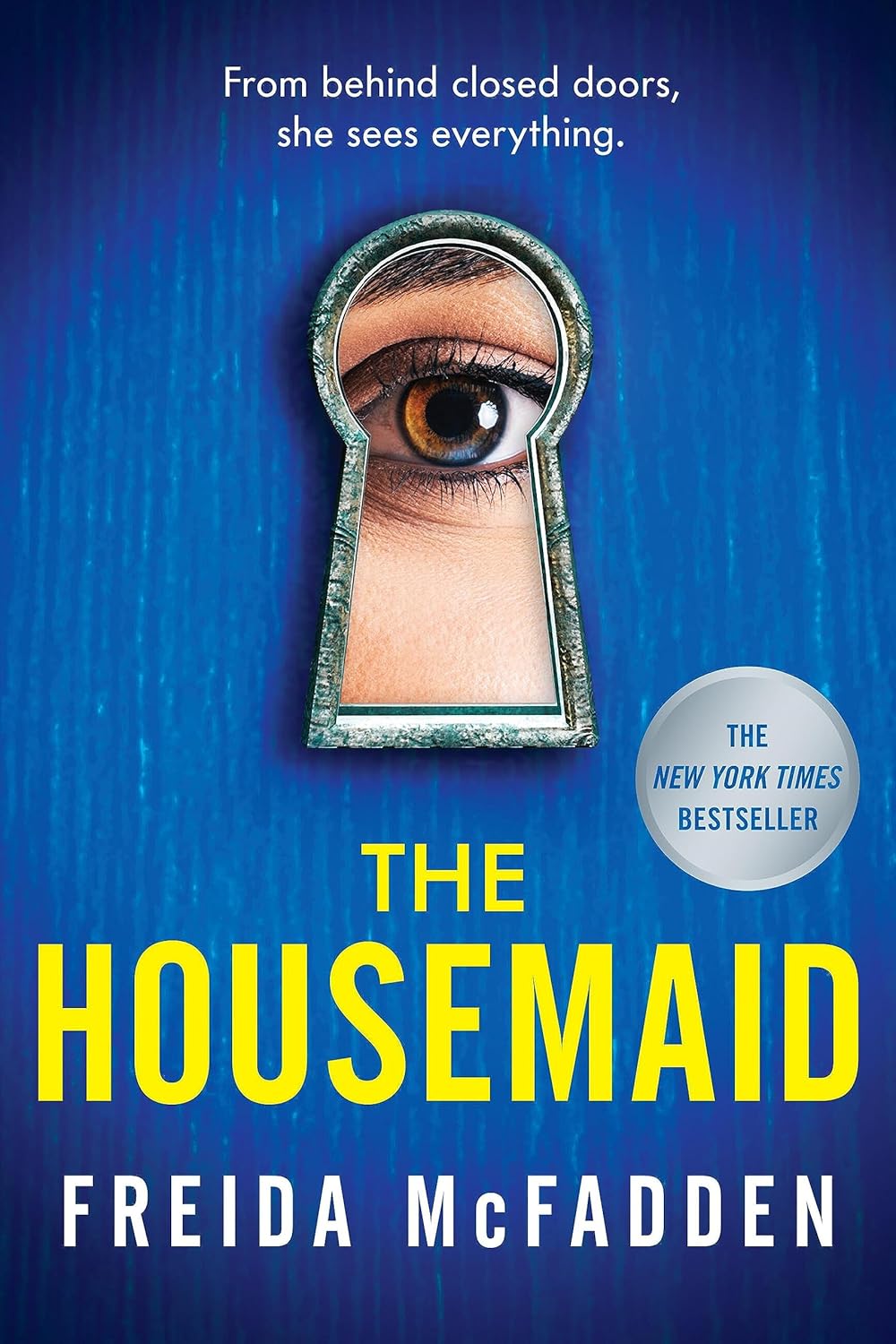
A review of The Housemaid, by Freida McFadden. Hachette Book Group, 2022.
The Housemaid came to my attention after the movie adaptation released in theaters in December of 2025. I got my hands on Freida McFadden’s most popular book and went in with very little information; I didn’t watch any movie promos or scenes, as I didn’t want my opinion tarnished!
The Housemaid follows Millie Calloway, as she desperately tries to restart her life after serving ten years in prison. She finally gets a job by working as a maid for the wealthy Winchesters (mostly for Nina Winchester). She gets a small room in the Winchester’s house but, suspiciously, her door locks from the outside.
This psychological thriller is fast paced and full of head-spinning plot twists that had me spiraling. The short chapters and McFadden’s writing style made me fly through the book; I was hungry for answers and I wanted the story to unfold.
McFadden is no stranger to the psychological genre. Writing over twenty novels and novellas, she is a seasoned veteran of the genre. There is an uneasy ambiance to the book that I picked up on while reading. McFadden writes suspense very well. There were some parts that I was stressing for Millie, but I also understood her curiosity. After Millie completes her interview with Nina Winchester, she sees the landscaper outside and has an unsettling “interaction” with him:
‘Hi,’ I say.
The man stares at me. He doesn’t say hello. He doesn’t say ‘quit trampling my posies.’ He just stares at me.
‘Nice to meet you too,’ I mutter under my breath.
…I look back one last time at the landscaper in the yard and he is still watching me. There’s something in his expression that sends a chill down my spine. And then he shakes his head, almost imperceptibly.
Almost like he’s trying to warn me.
But he doesn’t say a word. (McFadden 12)
This is the first moment that McFadden shows this eerie feeling through Millie’s experiences. This feeling increases throughout the book, as the plot unfolds and the author reveals more about her characters.
One of the main conflicts in the book is Millie’s growing infatuation with Nina’s husband, Andrew Winchester. They both try to deny themselves of this developing, forbidden relationship. This phase, obviously, does not last very long, and they start a secret affair. I was worried that the book would shift into the “romance” genre, but McFadden stays on course. After this new plot point is introduced, my worry drifted away and I became curious about how McFadden was going to write these secret lovers’ intimacy and about how far she would take it.
Thanks to BookTok and the books that are made popular by the community, I feel that many new books being published are nothing more than explicit content. McFadden was classy. She makes it obvious that an intimate scene happens between these characters. There are clothes on the floor and Millie and Andrew say that they can’t continue the affair in the next chapter. It was very easy to understand that they started an affair without getting an explicit scene. She doesn’t give the audience explicit details that do not further develop the plot:
Needless to say, we don’t get two separate rooms at The Plaza.
So yes, I slept with my boss.
After he kissed me in the taxi, there was no going back. We were basically ripping each other’s clothing off at one point. It was all we could do to keep out hands off each other while Andrew was checking us into our room. We made out in the elevator like a couple of teenagers. (139)
McFadden gave enough details for the audience to get the picture without making it weird or uncomfortable.
I also appreciated how realistic the characters were. There isn’t really a “good guy.” Millie is the protagonist but has been to prison and is sleeping with her boss. She is not a character that I would put on a pedestal and rave about after finishing a book. However, real people go through similar situations as Millie, and life is not black and white; The Housemaid reflects that.
Nina Winchester is also written as an unlikeable character. There were many points in the book where my blood was boiling because of how angry this character made me. She would tell Millie something or give her a task and then retract it and reframe it so it reflected poorly on Millie in front of Mr. Winchester. It was aggravating to read. At one point, Millie is at the grocery store getting food for her employers, and is having enough trouble trying to find the right items for Nina, when a security guard approaches her, saying, “I’m super market security. Can you come with me, Miss?” (159). When Millie is moved into a separate room, she proves that she has paid for every item and is not stealing. The security guard responds, “I’m sorry to bother you like that, Miss Calloway. But we have a lot of problems with shoplifters, so I had to take it seriously. And I got a phone call alerting me that a customer matching your description might be planning to take something” (160). Millie explains that Nina is the only person capable of this, especially after other events that she has experienced throughout the book.
I thoroughly enjoyed reading The Housemaid and plan on reading the sequel to see how McFadden handles the narrative after the plot twist! I never knew what was going to happen next, which can ruin the experience for me if I can figure out the twist. I would highly recommend this book. It was a quick read and kept me guessing. There was no drag, and McFadden had purpose behind her characters that she slowly reveals throughout the book.





Leave a Reply