
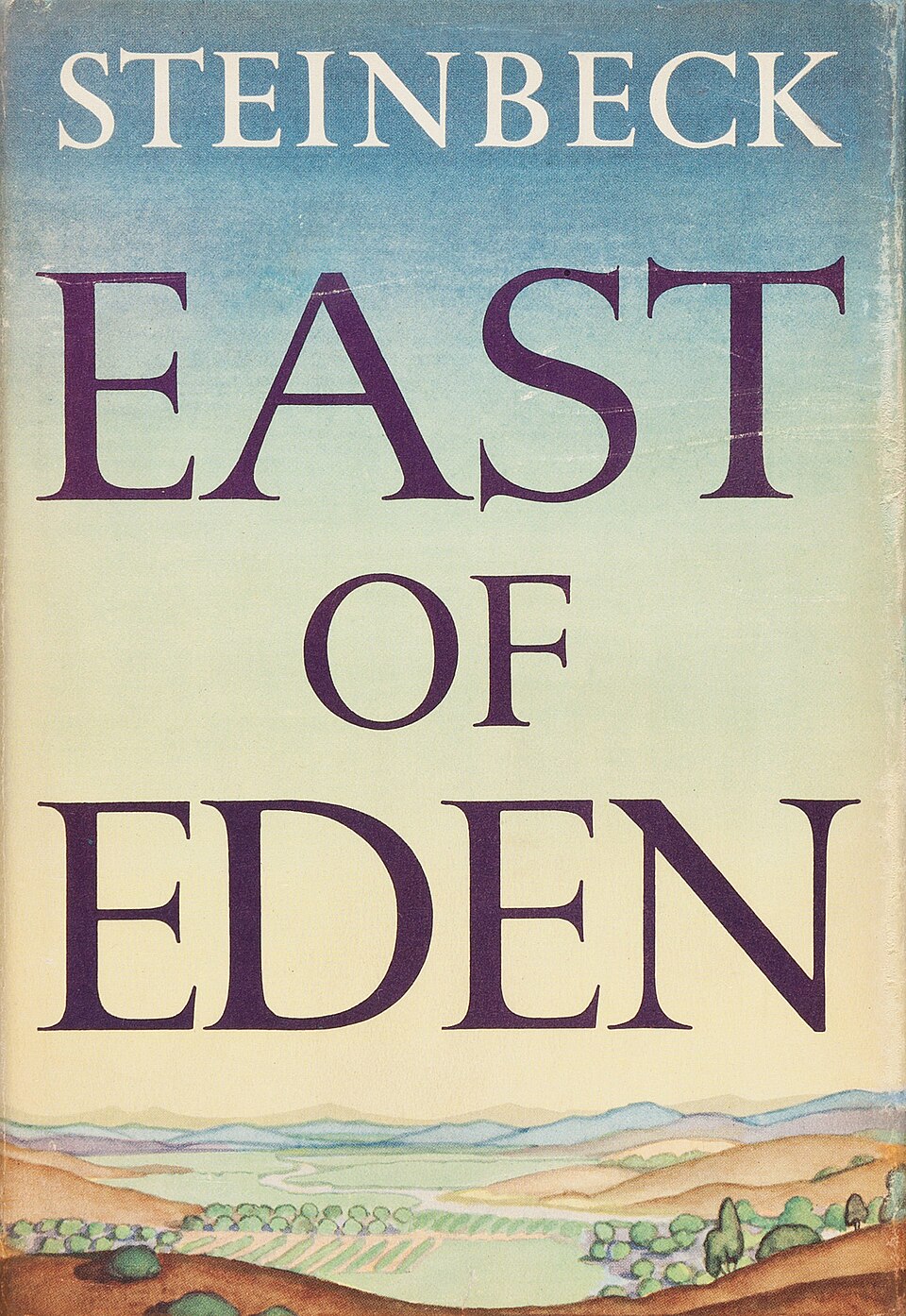
A review of East of Eden, by John Steinbeck. Penguin Books, 1952.
John Steinbeck is a household name for a reason. He is the author of classic books, like Of Mice and Men and Grapes of Wrath, but I believe East of Eden is his most famous work of fiction. This novel follows Adam Trask as he navigates life in Salinas Valley, California with his twin sons Caleb and Aron, and Lee, who helped raise the boys. The twins’ own story resembles Cain and Abel’s from the Bible.
I had not read Steinbeck since reading Of Mice and Men in high school, so it took me a while to get used to his writing style. The writing was beautifully done and clearly handled with care. Every word was chosen with precision. Steinbeck drew me in from the first page with his artful skill: “I remember that the Gabilan Mountains to the east of the valley were light gay mountains full of sun and loveliness and a kind of invitation, so that you wanted to climb into their warm foothills almost as you want to climb into the lap of a beloved mother. They were beckoning mountains with a brown grass love” (Steinbeck 1).
After an introduction into Steinbeck’s world, there were many passages that I wanted to go back and reread because they deserved a second look. One such passage follows:
“I believe there are monsters born in the world to human parents. Some you can see, misshapen and horrible, with huge heads or tiny bodies; some are born with no arms, no legs, some with three arms, some with tails or mouths in odd places. There are accidents and no one’s fault, as used to be thought. Once they were considered the visible punishments of concealed sins. And just as there are physical monsters, can there not be mental or psychic monsters born? The face and body may be perfect, but if a twisted gene or a malformed egg can produce physical monsters, may not the same process a malformed soul” (71)?
Reading this section forced me to close the book and grapple with the sheer weight of its words. It was such a deep and psychological topic that I had never thought of on my own before reading this passage. Steinbeck reframes the nature of human evil, making a subtle shift from moral failing to a natural anomaly. This prompt haunts the rest of the novel, and although the characters do not realize it, they work throughout the entire book to find the answer to this question.
Arguably one of the most important lessons given in this book is “Timshel.” Timshel is giving humans the choice of freewill. We, as humans, are not commanded to be good or evil and we are not doomed to fail or sin. Lee, Adam, and Samuel, who is a neighbor and dear friend, ponder over its true translation and conclude that the best translation is “thou mayest” from the Hebrew version of the Bible. Samuel is on the receiving end of Lee’s findings of the word: “‘My old gentlemen felt that these words were very important too— ‘Thou shalt’ and ‘Do thou.’ And this was the gold from our mining: ‘Thou mayest.’ ‘Thou mayest rule over sin.’ The old gentlemen smiled and nodded and felt the years were well spent” (301). Caleb is one of the main characters that stresses the question of whether he is good or has inherited evil. With Timshel, we can chose our own path. This interpretation emphasizes freewill, unlike the other translations that come across as a demand.
These characters struggle with their morals throughout the book. Abra is Aron’s lover until she realizes that she also has feelings for Caleb. Abra chooses to explain her feelings to Lee, who offers the following advice: “‘Lately I never felt good enough. I always wanted to explain to him [Aron] that I was not good’. ‘And now that you don’t have to be perfect, you can be good’” (583). Lee’s words are not only applicable to Abra, though; they are also a way for Steinbeck to let the reader know that we do not have to be perfect. Through this book, he proves that we are all human and that we all have our faults. I don’t think that I had ever read a book where the characters felt real. I could feel the emotional turmoil in Caleb and I could feel Adam’s cowardice, but there was a part of me that was rooting for them to make the “right” decision. But they are not perfect. I think Steinbeck did a wonderful job making real characters that made poor decisions and learned as they grew, just like in the real world.
Steinbeck writes in vivid detail about good and evil in men, but I don’t think its necessarily black and white. East of Eden focuses on love, or the absence of it, and its consequences. Are children meant to be just like their parents or are they their own person? While reading, a character might appear to be pure evil, but a part of me still wants them to have some sort of redeeming quality. I wanted to understand these characters and why they acted the way they did, but to a certain extent, that wish was not granted. I had to keep myself from wanting these characters to be different, or be better, when that was not Steinbeck’s intention with East of Eden. I needed to read Steinbeck’s vision and not create alternate versions of the characters’ choices or fates in my head, which would sway me from liking or understanding the themes. After all, everyone makes mistakes and it’s everyone’s first time living.
Steinbeck’s East of Eden gives us human characters and none of them are perfect. This is a classic that everyone needs to read. This is a novel that one could read repeatedly and find different meanings and understandings in every time. I have my copy on my shelf with full intentions of picking it up again soon. Timshel.
Edited by Cecilia Garcia Luengas and Carter L. Myers



Leave a Reply