
I went through my American Girl phase between fourth and fifth grade, and read through piles of the books. This obsession culminated in my brother throwing Changes for Samantha into a tub of dishwater so that I had to pay the fee to the library and purchase the book. Destroying property was bad, of course, but I finally had something of my own with that iconic American Girl label on it. God knew I was too poor for a doll, and I knew better than to ask for one. But this book was all mine. So, whenever I was feeling bored, I could read about Samantha rescuing those poor orphans and about her dandily-dressed uncle agreeing to adopt them on the last page, without more than thirty second’s hesitation.
Why didn’t I stay an American Girl freak for life?
Maybe it was the fact that the books felt too much like school, with the “Looking Back” sections concluding each installment. I loved history, but I was mostly reading those books for the girls themselves, who, by the way, all felt like what would happen if you asked a computer to generate an “American Revolution Girl,” a “Victorian Girl,” a “Great Depression Girl,” and so on. Their entire personalities were their historical eras. The other slightly infuriating thing was the blatant girl-bossery that they displayed.
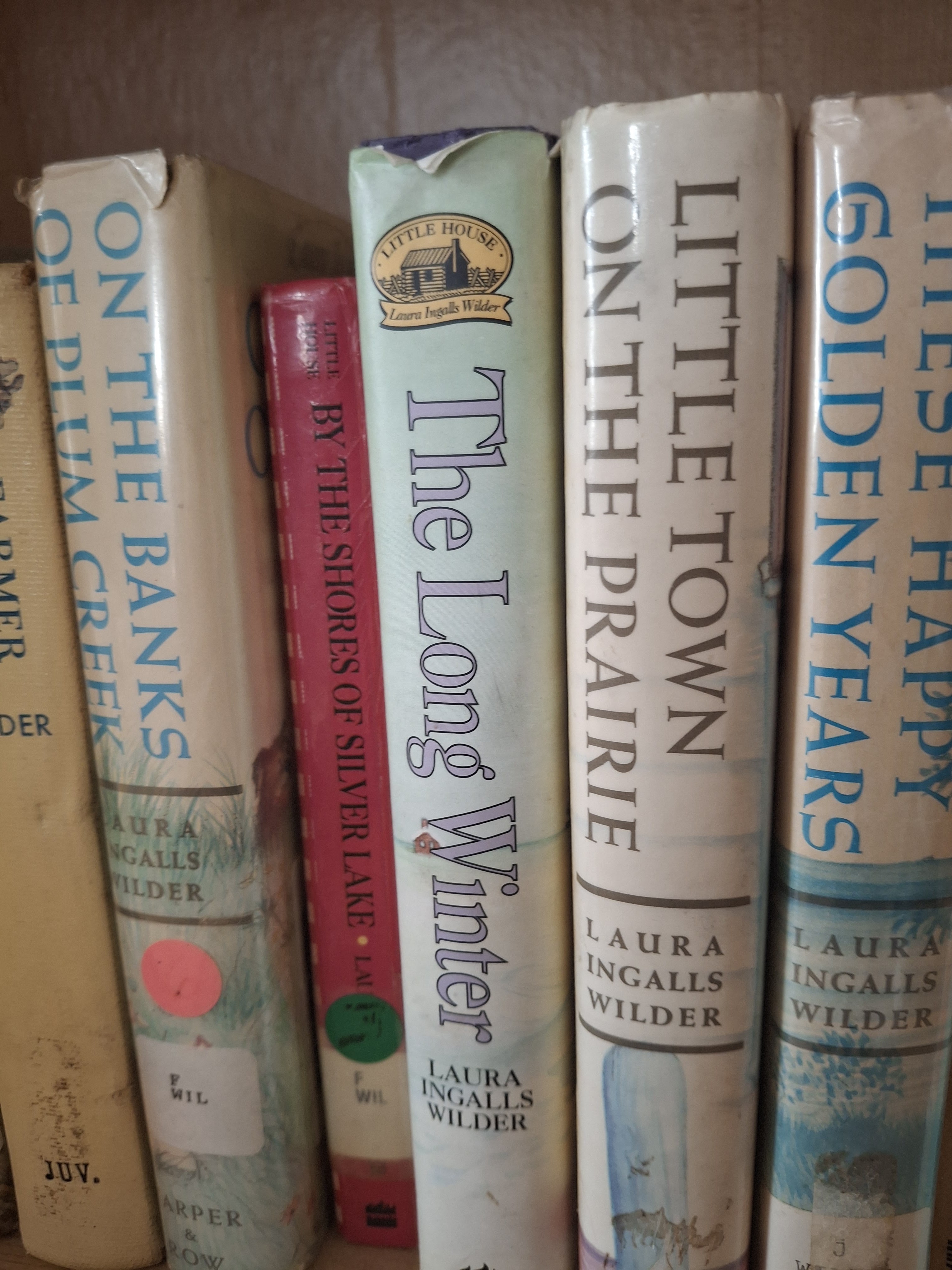
You see, most of the Old-Fashioned Girls (I insist on capitalizing this term) that instead filled my childhood bookshelf followed a particular formula. They started off little and cute and adventurous, but around the fifth-tenth book in their series, they had shed their tomboyish ways. They put up their hair, they lengthened their skirts, they stopped romping through the woods, and they “put away childish things.” After all, this was the 1900s. Things were different back then. Eventually, they married some guy, who showed up in a haphazard last-minute way and added nothing to the story except to fill the role of “Old-Fashioned Girl’s Future Husband.”
I devoured these books. I just couldn’t get enough of them. Betsy-Tacy was my ultimate favorite. Little Women and Anne of Green Gables entered my library when I was in middle school, and these books had me in the same chokehold that Betsy-Tacy had me in when I was five.

I was deeply, mind-bogglingly, catastrophically obsessed. My little brain was full of Old-Fashioned Girls. I did not just read them—I wrote them. I acted them out with paper dolls that I made myself. Harry Potter and most fantasy books were forbidden, The Chronicles of Narnia was too preachy and didn’t interest me, I wasn’t interested in horse stories, and I deeply resented any story that revolved around kids adopting a lost puppy. But the Old-Fashioned Girls were always there, like eternal friends. These books raised me, and I will always hold a deep and loving place for them in my heart. I will always treasure them more than the neatly polished American Girl books, with their hundred-page paperback adventures and their overpriced dolls.
At the same time, there was always a bittersweet disappointment at the end of those Old-Fashioned Girl’s childhoods. Jo March had her Mr. Bhear. Anne Shirley had her Gilbert. Laura Ingalls ended up with Almanzo at the tender age of eighteen. And Betsy Ray, my favorite, my heroine, and the example for everything I wanted to be in life, ended up with Joe Willard, a stuck-up blond guy who was loosely modeled after the author’s own husband.
As Betsy’s number-one fan, I must say that I’m glad she found true love. But true love only found her in the last book of the series, Betsy’s Wedding. This Joe Willard guy was playing hard-to-get for three or four years and she ended up committing her life to him. Meanwhile, she and her friends, Tacy and Tib, had known each other since kindergarten, and they planned to travel the world—to see the Taj Mahal in the moonlight and go to Paris and have French maids fill their bathtubs. Guess what all three ended up doing instead? …Getting married and becoming housewives. Tacy went from listening to Betsy’s fantastic stories, to giving her advice on how to make the perfect piecrust. Tib was worryingly independent, but she got married in the last chapter of the last book in the series just so things could be wrapped up with a neat bow (a wedding). They all sailed off into the sunset and the books closed.
I mean, I must say, they tried to escape before they resigned to traditional womanhood. Anne Shirley kept up a fierce hate campaign against Gilbert after he compared her pigtails to carrots. Jo March had originally resolved to be a spinster, saying that she was “too old and odd and fond of liberty” and too obsessed with writing to marry Laurie. In The First Four Years, Laura expressed a shocking reluctance to marry Almanzo, which contradicted the sugary account she gave in These Happy Golden Years. Caddie Woodlawn (her author was Carol Ryrie Brink) threw eggs down the dress of her frilly cousin before breaking down into tears and surrendering to womanhood at age twelve. She had “run with the colts” long enough. I can’t describe the heartache in that phrase. Sure, she had it good while it lasted, but it couldn’t last. She had to get gentle, and learn to love being indoors.
When Jo March’s dad came back from the war, he said that he didn’t see the masculine Jo that he left behind, but instead, a well-mannered and well-groomed young lady. At first, when I read that, I expected Jo to throw a fit of rage, but instead, she just glowed with pride. Tomboyishness, for her, and for Louisa May Alcott’s society, was not just a phase, but a character flaw. It was painful to see her wild, “Christopher Columbus!”-yelling, theater-loving, and running-in-a-long-skirt ways being slowly worn away by time.
The American Girls had it too easy. They all magically seemed to believe in women’s rights, like the prejudiced attitudes of their era didn’t affect them. They stood up for women’s suffrage. In the seventies, the American Girl named Julie relentlessly fought to play on the boy’s basketball team. Kit wanted to be a newspaper writer. And so on and so on.
I know there are people out there who whine about the American Girls being Marxist and feminist and all that. I know there are others who wistfully point to the more traditional Old-Fashioned Girls and say that they do a better job modeling femininity to impressionable young girls. I don’t care what these people think. American Girls are mine, and Old-Fashioned Girls are mine. They are what I choose to make of them.
Still, I’d be lying if I said I didn’t carry the expectations and messages of those books with me into young adulthood. The good, the bad, and the sad.
Growing up, I was obsessed with growing up. The Old-Fashioned Girls made it look as painful as their corsets. But it also seemed thrilling in a melancholy sort of way, like crossing a misty bridge into adulthood, with a wistful wave goodbye to the carefree world of childhood. I wanted my coming-of-age to be just like theirs, with long skirts, with piled-up hair, with cute but, ultimately, irrelevant boys filling my life, making me a beautiful void. I both craved and dreaded that never-going-back sort of experience.
The American Girls’ lives were stuck in limbo. They belonged fully to their eras and never changed. Molly never became Julie’s mother, and Kirsten wasn’t Samantha’s grandmother. They were perpetually nine and ten years old in each respective series. They went from nine to ten-and-a-half, having a birthday episode in the middle of the series that was so important it took up a whole book. And yes, I did the math about their ages and I mapped their character development from nine to ten-and-a-half, finally concluding that there wasn’t any. Growing up wasn’t a threat to them, and they would only become more independent and more girl-bossy with time.
In the end, some of those girl characters (both American Girl and Old-Fashioned Girl) did have complex natures. I needed to know that. I needed to know that women don’t exist in two entirely distinct states: Tomboy and Lady. I needed to know that it was okay to just be me—something that the world couldn’t define.
Anne Shirley was “as many colors as a rainbow.” Each color was as beautiful as the ones before it, while it lasted. She said, “There’s such a lot of different Annes in me. If I was just one Anne, life would be much simpler, but it wouldn’t be half as interesting.” She couldn’t restrain her personality any more than she could keep her hair from being definitely red. I loved that, and I still do.
Did that fierce Anne survive to the end of the series? I don’t know. I never read past the second book because she didn’t seem as interesting as an adult; that’s what happened to most of my Old-Fashioned Girls.
Dear Old-Fashioned Girls:
It’s getting lonely here in the 2020s. I miss you.
Sure, you were weird, and you had your moments. And I can understand why you fell for those guys at the end of the series. I just wish you’d thought long and hard before you surrendered your whole story to them. But, above all… thank you. Thank for making me love my childhood while it lasted.

Edited by Shaylie Muehl


Leave a Reply