
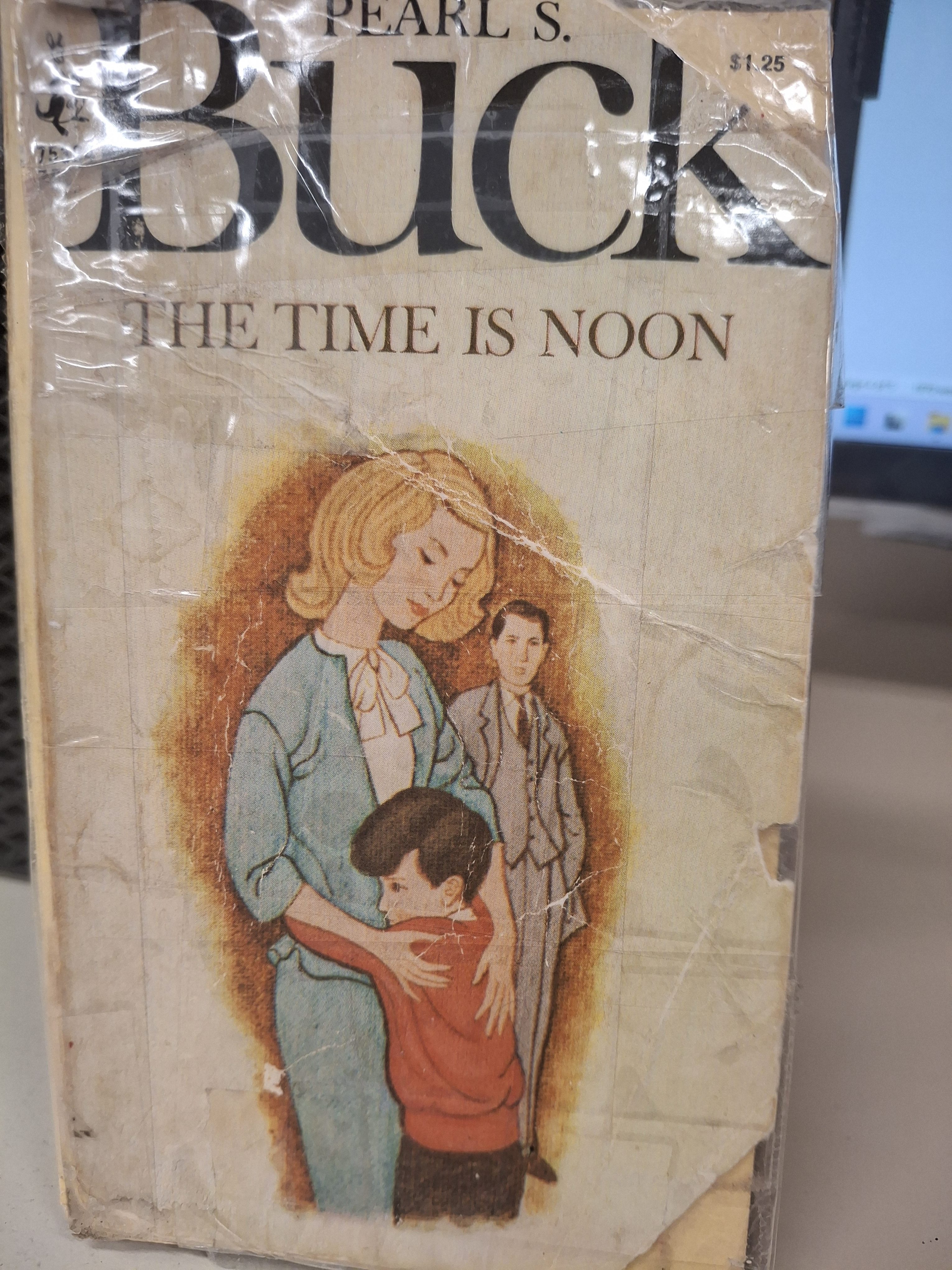
A review of The Time is Noon by Pearl S. Buck. The John Day Company, 1966.
The Time is Noon, a 1966 novel by acclaimed author Pearl S. Buck, is a highly underrated story about a young woman’s coming of age in rural Pennsylvania in the 1920s. I have read this book to sleep (read it to tatters) for years now, unable to pin down exactly why it appeals to me and why I love it so much.
Maybe it was just the gracious unfolding of language, the lyrical storytelling skill, and the rich character development that stood out to me as I first read it. But the more I read and reread it, the more I see themes broiling below the surface of this tight, seamlessly woven story: troubling themes, and complex ones, as well.
Joan Richards, a minister’s daughter, is the protagonist. The reader watches her grow from a happy-go-lucky college graduate, who is just her mother and daddy’s girl at heart, to an independent woman who has seen enough tragedy for two lifetimes and has learned to live on her own terms as a result. The book spans ten years of her life.
A tall, strong, hearty woman, Joan stands out as a nonconformist in her sleepy village full of pious old people and failed missionaries. She wants life, laughter, madness, carelessness, and all things done her way. She is also a born caretaker, always eager to rescue her family members and ready to empathize with others, a trait that sometimes works to her disadvantage. As a young woman at the beginning of the book, she is musically inclined, flirtatious, fun-loving, family-oriented…and doomed.
Though her home life seems happy on the surface, serious problems have been brewing from the start. Joan’s mother, Mary, is the rock and glue of the family, spoiling Joan and her siblings, dutifully serving as a minister’s wife, and generally being the life of the party (just like Joan). Joan’s father, Paul, is the opposite, a distant and unemotional man. Mary secretly hates him. Paul is also a nonconformist, wanting to set up a ministry for the Black side of their segregated small town, an idea that turns the racist and complacent members of his congregation against him. Joan’s sister, Rose, is a bit of an oddball and spends her young life in deeply private religious ecstasy. Joan’s brother, Francis, a moody teenager, has a serious Oedipus complex—his feelings about his mother are quite intense. When Mary falls ill, he turns to destructive habits to cope with the vacuum in his soul.
By the end of the book, every member of this family, except for Joan, is dead—most under quite sudden and violent circumstances.
Mary dies first, of course. Her death is the first major crack in the once-strong foundation of the family. Joan, who was once safe in a family of five, is slowly left alone in the world. This is where one of the troubling themes I noticed (isolation versus intimacy) comes in. Joan’s home seems so happy, so secure, so comforting, and yet every member of the family is alone in personal suffering. In the midst of what should be a tight, bonded Christian family, everyone is secretly desperate and lonely. This quote from the first half of the book stands out to me:
“She entered the house softly, every sense sharpened. While she had sat brooding over her restlessness, dwelling upon her loneliness, her father had been needing her and she had not known. When would she learn not to think of herself? While she was playing through a summer her mother had sickened, saying nothing. In the silence of this house her father was suffering without speaking.” (Buck, 157)
Mary, determined to look out for everyone’s needs but her own, ignores her symptoms until it’s too late and dies a slow, unhappy death from cancer. Joan is responsible for nursing her. After Mary’s death, Rose announces that she is going to get married and be a missionary in China, badly upsetting her fiancé’s parents, who are prominent community members. Then Francis, desperate to escape a sexual and emotional entanglement with his secret Black girlfriend, runs off to New York to become a pilot. Joan is now alone in the house with her ethereal, aging father, and she is hopelessly bored. Her basic needs are still being met—food, shelter, and safety—but she doesn’t have anything close to real freedom, wrapped up in her father’s life and stifled by the tiny town. At this point, finding a husband is her only hope.
As Joan hears from local gossip, her father is going senile and can’t remain a minister anymore, and the townspeople are plotting to kick Joan and her father out of their parsonage. Her father remains tight-lipped about this, and the stress hastens his death. Now Joan is homeless and orphaned, Rose is on another continent, and Francis can’t be reached. Living in an era (the 1920s) when women do not work or support themselves, she has to find a husband immediately. Desperate, she marries the only man available to her: Bart Pounder, a farmer who is ugly and repulsive in his manners and makes about as good a husband as a pile of manure. She marries him solely for survival and forces herself to adjust to life with him and his mean parents.
Lost in loneliness, Joan turns to her last hope: pregnancy. She makes her unborn child the center of her universe, leaving Bart out of it entirely. Because Bart’s parents are sullen and reticent, Joan uses their silence as her weapon. Avoiding the intimacy that she can’t have, she takes all she has of her life and molds it into the vision of a better life that she has for her unborn child. She also uses the silence as protection for her soul in this draining environment:
“She had at first hated the silence of the house. It had pressed upon her, intolerable to bear. But now it was a cloak under which she could hide. She was glad for their habit of silence. Since none spoke and none revealed himself, she also need not speak nor reveal herself to any. Silence was shelter. And day and night she was kind to Bart…” (Buck, 191)
In the silence, Joan is constantly rebelling internally. Whenever she speaks, however, she upsets her husband’s family. Her boldness is too much for them:
“They were shocked at her indecency. But she was no afraid of their silence anymore. She had learned how to live in it now. She took what she wanted and was not afraid.” (Buck, 193)
In sharp contrast to her girlhood family and home, Joan’s marriage and home are a cold, emotionless void. Her husband thinks of Joan as an impersonal vessel to fulfill his animal-like sexual needs. On the morning after her wedding, Joan looks sadly out the window and feels that her life is over, knowing that she has consummated her relationship with Bart and cannot escape him.
She compares life with Bart to living in a hole underground and detests the close, dark earthiness of their life together, obsessing instead over the sky, clouds, and airplanes. Then Francis returns briefly, homeless, jobless, and longing to get into pilot school so he can escape into the clouds. The sky seems to represent a lack of intimacy, and completeness found in individual identity, as opposed to the earth, which is so close and dark and intimate that it suffocates and destroys life. This contrast between the earth life and the sky life is repeated over and over through the second half of The Time is Noon. At this point, I get the impression that neither earth (total intimacy) nor sky (total isolation) creates a truly happy life.
Longing more and more to be alone, Joan leaves Bart’s bedroom and goes up to the attic to give birth unassisted in a place closer to the sky. She dotes on her healthy baby boy, named Paul, after her father. But her joy soon turns to despair; the child’s mind is as stunted and dead as Joan and Bart’s relationship. Though he grows, thrives, and becomes beautiful, he never learns to walk or talk. To Joan’s distress, he doesn’t even know her.
Her mother-in-law hatefully tells Joan that she should put the boy in a mental institution, but Joan refuses. She prays for a miracle when doctors give her no hope. Nothing works. Now Joan is at her lowest point, not only enslaved in a lifeless marriage, but bound to a child who will need lifelong care from her. Paul will never be able to give back to Joan the life she has given him.
Tragedy follows tragedy. Finally, at the end of her rope, when Joan comes home from church one Sunday and finds out about Bart’s infidelity, she decides the family will be better off if she leaves. The reader really can’t blame Joan for this decision, but in her era, a woman leaving her husband for any reason is an almost unpardonable sin. Now that she is stigmatized by scandal, Joan can’t rely on her neighbors to shelter her—except for one old, paralyzed woman, Mrs. Mark, who lives alone in a small stone house. Mrs. Mark has reached the point where she just doesn’t care anymore.
Mrs. Mark is on her deathbed when Joan flees to her house. Finally, in the presence of Mrs. Mark’s greater sorrow, the two women unite, and Joan finds unconditional acceptance. Poignantly, Mrs. Mark tells Joan that she can still love and value her son for who he is, even if he doesn’t know her:
“You can’t put your child away from your heart. Besides, you don’t want to miss everything of him just because you haven’t all of him. He’s got his own ways. He’s Paul. Don’t measure him by other people. Just take him as he is. If he talks, those few words he’ll say will mean more to you than anybody’s.” (Buck, 271)
When Mrs. Mark dies, Joan inherits her house and starts her new life. She corresponds with Francis’s flight instructor and starts a romantic relationship with him. Joan shuns religion and starts a household of misfit children. She adopts an abandoned boy named Frankie—the illegitimate child of Francis and his Black girlfriend—and her orphaned niece and nephew from China. Now she finally has a family of her own, although it’s far from what is considered normal in her society. And though she is isolated from society, she finally gets a form of intimacy in being a mother to Paul and to her adopted children.
Joan’s journey to independence is painful, rocky, and far from over at the time this story ends. She is scared, easily hurt, but still tough, learning to stand up for herself. Joan has to be her own shelter, as well as creating a shelter for her new family. Her generosity makes her a powerful woman. She carries her own burdens and accepts her lot in life, learning to find joy in the children she is raising, becoming more and more confident and serene as they grow.
Slowly, she begins to heal. She still craves intimacy, but is able to bear up under isolation. She finds spaciousness within herself, like the sky, to open up to new love, to be patient, to wait for love to unfold naturally while she goes about her everyday life. And at the end of the book, she realizes that there is still a lot of time left for her life to change for the better.
“The day was still at noon” is the last sentence of the book. There is a sense of great liberation in this simple phrase. Once again, I can’t express enough how much The Time is Noon means to me.
Edited by Cecilia Garcia Luengas





Leave a Reply