
On September 24th, 2026, as part of the Fred Ewing and Lola Austin Case Writer-in-Residence Program, the English Department welcomed Jennifer Whalen to Western Illinois University. Whalen is a poet and labor organizer, and currently works as an English instructor at the University of Illinois Springfield.
Whalen met with students and faculty within WIU’s Art Gallery to discuss her poetry, particularly from her 2024 collection, Eveningful. Dr. Merrill Cole, the organizer of this event, briefly introduced Whalen to the audience and told the story of how the two met and how he discovered her poetry collection. Dr. Cole noted that her poetry has a very recognizable voice and very distinct themes and, when reading through her collection, you can tell that it is all clearly written by the same poet. You can tell “it’s a Jennifer Whalen poem,” he said, “but it’s not monotonous.”


From there Whalen stepped up to the podium and began her talk by reading through some of her 2024 collection, Eveningful, starting with the poem “Even in Disguise.” Her talk ran through a number of poems within her collection and was often broken up by discussions about the poems. Whalen explained that she likes reading one of her poems – titled “11 Versions of Taking Off My Love,” – to her students to emphasize to them that “…what we think matters.” For a long time, Whalen didn’t think break-ups belonged in – what she described as – “capital-P Poetry,” so she wanted her students to have a different idea from what she had been taught.
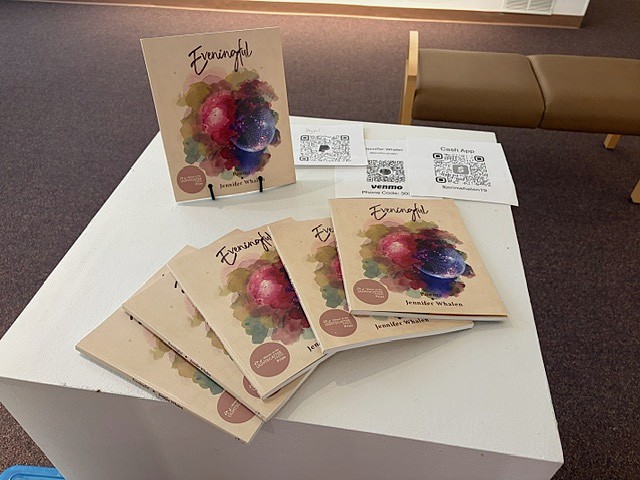
Whalen’s reading was also broken up by discussions about Eveningful in general. She explained that the collection’s title came from her fascination with thresholds; evening is the threshold between day and night, just as her poetry collection is a threshold between her internal thoughts and the outside world. Whalen also talked about the art on the cover of Eveningful (seen below in a photo by Professor Barbara Lawhorn), which features a color blot made by Mary Gartside, an English watercolorist and color theorist. Color theory, to Whalen, is an “interesting study in transitions,” just as evenings are, and she thinks of color theory, –particularly Mary Gartside’s work – and poetry as “giving language to things you can’t easily give language to.” Gartside’s work can be found in the section breaks throughout the collection. There are also as QR codes at the bottom of pages, which takes you to a website in which you can hear Whalen read her poetry and view other watercolor paintings made by Elizabeth Fuller, which she created in response to Whalen’s writing.
After reading a couple of poems from an unfinished manuscript, titled Visit, which tackles the question of how we receive new people in our lives and how we create spaces where vulnerability is possible, Whalen ended her talk by reading “The Gold Door,” the first poem in Eveningful. She explained that she has ended visits with this poem for a long time so that, when you open her collection later, you can “pick up where you left off.”
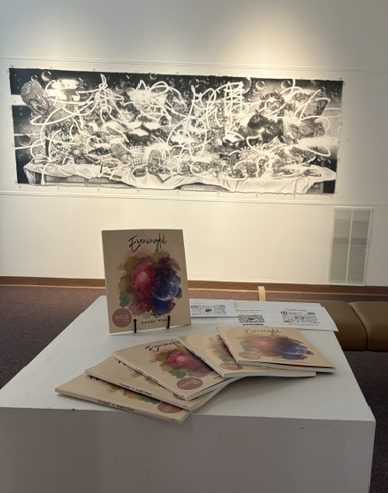
After her talk ended, faculty and staff mingled, viewed the artwork within the gallery, and were able to chat with Whalen and pick up their own copy of Eveningful, which can also be ordered online through her website. Needless to say, Whalen’s visit to WIU was an eveningful event in itself, as we met Whalen at the threshold between her writing and our own lives.
Edited by Carter L. Myers
Photos by Barbara Lawhorn



Leave a Reply