
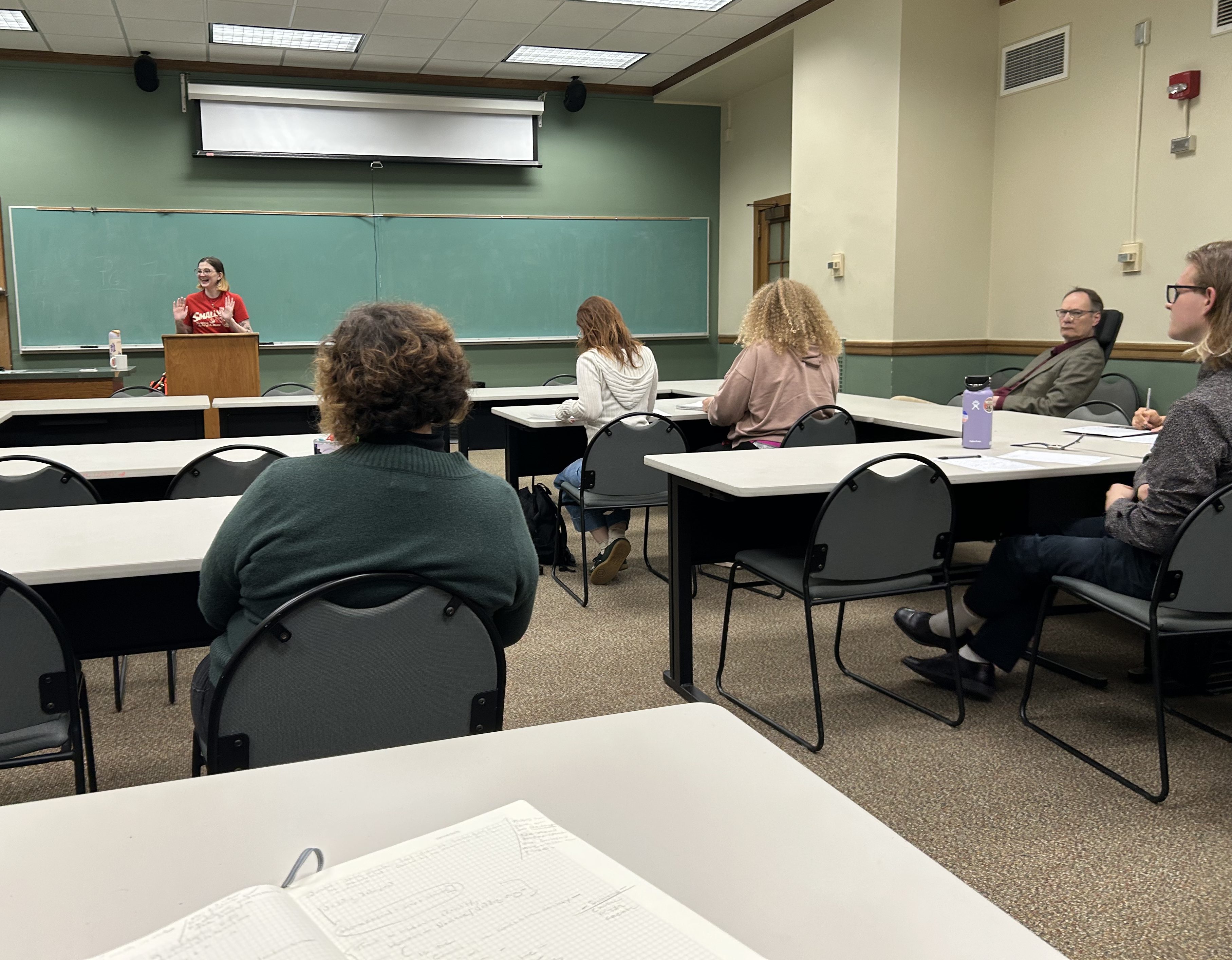
Dr. Desiree Steele, a WIU alumna and recent PhD graduate, paid her Alma Mater a visit to lecture about her dissertation, Up in the Sky: Superman and the Invention of the Superhero Tradition. Dr. Steele addressed the chapter where she discussed The CW television series Smallville, a well-known action sitcom of the early 2000s which followed teenage Clark Kent trying to navigate the challenges of balancing his superhero identity and his duties as a high school student.
Dr. Steele’s argument revolved around how Clark’s lack of disclosure about his superpowers as well as his relationships to the people around him serve as a representation of an “other” identity, more closely related to the queer other. Her argument also examined the homoerotic bonds the narrative centers around, despite the series’s overall conservative values.

Ultimately, despite the setting in Smallville, Kansas, establishing an inherently conservative ideology, Clark still functions as a disruptor. His alien identity and undisclosed abilities unsettle the pre-established order of the small town. Yet, due to the “pastoral fantasy” that surrounds him, Clark is set to idealize and pursue the normalcy that is denied to him by his origin. His status as an other in various forms deprives him of experiencing the ordinary experiences of a young man living in the rural Midwest. He fantasizes about fitting in—playing football and having a cheerleader girlfriend—but he cannot access such things because he keeps a secret that alters the perception that others have of him.
For instance, his relationship with Lex Luthor—whom the audience acknowledges as Clark’s future nemesis—and the comparison drawn between this bond and the one he has with Lois Lane is astoundingly queer, according to Dr. Steele. In this iteration of Superman, the two future rivals meet when Clark saves Lex from drowning after the latter accidentally hits Clark, which redirected Lex’s car off the town’s bridge and into the river under it. Clark performs CPR and, in this first encounter, “they’ve locked lips before they’ve even talked,” as Dr. Steele put it during her lecture.
Moreover, as the relationship between Clark and Lex develops into animosity, one can recognize a more intimate bond than they had during their friendship. As Clark tells Lex his secret, Lex focuses on the former’s “otherness.” Clark is no longer a friend; he is a liar and an alien. Yet, when Lex comes back to the show, this previous honesty becomes the base for a more accessible bond between the two rivals. Steele mentions how Lex says, “We’ll become great men because of each other,” thus reinforcing this inherent connection and consistency that Clark does not have with anyone else… not even Lois. While Lois only has limited access to Clark due to his other identity, Lex has complete access to Clark because of it. Lex and Clark are bound to “constantly orbit each other” as nemeses, leaving no time or space for the long-promised and frequently postponed domestic life with Lois. Lois favors Clark’s responsibility to the world as Superman and accepts not being prioritized as part of his neglected personal life as Clark Kent. But Lex, being part of Clark’s other life as Superman, becomes part of Clark’s ultimate focus, hence allowing Clark no chance of fulfilling those conservative-aligned fantasies of normalcy and reproduction.

Dr. Steele’s reading of Superman was simply fascinating. The application of Queer Theory on more contemporary media is something I have been gravitating towards since I found my way into the world of fanfiction and the negotiated reading that entails. Witnessing such a thorough analysis of a piece of media that I grew up watching and listening to how it relates to the themes I have only ever found in AO3 was exhilarating. Knowing that one can back such mundane claims as “Superman is actually queer” is hopeful, as someone who considers themselves immersed in popular culture.
Superheroes have always meant a lot to me, and seeing myself in them has sometimes only been a matter of opening a fanfiction website, but with work like Dr. Steele’s, which brings fanfiction claims into academia, it feels like the world moved before my eyes. It’s innovative and familiar, and still academic. Dr. Steele’s dissertation essentially confirms that you can truly transfer your passions into work and make something impactful with it all.
Edited by Karissa L Geisinger




Leave a Reply