
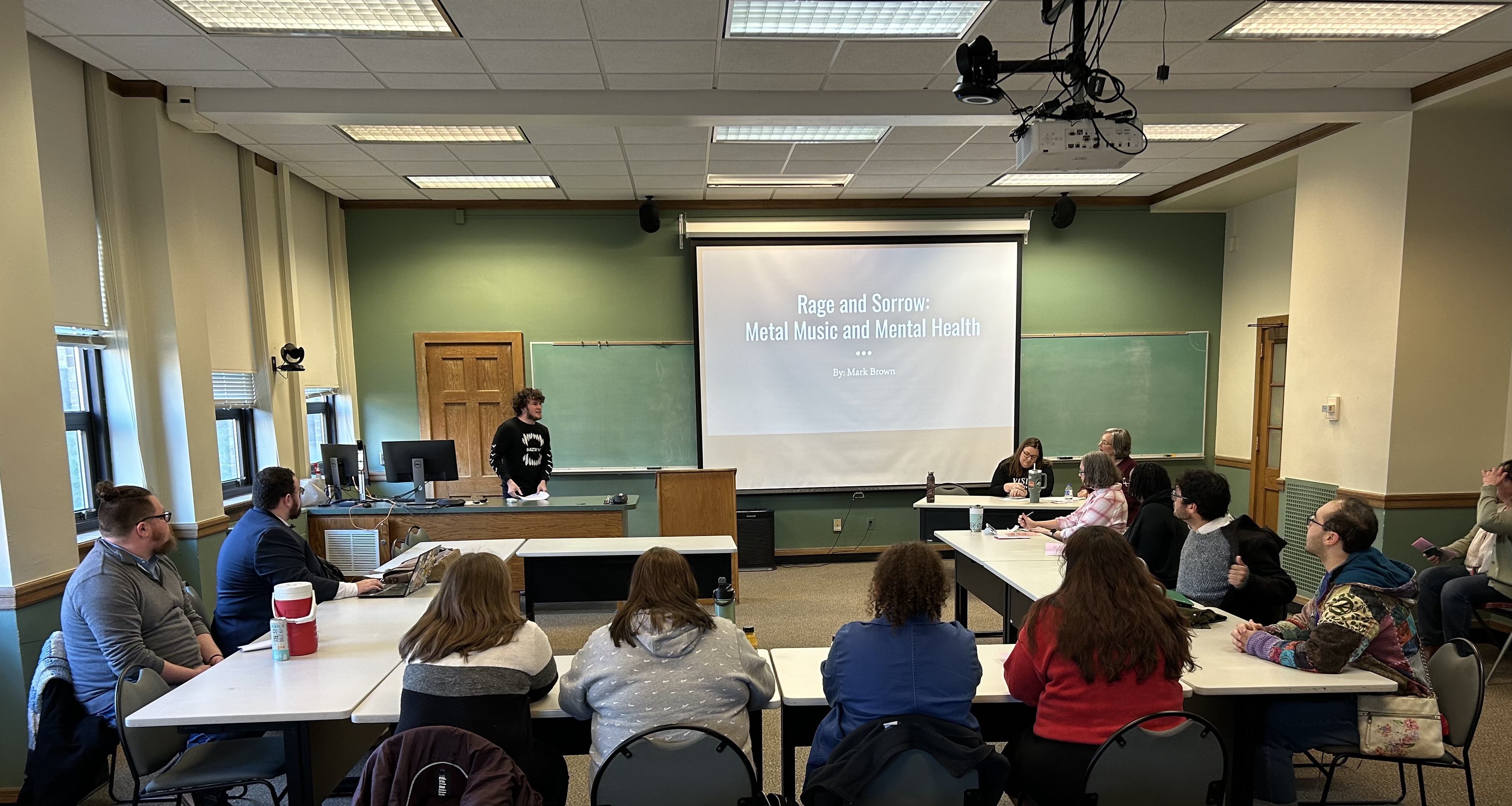
Second-year English graduate student Mark Brown presents his paper to the audience
On March 23rd, the English Graduate Program held its second colloquium since covid, and this one sees the event growing again! Meeting in person again made this a very special event, as once again graduate students, prospective students, select undergraduate students, guests, and family members gathered in Simpkins Hall to present academic papers, ask questions, and share food and conversation together.
The event was organized by the English Graduate Organization (EGO) and the Director of Graduate Studies in English, Dr. Roberta di Carmine, who welcomed everyone to Simpkins at 9:30 am in the Reading Room and kicked off the colloquium with coffee and breakfast. Dr. di Carmine said, “I’d like to thank everyone for supporting this event, particularly our department chair, Marjorie Allison, the EGO co-presidents, Isabella Perez and Chris Perez, and the English Graduate Committee.”

and English Graduate Organization co-president Chris
Perez welcome everyone to the colloquium.
Nine students presented their work in a series of academic papers. The topics reflected the broad range of what graduate students in English can research. Some students worked on traditional literary topics, like Sara Murphy’s paper on Nigerian novelist Ben Okri’s Booker prize winning book The Famished Road, but many others took the broader approachs of rhetorical and cultural criticism: these included Mark Brown’s deep analysis of masculine vulnerability in contemporary heavy metal music, Chris Perez’s work on the musical and the value of art, Joshua Stinson’s deep analysis of the television show Stranger Things, Isabella Perez’s analysis of domesticity and the horror film, and Kristen Lippold’s analysis of fan-fiction subcultures.
Some of the most lively and engaged conversation happened in the question-and-answer periods at the end of each panel. Particular standouts that got the audience engaged were Marie Watson’s paper on Pier Paul Read’s bestselling non-fiction account of cannibalism and survival, Alive (1974), which raised questions about the taboos of civilization, the religious imagination, and just what readers themselves were experiencing in these survival stories. Joshua Stinson’s paper on Stranger Things and the 1980s with Collin Burns’s paper on Frank Herbert’s Dune and its celebration of feudalism both raised questions about nostalgia, both for the authors of these texts and for their readers. Abigail Heinecke’s paper on adaptations of the classic “Little Red Riding Hood” fairy tales had the audience asking about the function of fairy tales in older eras when they were oral tales versus today’s film, television, and graphic novel adaptations.
In addition to listening and responding to papers, the panelists, faculty, and guests gathered together for lunch in the reading room, continuing the conversation and swapping book recommendations, questions, and insights. Presenters were excited to talk about how the work they were presenting is part of their exit-options for the program in the shape of both the traditional thesis and the applied project.

Leave a Reply