

“. . . you made a book of your own, one stamped with your personality.”
– Darnton Robert
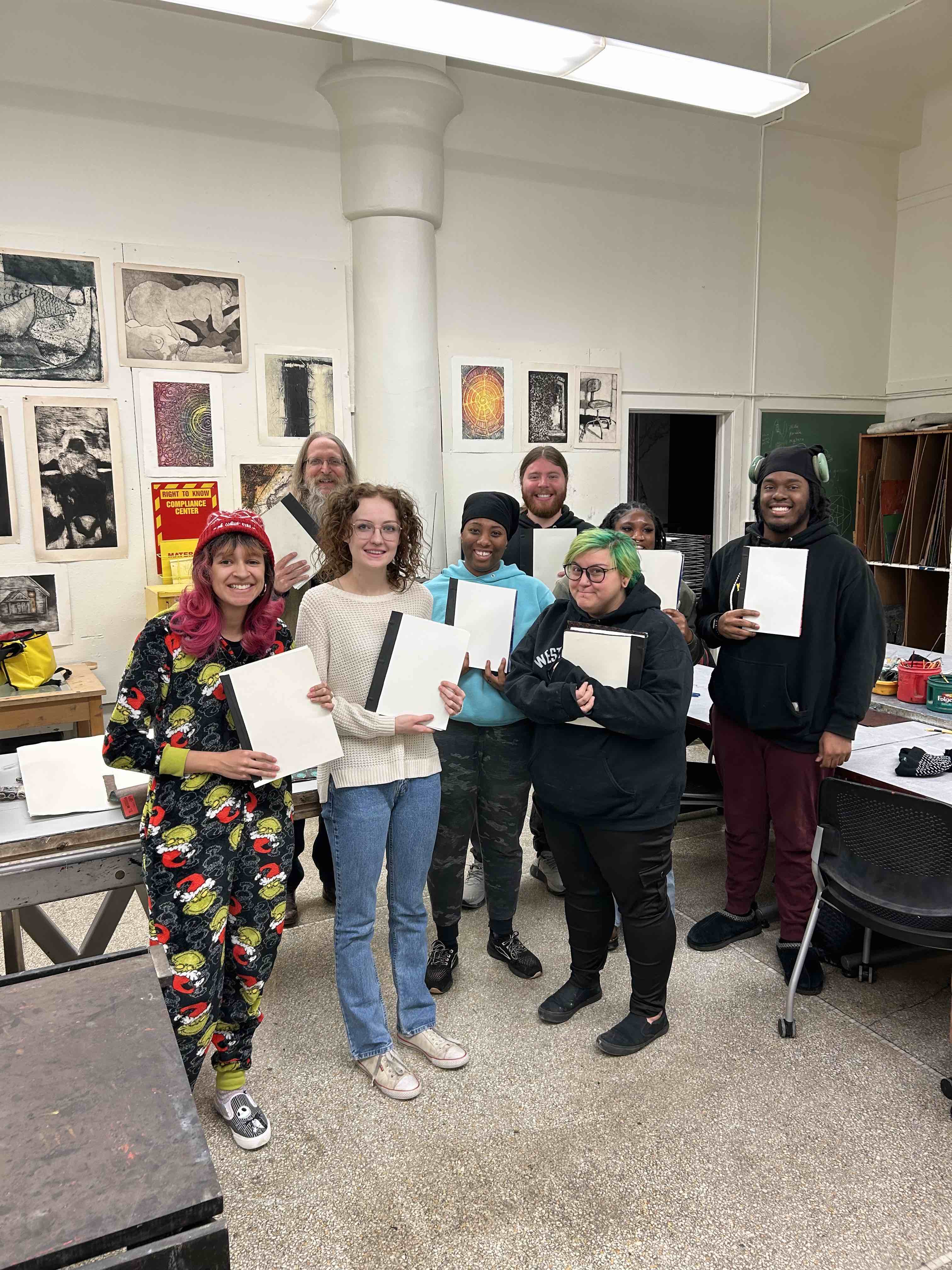
Dr. Banash’s fall 2024 section of ENG 328 Survey of British Literature had only one writing assignment: keep a comprehensive, handwritten, commonplace notebook that tracks everything read in the course. As students read through one thousand years of major texts of British literature, from Beowulf to Virginia Woolf, they kept detailed sets of notes on the texts, lectures, discussion, and their own responses to the stories, poems, plays, novels, history, and criticism. For the final at the end of the semester, Professor of Art Bill Howard invited the class to his studio to bind their notes into books, using the “raised band spine” technique.

Students wrote their notebooks in a modified form of “commonplacing,” which was a major early modern form that scholars used to track and remember what exactly they had read. Foregrounding exact quotations, notes on those quotations, and bringing quotations from different texts together, these notebooks develop a way of tracking themes, ideas, and concepts, bringing a whole life of reading together on the page. Over the course of the semester, students wrote their own books of notes, often running to hundreds of pages, that summed up what they had read and how they engaged with the long history of British literature.


In an age of digital texts, AI writing, and screens generally, writing pages of handwritten notes each week put students in touch with a slower method of reading and writing. It brought them closer to the older texts they were reading, texts that were originally written by authors who almost always composed and copied by hand before their texts were ever set in type.


Scholar Robert Darnton described how the use of commonplace books defined the fifteenth and sixteenth centuries in England:
“Unlike modern readers, who follow the flow of a narrative from beginning to end, early modern Englishmen read in fits and starts and jumped from book to book. They broke texts into fragments and assembled them into new patterns by transcribing them in different sections of their notebooks. Then they reread the copies and rearranged the patterns while adding more excerpts. Reading and writing were therefore inseparable activities. They belonged to a continuous effort to make sense of things, for the world was full of signs: you could read your way through it; and by keeping an account of your readings, you made a book of your own, one stamped with your personality” (Darnton, Robert. “Extraordinary Commonplaces.” New York Review of Books. 21 Dec. 2000. p. 82).
Reading in a massive survey was very much like how Darnton describes these early modern scholars reading. Students in the the class read texts in bits and pieces, jumped from one to another, and then used quotations to break these readings into fragments, reassembling the quotations in new arrangements in the notebook. By the end of the semester, each student’s notebook truly became a book of their own: some with doodles and smart illustrations, others with quotations from their own pleasure reading, and some with lines pulled from their favorite television shows and big box office hits. While no two notebooks looked alike, they all were as Darnton said—stamped with personality.





Leave a Reply