

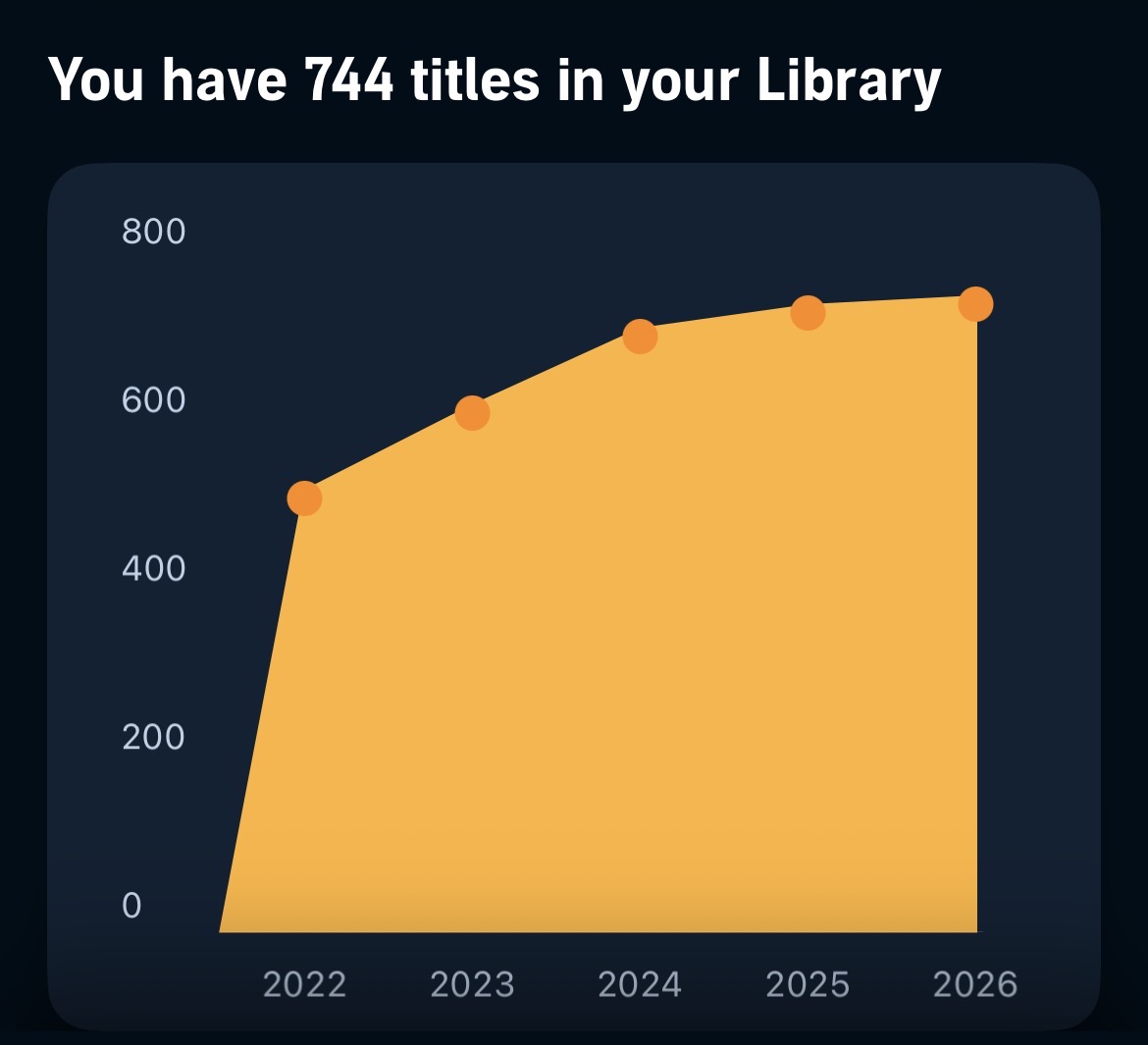
I have apparently held a Goodreads account since January of 2018, when I was a wee child in the seventh grade. Since then, I have tracked my reading habits with near-religious fervor, logging everything I read or wanted to read. I happened upon some things at the right time; others, I probably should have encountered as an adult. I say this not because the complexity of these books eluded me or that their contents are too mature for a teenage audience; I rather think those traits conduced a certain flexibility and empathy in me, that being challenged on an intellectual and ethical level made me who I am today. The problem is one of timing, not of age; books have the uncanny ability to fall into my lap just before their themes are mirrored by reality. However, there are a few books that escaped this habit of coincidence, ones that I really should’ve read earlier.
This is a ragtag bunch of books; you may wonder how a high schooler in the rural-ish Midwest managed to encounter them. But my parents were both dedicated readers before having children, and they both passed their recommendations onto me. My father is an inexplicable yet ardent lover of Russian literature, and so would hand off his old college copies of Bulgakov and Dostoyevsky onto me; my mother read feminist literature extensively and thus urged me to pick up Walker and Le Guin. I didn’t always follow the literary guidance of my parents, but their taste influenced me nonetheless.
With that preface out of the way, we can journey into the dungeons of my Goodreads account, unearthing those books I read and didn’t.
Note: The image for each book cover matches the edition that I read, albeit missing all the dents and library stickers.
But First, An Honorable Mention: The First 50 Pages of Ulysses

As a freshman, I swore, resolutely, to finish Ulysses before graduating high school. If I read 25 pages a day, I reasoned with the unparalleled hubris of a closet-case English major, I could even have it done in a month. I understood nothing; I couldn’t even fathom the depths of all that I didn’t know. I still haven’t read any Joyce, but I applaud my younger self for trying.
Should Not Have Read: The Blind Owl by Sadegh Hedayat

This was a venture to prove to myself that I wasn’t a coward. As a high schooler, I would read anything given that someone claimed it was the most depressing/complicated/unsettling book they read. (This is famously how I got into The Jungle; shockingly, I’m not a vegetarian.)
Should Have Read: Wild Seed by Octavia E. Butler

I so wish that I had listened to my mom and read some Butler in high school! When I encountered her through a course on her work my first semester of college, I found my perspective on literature radically changed. Here was an author who wrote science fiction as a means of processing our current world, an author who noticed and cared about everything, an author who wrote unabashedly strange fiction. Her style, relatively unadorned, hit me with more impact than that of any other author; the spareness of her prose only heightened the sophistication of her conceptual work. As a creative writer, I learned so much from Butler; I think it would have been easier to identify and hone my impulse to write as a young person had I read a book like Wild Seed. Wild Seed may be my favorite novel by Butler; if you haven’t read it, please do!
Should Not Have Read: Cancer Ward by Aleksandr Solzhenitsyn

I really loved this book as a senior in high school. There are sequences in Cancer Ward that have sunk into the bottom of my soul; I wish I could read it again for the first time. But as a current frequenter of doctor’s offices, I sometimes regret having read it when I did; those images of illness that so unsettled me when I was well have become all the more poignant now that I’m not. I wouldn’t say that a Russian novel—famously a depressing type—was the best thing to influence my perspective of wellness. I’d read it again though.
Should Have Read: Stoner by John Williams

For a long time, I resisted the call of the English degree. I thought that the sciences, with their supposedly infinite job opportunities and higher pay, would afford me the privilege of pursuing the passion of literary scholarship as a hobby. Obviously, I’m not the chemical engineer I told myself I’d become throughout most of junior high and high school. When I read Stoner earlier this year, I was overcome by the relatability of its central figure, at the beginning of the novel a young man studying agriculture. But he finds himself in literature; despite his status as a relatively average person, he has the exceptional courage to change course and follow that natural calling within himself. I think that if I had read this as a teenager, making that decision myself would have been all the easier.
Should Not Have Read: Against Nature by Joris-Karl Huysmans

Made me terribly insufferable. Next!
(But really, I’m often embarrassed by the frequency with which I’m tempted to mention this book in class discussions. There’s really no easy way to catch people up with my train of thought; how do you fill people in on the bedazzled turtle? The ventriloquism kink? The Catholic torture art boudoir? It’s embarrassing because there is no way to mention Against Nature without seeming like a freak, a fact I’ve been known to forget. Plus, it really isn’t making me seem less pretentious.)
Should Have Read: Any Dungeons & Dragons Sourcebook

I first started playing D&D right after I graduated high school and wish that I’d done so sooner. In playing as a number of diverse characters, I found that 1.) I loved writing, especially worldbuilding, and 2.) Getting excited about your own characters and the world they inhabit isn’t embarrassing. Curse of Strahd is perhaps my favorite of any campaign I’ve participated in, mostly because my pathetic bard likes to acquire (not steal!) tomes of esoterica that I then get to vicariously read as player. I firmly believe that D&D is literature and thus the purview of English majors; get in on it!
Should Not Have Read: The Fifth Child by Doris Lessing

Why my mother had me read this as an eleven-year-old is beyond me, especially given that she did so when the fourth child of our family was having some behavioral issues. When I reread this as a senior, I was astounded by her sense of timing. The nightmare-inducing cover alone should have been a clue that this was not a book for a child with anxiety.
Should Have Read: The Portrait of a Mirror by A. Natasha Joukovsky

This one is cheating: I did actually read The Portrait of a Mirror in high school; this is merely an opportunity to affirm my good taste. In particular, the appendix “Anxieties of Influence” was an excellent guide to canonical literature slightly off the beaten path, and also deeply expansive of what types of literature can influence a narrative. Joukovsky cites Henry James alongside Arcade Fire, Oscar Wilde as easily as a statue of Narcissus. She meta-textually opened my eyes to a new way of defining and valuing literature, one that creates space for the digital works I take direction from.
One of the things I learned very quickly upon starting my degree is that I am a total neophyte of literature. As a teenager, my love of reading came to have a signifying function; it was a matter of identification, a response to the question of what I did in my free time or what I wanted to study, but also a matter of identity; by invoking the nebulous literary persona of great readers present and past, I pointed beyond myself to what I wanted to be. I think that when something comes to hold such significance, it becomes easy to view oneself as its master; I certainly thought of myself as such. But upon stepping into the world of English scholarship, I became aware of the extent to which I truly know nothing! I’m not discounting the literary pursuits of my younger self; she read prolifically and seriously. But I, as you know, haven’t finished a work by Joyce yet. I have little clue what theorists mean when they call upon Hegel or Kant. Almost none of the mechanisms of the industry I’m so indebted to reveal themselves to me. What excites me is that I have time to develop and expand my understanding. There is still more to uncover about my favorite authors; there are even favorite authors I have yet to encounter. Maybe they’ll even reveal themselves at the right time.
Do you, dear reader, have a book you read too early or didn’t read early enough? Let us know so we don’t miss out!




Leave a Reply