
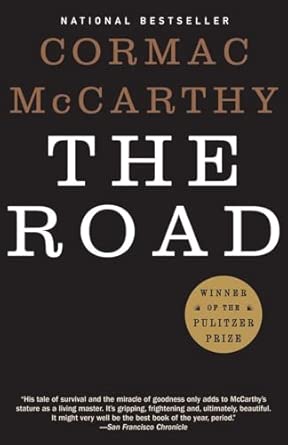
A review of The Road by Cormac McCarthy. Random House, 2006.
Cormac McCarthy’s apocalyptic world in The Road is void of color. In this brilliant novel, he shows that there is a beacon of hope when all seems lost, that we have to carry the fire. Everyone needs to get their hands on this novel to learn how these characters face such hardships, yet still cling to hope and humanity.
“[…]charred and limbless trunks of trees stretching away on every side. Ash moving over the road and the sagging hands of blind wire strung from the blackened light poles whining thinly in the wind.” There is a magnitude of evidence throughout the novel that something catastrophic happened to this place at 1:17. That is all the information we are given. We do not know if it was 1:17 in the morning or in the afternoon, let alone the day or year. McCarthy never describes the events that ruined the lives and homes of the people and caused this apocalyptic setting. Instead, McCarthy just leaves the reader with two main characters and the clothes on their backs as they journey to their destination.
We follow a man and his young son as they try to get to the Pacific Ocean, where they hope their life will be a little easier and warmer. The novel follows their journey with all the ups and downs in this new, unforgiving world. There are not many survivors, and if there are, they are usually violent and wish to eat the main characters because there is little to no food. McCarthy paints a violent and nauseating scene when the man and the boy come across a cabin and find “[…]naked people, male and female, all trying to hide, shielding their faces with their hands. On the mattress lay a man with his legs gone to the hip and the stumps of them blackened and burnt. The smell was hideous.” McCarthy’s relationship with language is a Wonder of the World. To be able to paint such a vivid picture, and later describe the fear and adrenaline pumping through their veins, is nothing short of talent.
Apocalyptic novels are not new; The Road, however, is different. It not only emphasizes the desire to survive, but the desire to keep one’s humanity. The man and the boy focus on always remaining as the “good guys.” They do not outright steal from other survivors or kill anyone, unless their lives are in jeopardy. They will not succumb to the rest of the world’s cruelty, and they will “carry the fire” even if they are the only ones left to do so.
The boy’s age is unsaid (as are their names), yet he seems to be old enough to understand that there are “bad guys” in this world. Whether it be emotional intelligence or the lack of choice in his upbringing, he knows that he and his father are constantly in danger. They have to look out for each other. After they escape from the cannibals, he makes sure to ask if they were bad guys. He always wants to make sure that he and his “papa” are the good guys. Their world needs more “good guys.” As they travel onward, “days are sloughed past uncounted and uncalendared.”
At the end of The Road, the boy is the only character who still clings to his humanity. The boy and the man come across a male child with a dog. The boy desperately wants to share his food and even take the child with them on their expedition to the ocean. The man is not taking any chances and leaves them where they were found. The boy pleads and begs, but the man does not budge. He will not risk their safety and survival, and the man puts that above humanity at moments like this.
McCarthy shows that these characters mean to survive these events, but believe in doing so in different ways. I am sure everyone has thought about what they would do in an event like this one created by McCarthy, and the man and the boy are very different. The man takes small risks when necessary. The boy thinks that some people are still good and wants to help them, but in these circumstances, it is every man for himself, and the father believes this. The man represents that mindset perfectly, in how he thinks and talks to the boy about certain topics discussed in the novel. The boy still has his moral compass intact, more so than his father who has more weight to bear.
The man is constantly aware of their surroundings, and it is his responsibility to keep his son safe. His worry and stress are often seen throughout the novel:
“He [the man] woke to the sound of distant thunder and sat up. The faint light all about, quivering and sourceless, refracted in the rain of drifting soot. He pulled the tarp about them, and he lay awake a long time listening. If they got wet, there’d be no fires to dry by. If they got wet, they would probably die.”
It is not a secret that McCarthy is no amateur. He is an accomplished and capable author and proves it repeatedly with every book he publishes, including The Road. Throughout this piece, McCarthy shows that hope gets you through tough times. Although these characters have seen more horrific events than a few of us, I’m sure. Nevertheless, they do not give in to the darkness and snuff out their fire. They carry the fire, and maybe we can take some inspiration from McCarthy and carry it as well.





Leave a Reply