
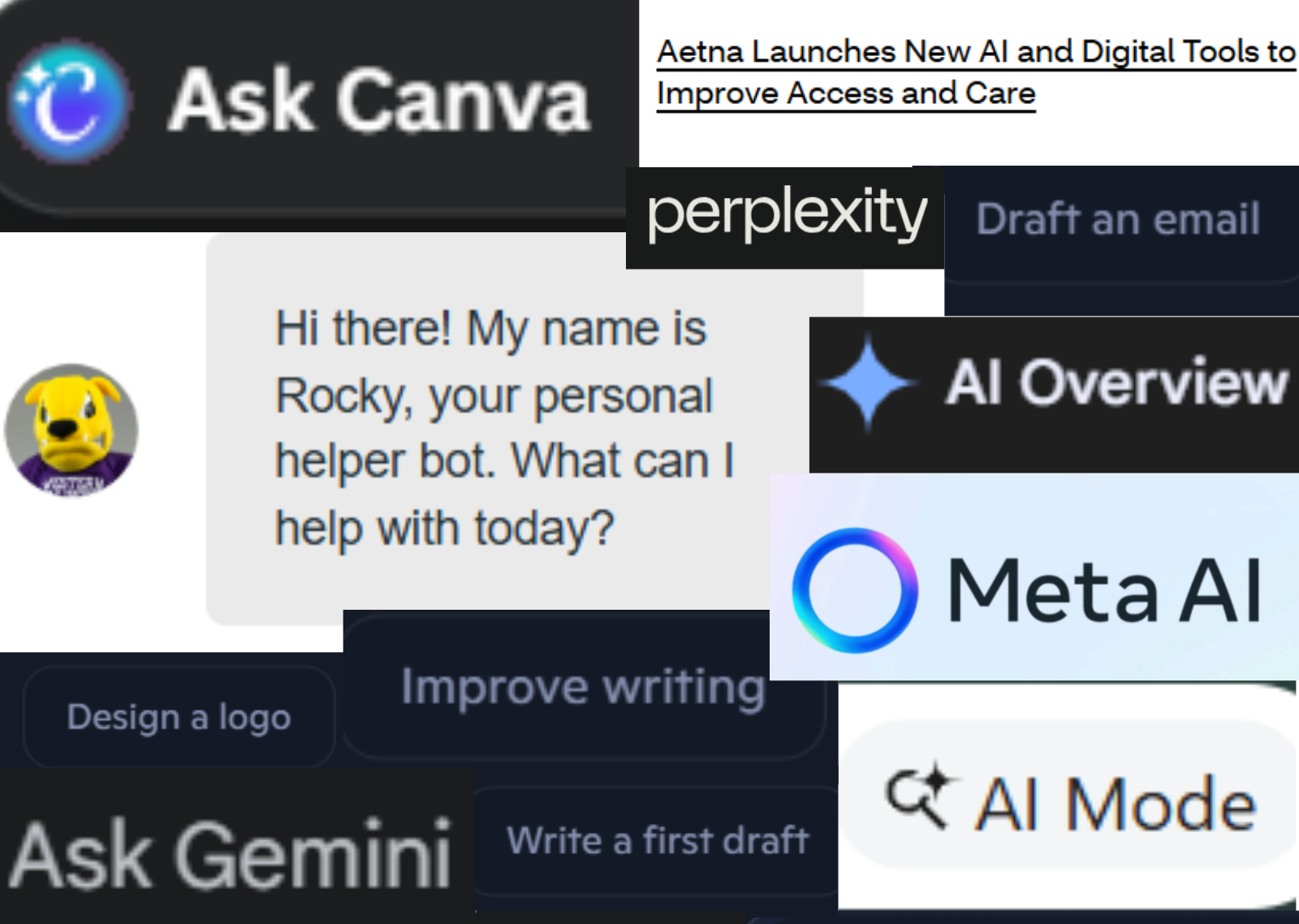
Times have changed, and while there are no flying cars or universal healthcare, artificial intelligence (AI) is definitely popular. However, in my experience, said popularity does not seem to give way to much productivity. The internet alone and the devices dependent on it were already disrupting the thought processes of those most reliant on them before AI. Now, with the instantaneous, effortless answers ChatGPT and other AI programs provide, some people think it is pointless to spend their time working creatively. Why read, write, draw, or paint anything? Why construct an opinion? Why burn brain cells or waste time when everything can be done in a few clicks? Essentially, I believe the oversimplification of academic or creative processes that generative AI platforms offer has normalized a disinterest in a myriad of practices and activities.
Personally, I despise AI. I absolutely abhor it. Maybe I am a purist for that; maybe I am an elitist, obnoxious, and inflexible fool, but the truth is that I simply enjoy the process of discovery, research, and creation. Even when consumed by the stress of writing a research essay or finishing a project that involves extensive reading I have no time for, I enjoy it.
I can understand the need for technological tools that help people maximize time. Some people, for example, do not have the luxury of time—whether they need it to read, annotate, or write—but there should be alternative strategies that lack the counterproductive consequences of normalizing common, idle plagiarism of generative AI. Yet, in current times, society revolves around the obsessive productivity of the “hustle culture” mindset that makes people internalize the glorification of work and prioritization of profit, which chains them to the whims of billionaires, who seek to fabricate a need for AI in social media, writing, and music streaming platforms for their own financial benefit.
I find it concerning that people do not even glance at the articles below their Google search anymore. Of course, it seems unnecessary when Google Gemini has already condensed those articles into a comfortable summary at the top of the screen. But the more people see or use such tools, the more normalized they become. The more these search engines and applications include chatbots or AI assistants, the easier it is for people to forget a time before AI, as they become conditioned to rely on these tools . . . but there was a time before AI.
Sometimes, it feels like people are determined to use accessibility as an excuse for using AI. While access to resources and accommodations for those who need them should be a priority in any space, there are other strategies to provide such assistance. It is difficult to live in a world that is not designed for everyone’s success, but to become dependent on AI that steals the writing and art of others when attempting to create something yourself feels contradictory. Creating AI art or writing defeats the purpose of artistic expression, which is to convey human experiences and emotions. The process of creation is a fundamental part of art, and that process involves experiencing human life and feeling the emotions that that experience evokes, which, so far, technology cannot recreate. Maybe one day it will. Maybe one day, ethical generative AI use will actually be a thing. But that is not today.

When I started college, despite lacking confidence regarding my degree choice, my commitment to my writing never faltered. Writing had always been an activity I enjoyed, and one that allowed me to release feelings and thoughts my tongue was never able to form coherently. I grew to consider my writing the testament to my humanity because it gave voice to complex human emotions and experiences I otherwise denied. Thus, when my Introduction to Literature professor gave me a zero on my poetry unit exam—a poem analysis I had spent five days meticulously crafting—and justified the grade with “overuse of artificial intelligence,” I was devastated. At the time, I honestly did not know the extent of my peers’ AI usage. I was a freshman at community college, so I barely had anyone to talk to about anything, let alone their research or writing strategies. The only knowledge I had about how college students were using AI was thanks to one of my long-distance friends, who used it frequently for her assignments (which I felt neutrally about). But, as I constructed a lengthy email—which I sent while sobbing in the corner of my room, after spending my day in crisis—asking my Composition I and Sociology professors (and even the English and writing tutor at my old school) if they had ever perceived my writing as “robotic,” my ignorant indifference for AI morphed into sharp awareness and hatred. Since then, artificial intelligence has plagued my college experience, as the example I mention was not the last time I had an unpleasant encounter related to or derived from the normalization of generative AI use, which adds to the confusion of seeing the growing encouragement to use AI to complete assignments.
Moreover, during the spring semester of my sophomore year, when I was taking World Literature II, one of my classmates continuously claimed that our professor hated her and unjustly failed her assignments. At first, I felt sympathetic toward her situation because I knew said professor could be incredibly strict (which some frequently viewed as harsh and inconsiderate). I could see why my classmate might have felt frustrated. However, as I listened to more of this classmate’s complaints, she shared that she primarily used ChatGPT to navigate the class, and admitted to relying on AI for her academic needs, which perplexed me, considering that most of our class discussions depended on sharing what we thought about our assigned readings. Our professor was not entirely anti-AI tools, but she did expect our work and opinions to be built without things like Copilot or ChatGPT.
I could see how the readings may not align with her busy schedule, but summaries existed outside of ChatGPT and, certainly, even SparkNotes could offer enough information to form a supported thought or generate questions worth discussing. How could it be possible for someone to be unwilling to even try to produce a personal thought? Did the readings not evoke any emotions, making her rely on what I—harshly—consider lazy plagiarism to pretend to gather a semi-concrete judgment and complete two-to-three-page assignments? This is not to highlight how the class was not challenging just because it mainly required us to express our opinion on a piece of writing. That was far from the case. Discussion-based courses are, in my experience, more demanding, and such was the case for the course I mention above, since it revolved around a relentless use of critical thought; this was its core, and it was something I genuinely appreciated. Was it humbling to be constantly questioned and redirected when it came to my thoughts on most of the reading materials? Yes! But that was the point: learning and exploring each other’s viewpoints. All we had to do was listen and respond.
It was—and still is—upsetting to see more and more people see such interactions as unnecessary, and simply choose to rely on generative AI to produce subjective responses. There are downsides to everything, and feedback is necessary for more effective dynamics between humans and technology. A multitude of factors contribute to the rise in AI use, and the problem in the way the world has come to prioritize productivity above all runs deeper than essays written by ChatGPT. The discourse surrounding AI writing tools like this exposes long-established issues with the way people’s time and effort is valued in school, work, and even at home, as I mentioned above. I can empathize with this urge to be productive and optimize our schedules that has been ingrained into our brains, but I cannot condone the devaluation of human research, writing, and art that the normalization of generative AI has helped escalate.
I recently heard someone say, “I just want AI to help me do my laundry and dishes so I can write, paint, and read, not the other way around,” to which other people around us agreed, and while my opinion differs, it made me reflect even more on this subject because, I thought, what if I did not have to choose between creating and working or maintaining a somewhat organized life? One can dream.
In short, it is discouraging to witness the current levels of devaluation and rejection of critical thought. Sometimes convenience is not the best option, and I think that applies to generative AI, as it not only has created a dilemma of rejection versus assimilation and the constant questioning of students academic integrity, but its overuse also involves a very real and vast environmental impact. Therefore, due to the intellectual and emotional ramifications of relying on AI and its now-obvious environmental and socioeconomic impact of the expansion of AI data centers, these increasingly popular technological tools are something I find worth discussing.




Leave a Reply