
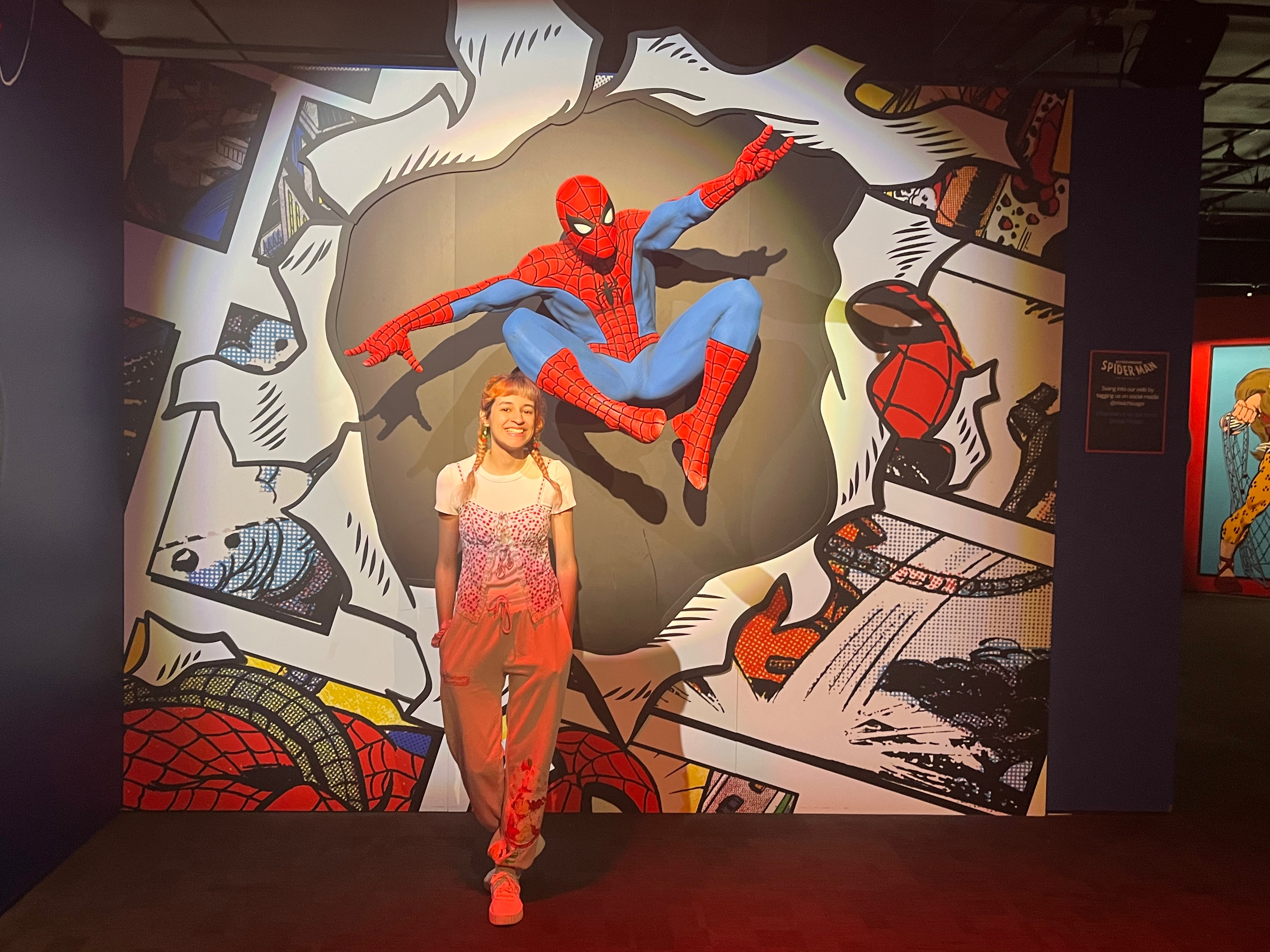
On November 25, 2025, my sister, my friend, and I drove about an hour to the Griffin Museum of Science and Industry to visit “Marvel’s Spider-Man: Beyond Amazing – The Exhibition,” which explores the history of Spider-Man, how he came to be, and how he continues to be a cultural figure that unites us.
The day started off pretty hectic. We had to buy our tickets ahead of time, in fear they would be sold out, and in doing so, we had to pick a time to view the exhibition. We chose noon, thinking that would be enough time to catch the 9:00 am train to get to Chicago, and still have time to walk. Due to a matter of circumstances though, we missed the train, and so we had to bear the Chicago traffic and drive there to make the exhibition time.
But have no fear, we made it with time to spare! Upon arriving at the Museum, we had to check into general admissions, which cost about $25.95 for each individual adult ticket. Oh, did I forget to mention? Yeah, you have to pay to enter the museum, and you also have to pay for an additional ticket to see the Spider-Man exhibit, which is $22.00 for each individual adult ticket. All together, you would have to pay $47.95 just to go see the Spider-Man exhibit – or in my case, $95.90 in total if you have a younger sister who goes with you – although you could make a whole trip out of it and see the rest of the Museum, but I only had eyes for a certain pop culture figure.

After checking into the Museum, and taking the escalator to Level One, we were greeted by a set of stairs that had the image of Spider-Man swinging in one hand, and his iconic web-shooting stance in the other. I thought this was a cool addition for the Museum to do, especially since you have to climb the stairs to get to the exhibit.
After getting to the second floor, we were greeted by a giant Christmas tree (I’m talking floor to ceiling height that just takes up the center of the rotunda). It was beautifully decorated, with white lights, blue, white, and gold round bulb ornaments, white snowflake ornaments, and a yellow star tree topper. Since it was only around 11:40 am, and our entry time for the exhibit was noon, we decided to kill time by looking around, and we noticed that this Christmas tree wasn’t the only one on this floor. In fact, the Museum had what was called “Christmas Around the World” where we got to see different types of Christmas trees, decorated by volunteers to share their cultural traditions. It was such a cool experience, and I’m so glad I was able to experience this, as I probably would have never seen any of it otherwise if it wasn’t for Spider-Man.

When it finally reached noon, we made our way to the closest Spider-Man exhibition, Spider-Man Exhibit #1.
Spider-Man Exhibit #1
Upon first entering the exhibition, the walls are tainted a dark navy blue and the lights are dim, immediately placing you in this new atmosphere that sets you up for the rest of the exhibit. You see some comic panels projected on the wall. They become large and take up the whole wall. Most of these panels consist of some of the famous poses Spider-Man has been seen doing throughout the years: swinging on his web, the ASL hand position for ‘I love you,’ and there are even some moments of Peter Parker without the mask. After you turn the corner, you enter what I call the “maze of Spider-Man…” then there’s this panel of information about the exhibition, where you learn a little bit about Spider-Man:
“Yet, since his debut in 1962, Spider-Man has become an international icon. He has appeared in every form of popular media, inspired a “Spider-Verse” of heroes and villains, and made millions of fans around the world. This exhibition takes you from the web slinger’s humble beginnings to the modern day….Welcome to the web-slinging, wall-crawling world of… The Amazing Spider-Man!”


After reading that panel, you are introduced to this giant figurine of Spider-Man on the wall. It looks like Spider-Man is jumping out of the comic panel and into the real world. Upon first seeing this, my group and the group of people behind us all just let a collective ‘awe ‘sound. It was really exciting to see, and it was such a picture worthy moment.

After seeing the figurine, the start of Spider-Man’s history truly begins. You start with a panel about the introduction of Spider-Man and how he came to be. These panels are written in both English and Spanish. Spider-Man first began in 1962, when Stan Lee and Steve Ditko released “Amazing Fantasy #15″ which featured a dramatic figure–whose face was obscured by a mask–swinging over a cityscape. In this eleven page comic, readers learn how Peter came to be a hero after losing his Uncle Ben and that “[…] with great power there must also come great responsibility.” This was also the first time that a teenage superhero was the main focus of a superhero comic ( before only appearing as a sidekick or as subjects of romantic comedies). It was in these eleven pages that the teenage protagonist, known as Peter Parker/Spider-Man, came to be, only Lee and Ditko had no idea at the time how popular of a character he would become.
Although they had no way of knowing at the time, because the series where Spider-Man was first introduced – Amazing Fantasy – was canceled by Martin Goodman. However, after sale numbers came back for “Amazing Fantasy #15,” Spider-Man was revived after six months in “Amazing Spider-Man (ASM) #1” in March of 1963. Even from the first comic, Lee and Ditko introduced this new hero who was uncertain at times and would even reject his powers, only to save the day at the end. This helped readers “[…]understand the painful relationship between power and responsibility.”
When I asked my friend Kara Tidwell, an alumni of Western Illinois University (WIU), what she thought connects Spider-Man to the world, she said that Spider-Man is “[…] a symbol of responsibility and also a role model for some people to look up to by not being the perfect hero.” I think this is why Spider-Man is such an important figure in pop culture; he teaches people to not give up and that they too can be a hero, and it all started with a piece of literature.
Going through Exhibit #1, you learn more about the beginning of Spider-Man, such as how Lee would tackle social issues in the comics, the different artists that would also come to create Spider-Man, the beginning of Spider-Man appearing on television, and some of the villains that appear in the comics. There are also mementos from some of the Spider-Man films, such as Spider-Man: No Way Home!


Exhibit #1 ends with the creation and death of Gwen Stacy. Gwen Stacy was introduced as a love interest to Peter Parker in “ASM #31,” but this romantic subplot never saw fruition because Gerry Conway replaced Stan Lee as the writer and decided to bring the story to a tragic end. Gwen Stacy’s death was something readers had never experienced before, and it had them confront the idea that “[…] even the bravest heroes are sometimes powerless.” However, Gwen’s story has been reimagined in the twenty-first century, with Spider-Gwen being a popular hero in today’s time.


While there was a lot of reading in Exhibit #1, I found it fascinating to learn about a pop culture figure that has been a part of my life for a long time. I think Exhibit #1 might be difficult for children, because while there is a lot of cool art and displays and giant figures, there is a lot of reading which may be difficult for young children to enjoy. There was one interactive moment where you can place a speaker to your ear and listen to some of the clips from a Spider-Man cartoon that children may enjoy, but if you are worried about taking your kids to see the exhibit I would say, “Don’t be, because Exhibit #2 is much more kid-friendly.”
Spider-Man Exhibit #2
If you thought the Spider-Man figure from the first Spider-Man exhibit was cool, it’s nothing on the figure you see when entering the second Spider-Man exhibit, which entrance is right next to “The Great Train Story.” There is this figure of Spider-Man, hanging upside down from the ceiling on one of his webs, with one of his hands forming the peace sign in a perfect picture pose. I just had to take a photo crouched underneath Spider-Man.

In the second exhibit you learn more about the history of Spider-Man, such as Spider-Man’s black costume, which first came from a fan named Randy Schueller. Marvel held a competition in 1982 for aspiring writers and artists and Schuller proposed a new “stealth” outfit for his favorite hero. Schueller’s design ended up being retooled and the first black costume debuted in January of 1984 in “ASM #252.” I just hope Schueller got paid for his design, but I thought it was cool to see how fans can change the stories you read.
With this second exhibit, you learn more about how some villains came to be! You also learn about some of the different artists that Spider-Man had over the years, and what these artists contributed to Spider-Man. You also learn about the creation of new characters such as Miles Morales, as well as some of the films that were created about Spider-Man, like Spider-Man: Into the Spider-Verse.

After this (and this is where it gets more kid friendly), you learn about Marvel’s Spidey and His Amazing Friends, an animated series that appeared on Disney Jr. in 2021. There was also this cool figure of Spider-Gwen taking a selfie, which I think is fun for everybody. As you get to the end of the exhibit, there’s this giant timeline that goes over the course of two walls, where you can trace not just the history of Spider-Man, but the characters as well. There was also this interactive digital screen where you can click on some of the different Spider-characters that have appeared in Spider-Man history.

As you get to the end, there’s this room of dining tables where kids can draw and color, and families can also sit down and take a break. There are a bunch of interactive tools for kids to enjoy here, like a giant sliding puzzle of Spider-Man. There is also a TV screen that plays Spider-Man cartoons, so there’s something for every kid to enjoy. After you pass this room, there’s the gift shop, where you can purchase something to remember your time here at the Museum in Chicago. I ended up purchasing a magnet Spider-Man kit for my little cousin, since he loves Spider-Man and I thought it would be something he would enjoy playing with. I will say the gift shop was a little pricey, although I expected nothing less, but man, did I put back that sweatshirt I thought was cute after seeing that “$100” price tag on it really quick.
Ultimately, I had a good time at the Spider-Man Exhibition at the Griffin Museum of Science and Industry, and so did my sister and my friend. I would definitely recommend checking it out if you ever find yourself in Chicago and have $50 to spare. But don’t wait too long to check it out, as it will only be in Chicago until February 8, 2026, so you have a very limited time. And if you go, make sure you pay your sister back!
“Spider-Man, Spider-Man, Does Whatever A Spider Can!“






Leave a Reply