
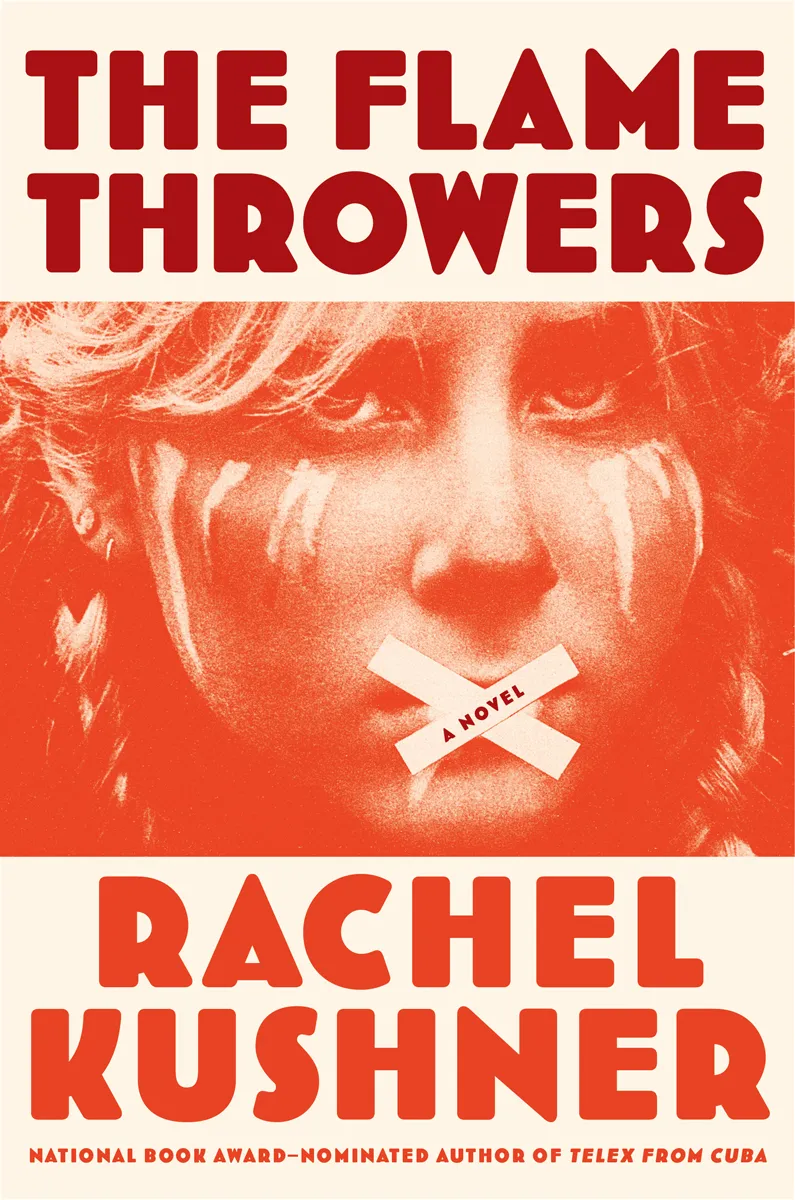
A review of The Flamethrowers, by Rachel Kushner. Scribner, 2013.
Some individuals may leave Rachel Kushner’s 2014 novel asking, ‘what was the point?’ What was the point in reading a book without a real plot? I think that Kushner answers this question in a very meta way near the end of her novel; I won’t spoil her response, but I will say that Kushner predicted the critique.
Told over twenty chapters and set across the twentieth century, The Flamethrowers follows – for the most part – Reno, a young artist from Nevada, living in New York City, motioning through life. Audiences start the novel viewing intimate facets of Reno’s life. From the get-go, this is a tell-all. Immediately Reno states, “I come from reckless, unsentimental people,” and “My uncle Bobby, who hauled dirt for a living, spent his final moments jerking his leg to depress the clutch while lying in a hospital, his body determined to operate his dump truck […]” full-stop; this is our protagonist (Kushner 5). Reno has lived before this novel and will continue to live in The Flamethrowers. From the first page of Kushner’s novel, it is clear that Reno has lived a full life (and will continue to do so); the readers of The Flamethrowers readers are simply voyeurs within Reno’s life.
In this fictional tell-all, Kushner does something utterly unique. While telling a narrative, she works to teach through Reno. We, as audience members, watch and glamourize Reno’s experience while learning with literature. The Flamethrowers is a story of sex, terrorism, art, motorcycles, racing, New York City, Italy, the nineteen-seventies, youth, etc., etc., etc.. There is no reader out there who has a fully formed understanding of every topic discussed within The Flamethrowers, and we all learn something from reading this novel. This is Kushner’s genius. Through Reno, audiences are given a snapshot of life, and we are allowed to learn through this art.
“Life, Giddle said, was the thing to treat as art” (88). Reno is not a perfect character, but, damn, is her life fun to read! Reno is the audience’s window into the action; her internal monologue and dialogue drive the novel. Even when Reno is internally interpreting what another character says or does, her monologues are a blast to read, and Kushner’s authorial talent flies off the page.
In one scene near the beginning of the novel, Reno observes two men eating food in a Mexican restaurant: “As she [a waitress] set the plates down, the men stopped talking and each took a private moment to look at his food, really look at it. Everyone did this in restaurants, paused to inspect the food, but I never noticed it unless I was alone” (16-17).
In another scene, later in the novel, Reno is deep in a self-deprecating internal monologue:
I’m relatively tall, which seemed to count against me, and I was once even told by a short man that I was retriggering his youthful nightmares of being ridiculed by tall girls in school, and I sensed he wanted me to apologize for this, for his adolescent trauma, and I didn’t and moreover, I gave up on short men partially if not totally, sometimes even preemptively disliking them, though seldom admitting this to myself. (116)
Kushner’s voice emanates through Reno in these short excerpts, and it is grand and stunning!
Reno’s life and point-of-view is the focal point of The Flamethrowers. There are other moments and other segments where Kushner diverts audience attention, but all of it is to better elevate Reno… to better provide context to and for Reno. The Flamethrowers is not simply a novel about a woman who wants to become a successful artist. It is not just a novel about a woman who has fallen in love. It is not a novel about a woman experiencing New York City or adulthood for the first time. The Flamethrowers is an education and that is what makes it so incredible. Through Kushner, readers are continuously driven to side with Reno. When Reno is sad, readers feel it, and when Reno is happy, readers feel it; this novel is electric and educated.
Kushner’s novel pulses whenever Reno is leading a chapter (which is the majority of the novel [about eighty percent of the book]). When Reno is not the individual driving the audience’s attention, The Flamethrowers works to provide an education and an understanding for audiences in a way that is untoward and brilliant.
There is a quote from late within Kushner’s novel that I feel embodies the aesthetic of The Flamethrowers so well. It goes, “A blend of good and bad characterized all humans, and to pretend to sort that out was an insult to human complexity” (357). The Flamethrowers is a complex novel that will work to reshape your understanding of a multitude of world and cultural issues while also providing an entertaining and electric character for you to grasp on to while you learn. I loved reading this novel because I loved learning, and I loved Reno; that experience might not be universal. Still, what will you learn if you don’t read! Rachel Kushner’s The Flamethrowers is a novel that has thoroughly changed how I’ve thought on certain topics, and for that, I think that it should be recommended wholeheartedly!





Leave a Reply