
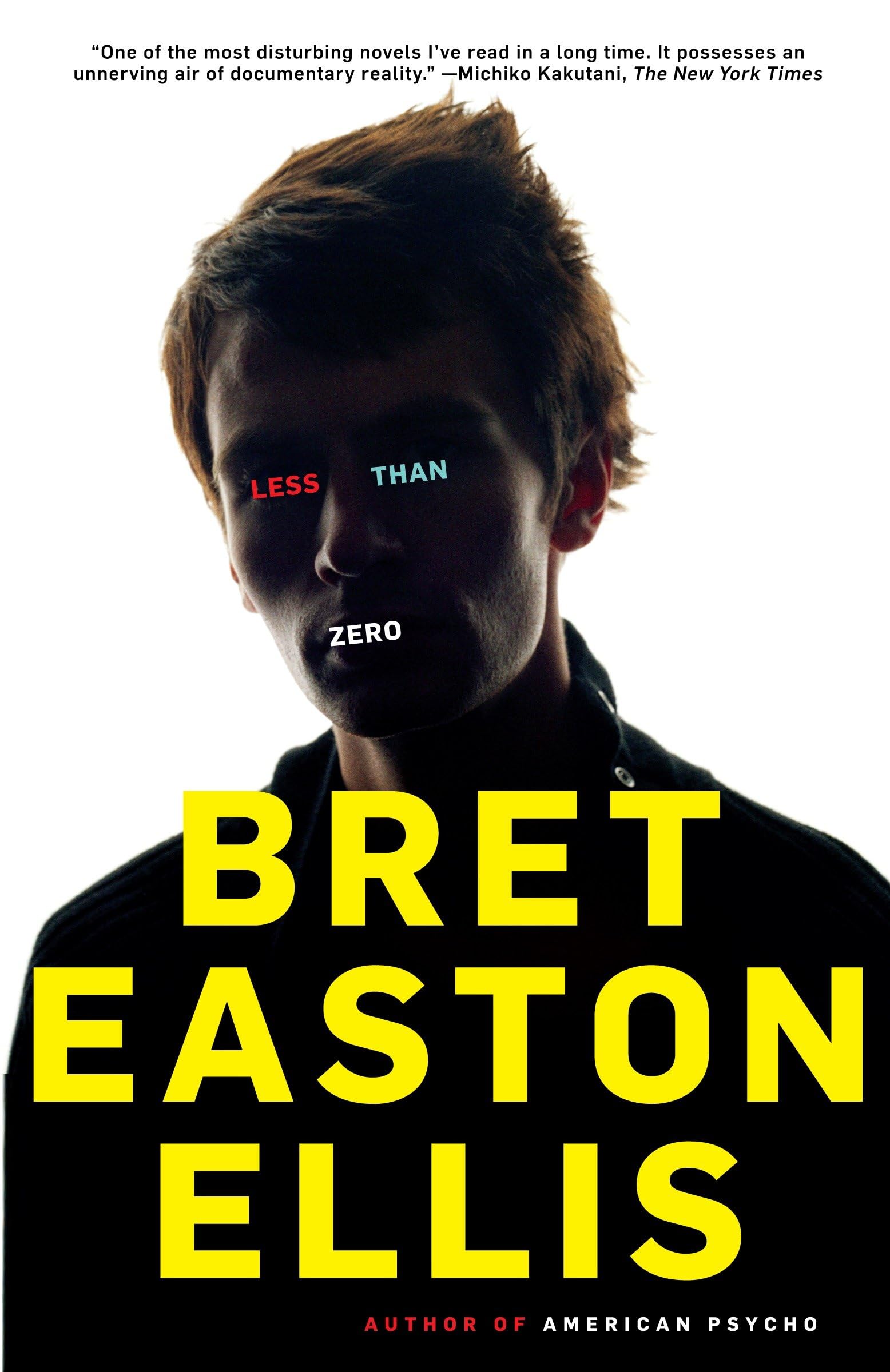
A review of Less than Zero by Bret Easton Ellis. Vintage Contemporaries, 1985.
“All it comes down to is that I’m a boy coming home for a month and meeting someone whom I haven’t seen for four months and people are afraid to merge” (Ellis 9-10). Launching into Less than Zero, Bret Easton Ellis forces readers to live within the mind of Clay, an eighteen-year-old undergraduate freshman from Los Angeles attending college in New Hampshire. Clay has returned home to California for winter break after his first semester away, and life happens to him.
Ellis welcomes readers to the high underbelly of Los Angeles. Inspired, perhaps, by J.D. Salinger’s The Catcher in the Rye, Clay, a resident of this high underbelly, feels eerily familiar to Holden Caulfield – lacking a similar sense of agency, but importantly, distinctly, and uniquely without morality. Ellis uses Clay’s lack of agency to take readers through a landscape that is expertly crafted to disturb and invite readers into a novel made to feel all too real. This novel is defined by Clay; he will make or break your experience. His character growth – or lack thereof (depending on your reading) – is this novel’s and Ellis’s greatest strength. There are incredible moments of tension conveyed throughout this winter break that Clay lives; however, Clay’s first-person narration is the standout point of this novel. In one scene, Clay blankly lies on a bed, smoking while he watches a pre-one-night-stand partner strip:
Griffin stands by his bedroom window, looking out into the backyard, at the pool, only wearing a pair of jockey shorts and I’m sitting on the floor, my back leaning against his bed, bored, sober, smoking a cigarette. Griffin looks at me and slowly, clumsily pulls off his underwear and I notice that he doesn’t have a tan line and I begin to wonder why and almost laugh. (37)
You can feel the unique passivity emanating off of Clay in almost every scene he narrates. In another scene, Clay reconnects with Rip, his drug dealer, at a party: “I don’t say anything, just stare at the half gram [of cocaine] he’s poured onto a small hand mirror… Rip laughs and lights a cigarette. With a razor he cuts the pile into four big lines and then hands me a rolled up twenty and I lean down and do a line” (32). Generally, in life, drugs may be considered glamourous… Clay, through his passiveness, makes them seem boring. Ellis neuters the Los Angeles high life using Clay’s incredible narration; he makes it so that the life portrayed by this novel is not desirable.
In a common scene of dialogue, Clay converses with his mother and two younger sisters (whose ages he doesn’t know) about locked doors:
“Bullshit! No way,” one of them yells.”Clay can’t have Galaga in his room. He always locks his door.” “Yeah, Clay, that really pisses me off,” one of them says, a real edge in her voice. “Why do you lock your door anyway, Clay?” I don’t say anything. “Why do you lock your door, Clay?” one of them, I don’t know which one, asks again. I still don’t say anything. I consider grabbing one of the bags from MGA or Camp Beverly Hills or a box of shoes from Privilege and flinging them out the window. “Mom, tell him to answer. Why do you lock your door, Clay?” I turn around. “Because you both stole a quarter gram of cocaine from me the last time I left my door open. That’s why.” My sisters don’t say anything. (25)
In all three of these separate passages taken from Ellis’s Less than Zero, something different about Clay’s passivity is shown. Clay is this novel’s driving force – he is the reason to read this book – and he is the only thing bringing readers through the sea of words that define the ‘plot’ contained within this book, yet he is (as previously stated) passive and nearly unchanging. If a novel where events simply happen, unchanged by a book’s uncaring ‘protagonist’ without agency sounds appealing, jump onto the Less than Zero bandwagon. This novel is, without a doubt, unique.
In this novel, marked end-to-end by a lack of agency, degeneracy is seen through the eyes of an eighteen-year-old boy. I imagine that some might say, “This book is evil,” and to that I say that this book is meant to critique the lifestyles of the 1980s in L.A. In this novel, Ellis creates a dastardly world that I might encourage some to enter; this created world is not meant to be glamorous or flamboyant. Under the surface, it is cruel, and for lack of a better word… evil. Ellis is trying here to offer a snippet of the world of his youth and to show, without context, what degeneracy and evil look like. Less than Zero is an exercise in audience morality. It is entirely up to YOU to decide what you receive from this novel. Test yourself. What do you find?





Leave a Reply