
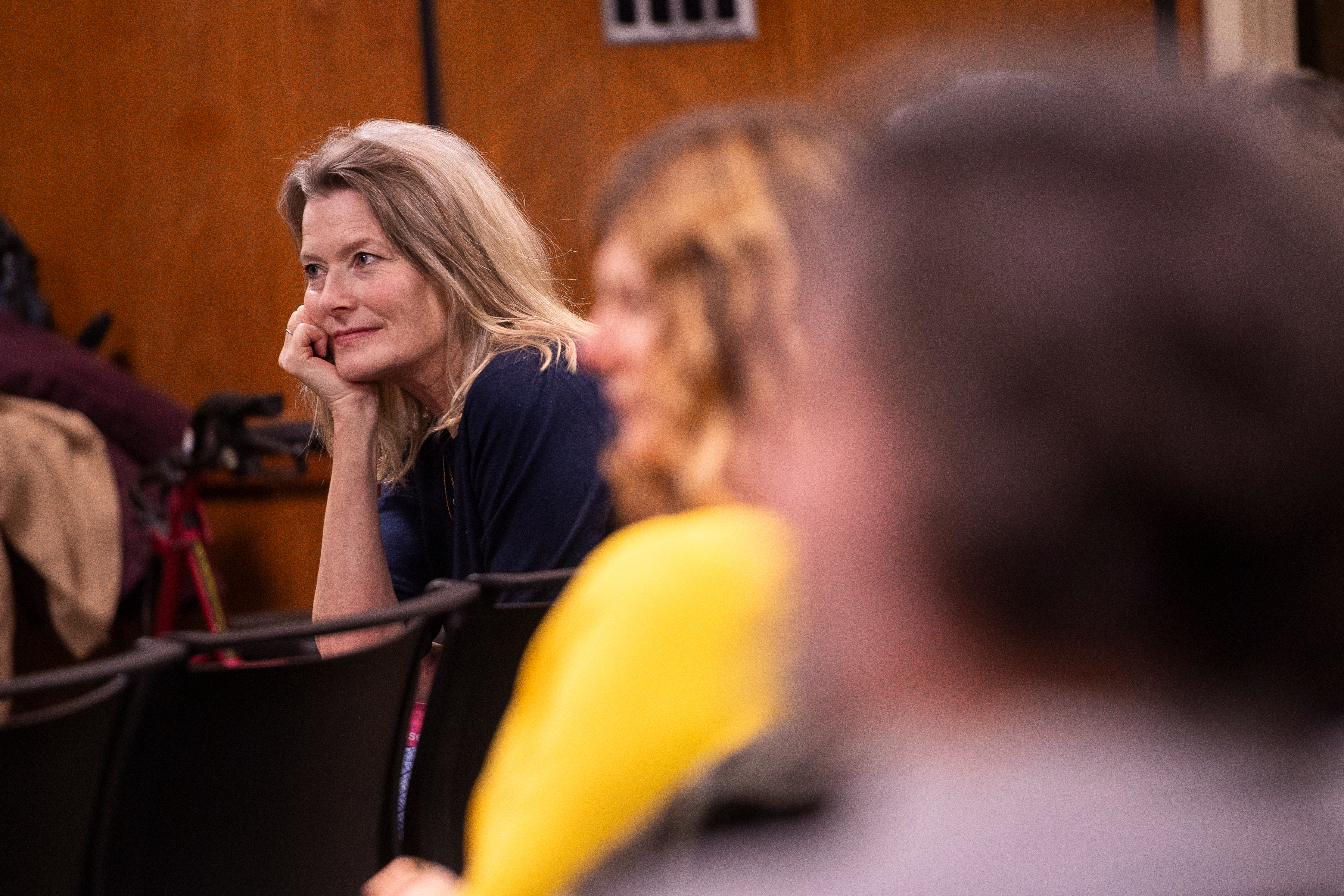
On March 5th, 2026, Jennifer Egan, Pulitzer Prize winner, journalist, and author of 2010’s A Visit from the Goon Squad and its 2022 companion novel, The Candy House, visited Western Illinois University (WIU) for a luncheon, book reading, Q&A, and signing as part of the university’s Fred Ewing Case and Lola Austin Case “Writer-in-Residence.”
The luncheon, attended by a dozen-or-so students (including myself) and two professors, served as a more intimate setting for Egan to talk about her craft: the how and why of fiction writing. Egan described her writing process as “unusual;” when writing, she always begins by envisioning the place or environment of a piece. She compared her fiction writing to improvisation. She works to find the action in her story and then pushes. “Improv doesn’t work if you say ‘no,’” she noted. While discussing the idea of “pushing” her stories, Egan told us that she writes every first draft of fiction by hand, describing screens as “stymying” to her progress, as she feels more inclined to go back and edit things before the entire draft is finished.
After finishing the handwritten drafts, Egan starts to edit. She continues pushing the story forward, looking at her first draft, and making an outline of revisions. Whatever is most “surprising and alive,” she suggested, is the best thing to write around. Egan also gave some advice on what to do when one might be struggling with making a piece work. She said that walking away from a story is okay, but if you can… find the good ideas amongst all the problems and “rewrite around those.” She also emphasized the importance of writing communities, workshops, or groups, and “reading your work aloud.” Reading your work out loud helps you hear the “music of language,” and is a great way, Egan suggested, for finding places that aren’t working in a story. No matter what we write or how stuck we might feel when writing, Egan encouraged our lunch group to always find ways to move our stories forward.
A few hours later, in WIU’s Union Lincoln Room, a much larger group gathered to hear what Jennifer Egan had to say. After reading an excerpt from “The Mystery of Our Mother,” a chapter from The Candy House, Egan sat for a Q&A. Starting with questions from Professor Barbara Lawhorn, Egan began by talking a bit about her eclectic reading life. She started reading at three years old and has not stopped since. She highlighted reading material like Carolyn Keene’s Nancy Drew series, Edith Wharton’s The House of Mirth, and John Fowles’s The Magus as some of her earliest inspirations. Egan also discussed her love of crime fiction, Greek tragedies, and nineteenth-century English literature, and specifically mentioned Marcel Proust’s In Search of Lost Time as a source of thematic inspiration for her novel, A Visit from the Goon Squad, as she “wanted to write a book about time.”

Egan then moved on to talking about her previous aspirations and her current career as both a journalist and an author, and how each of her experiences has shaped her as a person and a writer. Before she “got squeamish” around the world of medicine, Egan would have been a doctor, as she “wanted to cut people open” and study their different parts. Afterward, she considered becoming an archaeologist, as she wanted to know “how people lived.” Both aspirations, she explained, shaped her as a future writer, as journalism and fiction are their own form of cutting people open and figuring out how they live. Egan said she started writing, not because she was “chosen,” and not even to become “a good writer,” but because she felt like she had to do it to fulfill her curiosity about other people. From there, Egan went on to discuss her journalism and fiction writing, which actually help each other. Journalism, she explained, has helped her learn how to lay out the many components in a complicated problem and how to go from “knowing nothing about a topic” to “becoming an expert” on it. These skills from journalism have helped her in fiction, as she’s learned how to research and write about worlds different from her’s.
From there, Egan moved on to discussing her craft, echoing a couple of things discussed during the luncheon just a few hours before. A lot of what Egan writes is in reaction to something she has done herself; “if I’ve [already] done it,” Egan said, “[I] try to do the opposite.” She also discussed the making of one of the chapters from A Visit from the Goon Squad. “Great Rock and Roll Pauses” is one of the strangest chapters, formatting-wise, as it’s told through the format of a PowerPoint presentation made by a young girl named Alison. Egan explained that it’s “almost impossible to convey action” in a PowerPoint and that the format itself is very cold and associated with business. The chapter almost didn’t make it into the book, but after some tune-ups, which involved making the story very sweet and welcoming in order to offset the cold, action-less format, Egan included it as the penultimate chapter for A Visit from the Goon Squad.
Egan finished up her talk by discussing the importance of fiction writing and of having your own voice. She claimed, “Fiction is the only narrative art form that places us in the mind of another human being.” From reading and writing fiction, Egan explained that we gain ideas we wouldn’t otherwise have, as we’re introduced to new worlds and people. Fiction, to Egan, is also a way of combating the “groupthink,” or over-processed, collective voice, that is often seen in AI writing. She urged us to fight against this “processed form of utterance,” to find our own voices, to study, to write, and to read. “Deep reading,” Egan firmly stated, “is an act of resistance.”
Like in A Visit from the Goon Squad and The Candy House, there were through-lines in Jennifer Egan’s luncheon and in her Q&A answers. During both events, she emphasized the importance of community and finding your own voice. She also discussed the importance of the passage of time, as what you’ve experienced before will affect your work now. Egan, most importantly, felt strongly about moving forward. Her WIU audience can draw inspiration from her words and her motivations, as she left us with ideas for how we can continue to keep reading, writing, and pushing onward. If writing is like improv, like Egan says, we must simply keep saying “yes.”

All photos by WIU Photography and Design Production


Leave a Reply