
From an early age, I was immersed in literature—not only through printed pages, but through sound. My father owned a collection titled 100 Great Books, a multivolume set of cassette tapes featuring abridged recordings of canonical works. Alongside these were radio dramas, lectures, and unabridged audiobooks. Stories were not only read; they were performed, inhabited, and carried through voice.
One memory has remained particularly vivid. On a family road trip when I was perhaps ten or twelve, we listened to a BBC radio dramatization of Sherlock Holmes stories, featuring performances by Sir John Gielgud and Sir Ralph Richardson. When we reached our destination, we did not immediately leave the car. Instead, we sat—engine running, doors closed—until the story concluded. The boundary between travel and arrival had been suspended. Narrative had taken precedence over place.
That pattern persisted into adolescence. Audiobooks were a constant presence, though my father consistently encouraged me to return to physical books whenever possible. Reading, in his view, demanded a kind of engagement that listening alone could not fully provide. Even so, the auditory dimension of literature had already taken root for me. It was not a substitute; it was an extension.
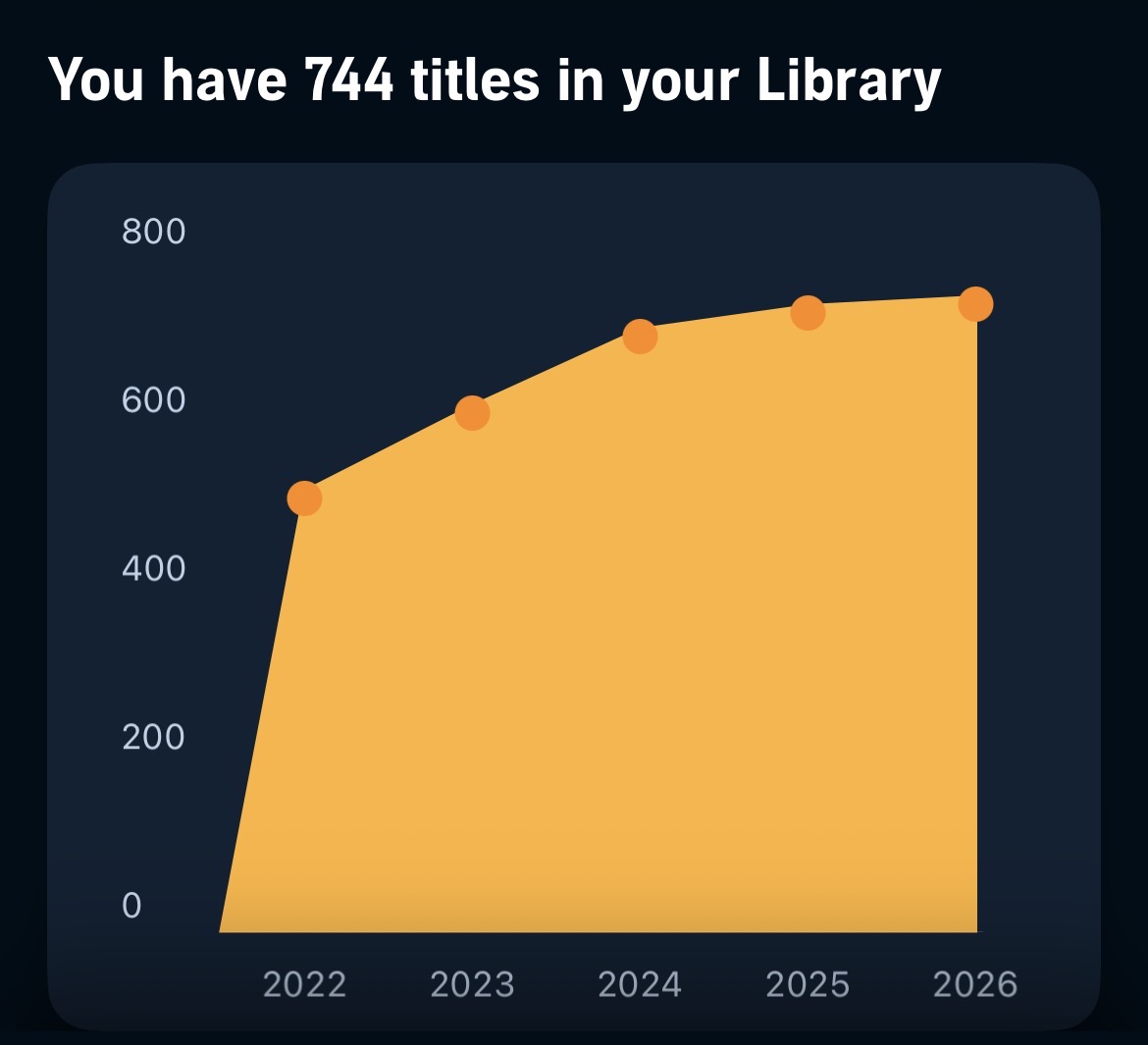
In adulthood, that extension became central. With the advent of platforms such as Audible, I found access to an almost inexhaustible library. Fiction, nonfiction, lecture series such as those produced by The Great Courses—I consumed all of them with a sustained intensity that, in retrospect, borders on compulsion. According to my listening statistics, I have accumulated nearly twenty-seven months of total listening time—approximately nineteen-and-a-half thousand hours. That figure does not include listening done outside of Audible.
Audiobooks, for me, became a way of reconciling two competing demands: the desire for continual intellectual and narrative engagement, and the practical requirements of daily life. I could wake, continue a book, and carry it with me through the day. Cleaning, cooking, driving, walking to class or work, woodworking—even showering—became compatible with narrative immersion. Listening transformed otherwise routine or transitional moments into something structured and meaningful.
Over time, this practice took on another function. It became a way of exerting control over my environment. When the external world felt chaotic or unstructured, I could impose continuity through a familiar voice, a known story, or a repeated text. I often revisit the same books dozens of times, not out of novelty, but for stability. The audiobook becomes less an object of discovery and more a constant—something reliable against the variability of lived experience.
Yet this continuity introduces its own tension. The conclusion of a long narrative can produce a kind of psychological dislocation. After hours—sometimes days—spent within a constructed world, the return to ordinary life can feel abrupt, even hollow. Attention must be redirected outward. The internal cadence established by the narrator disappears. What remains is silence—or at least the absence of that particular structure.
I have experienced a similar effect after extended periods of watching films or television. When leaving a theater, or simply standing up after a prolonged viewing session, there is often a moment of uncanny transition—a sense that reality has resumed, but without the coherence the narrative provided. Audiobooks intensify this effect because they accompany daily activity rather than replacing it. The narrative does not require stillness; it overlays motion. Its removal is therefore felt not only as an ending, but as a subtraction from the environment itself.
For this reason, I have had to become more deliberate. At times, I recognize the need to step away—to allow silence, or at least a different form of auditory input, to reassert itself. Without that adjustment, it becomes difficult to remain fully present in my own life, rather than continuously inhabiting the constructed lives of others.
At a cognitive level, I cannot say with certainty that listening alters my thinking in a measurable way when compared to reading. I am aware that different mental faculties are engaged—visual processing, internal subvocalization, and eye movement in reading versus auditory parsing and temporal sequencing in listening—but my experience does not present a clear hierarchy. What I can say with confidence is that I tend to retain information more effectively when I hear it. Interpretation, however, is more variable.
Narration has the capacity to deepen a text, but it can also constrain it. A skilled narrator introduces rhythm, emphasis, and tonal nuance that can illuminate character, intention, and subtext. A less effective performance can flatten those same dimensions. Over time, I have come to recognize that the narrator functions, in a sense, as a secondary author—someone whose interpretive choices shape the experience of the work in ways not immediately visible on the page.
This becomes particularly evident when multiple recordings of the same text exist. My experience with the Harry Potter series illustrates this clearly. Having grown up with the narration by Jim Dale, his rendering remains, for me, definitive. Each character is given a distinct and immediately recognizable voice. Dialogue does not require attribution; identity is embedded in sound.
By contrast, the version narrated by Stephen Fry, while competent and widely respected, lacks that same degree of differentiation in my experience. Fry’s performances tend to operate within a narrower range of characterization. Some of this preference may be attributable to familiarity, but as someone with a background in audio engineering, I am attentive to subtleties in vocal performance, pacing, and tonal variation. These differences are not incidental—they materially alter the way a text is perceived.
There have been instances in which I have begun an audiobook and set it aside almost immediately due to dissatisfaction with the narration. While this is relatively rare, it underscores the degree to which performance mediates the experience. The text alone is not sufficient; it must be delivered in a way that sustains engagement.
When a book is not available in audiobook form, I have sought alternatives. Applications such as Speechify allow written material to be converted into spoken language. I have used this for academic articles, lecture notes, and even screenplays. While synthetic voices lack the nuance and interpretive depth of human narration, they preserve the fundamental advantage of audiobooks: the ability to integrate language into movement.
Even so, the absence of performance becomes immediately apparent. Where a skilled narrator shapes meaning through timing and inflection, synthetic speech reveals the text in a more neutral—and often more limited—form. The comparison makes clear how much of the audiobook experience depends not only on what is said, but on how it is said.
My tendency to revisit the same works reflects another dimension of this relationship. I return to certain books not only to refresh my memory of plot, but to re-experience specific scenes, dialogues, and tonal environments. Among these are Thomas Harris’s Red Dragon, The Silence of the Lambs, and Hannibal, as well as the Harry Potter series, The Lord of the Rings, the Sherlock Holmes stories, Shōgun, Shantaram, and works by Neil Gaiman. Science fiction by authors such as Robert A. Heinlein and Stephen R. Donaldson, along with numerous Star Wars novels, also occupy this space.
These are not merely stories to me. They are environments—structures I can re-enter at will, each with its own internal rhythm and emotional architecture. Re-listening becomes less an act of consumption and more a form of recalibration.
Silence, in contrast, is not always neutral. At times, it can feel threatening, though this is contingent on my internal state. What I consistently prefer is the presence of some form of auditory stimulus: music, narrative, ambient sound, or even film dialogue. I find that I want something I can mentally point to—something that marks the passage of time. Without it, time can feel diffuse, less structured.
In recent years, my engagement with audiobooks has become cyclical. There are periods in which I rely on them heavily, followed by periods in which I step back and replace them with music or ambient sound. These shifts are not arbitrary. They reflect an ongoing attempt to regulate my relationship with the medium—to prevent reliance from becoming dependency.
Since December 2025, I have entered another period of intensive listening. My current average is approximately 1,760 hours over a relatively short span—roughly fifteen hours per day. At that level, it is difficult to avoid the conclusion that what I am experiencing resembles addiction. But that term requires careful consideration.
If addiction implies compulsion without awareness, then my experience only partially fits. I am aware of the pattern. I can describe its effects. I can, when necessary, alter my behavior. And yet, the pull remains strong. Audiobooks offer something that is not easily replaced: a continuous, structured engagement with thought, language, and narrative that integrates seamlessly into the flow of daily life.
The question, then, is not simply whether this constitutes addiction, but what kind of need it satisfies—and whether that need can be met in other ways. I might even question whether I want to limit my use of audiobooks at all, given how many titles remain to be explored.
Edited by Shaylie Muehl




Leave a Reply