
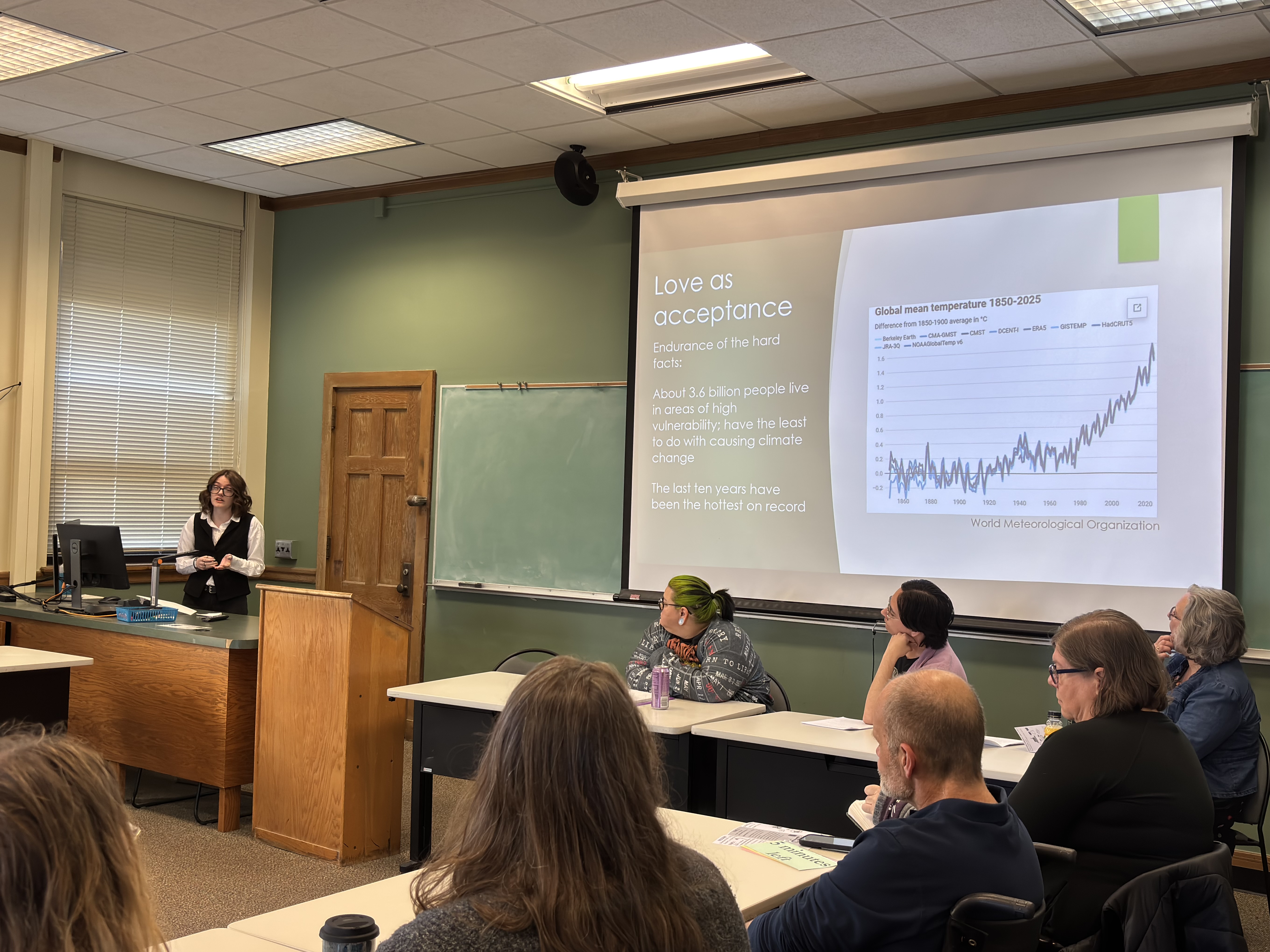
On Saturday, March 28, 2026, the WIU English Graduate Organization (EGO) hosted its annual colloquium, inviting graduate and undergraduate students to share their research across two panels. The event drew an engaged audience of faculty, students, and guests, offering a space for thoughtful discussion across topics ranging from environmental ethics and cultural memory to adaptation, genre, and creative process.
The first panel, “Examining Relationships Through Space and Culture,” opened with Karissa Geisinger’s presentation, “Something’s Gotta Give: Love and Other Tools Against the Climate Crisis.” Geisinger framed love not as passive sentiment, but as an active force expressed through acceptance, anger, and hope. Situating their discussion within the realities of the climate crisis, they emphasized endurance in the face of difficult truths, the productive role of anger in motivating action, and the importance of hope grounded in agency, rather than certainty. Drawing on both contemporary climate discourse and faith-informed perspectives, their talk positioned love as a sustaining and renewable resource—one that shapes how individuals respond to global challenges.
Sam Adcock followed with “From Unpaved to Memorialized: One Mexican-American Community’s Journey of Reclaiming Space for Cultural Recognition,” tracing the history of Hero Street in Silvis, Illinois. Through a detailed recounting of the lives commemorated there, Adcock highlighted the persistence of a community that endured social and spatial marginalization while maintaining its cultural identity. The transformation of the site into a place of remembrance—marked by symbolic architecture and ongoing community engagement—illustrated how space itself can be reclaimed as a form of historical and cultural affirmation.
Blake Traylor’s presentation, “Feeling Queasy in Dreamland: A Queer Film Phenomenology of John Waters’ ‘Good Bad Taste’,” examined the role of discomfort and transgression in queer film aesthetics. Focusing on the deliberate use of shock and “bad taste” in Waters’ work, Traylor explored how disgust can function as both a boundary and a point of connection. By engaging with audience response and embodied experience, the presentation considered how marginalized identities can reclaim agency through exaggeration, inversion, and the strategic use of aesthetic friction.
Concluding the panel, Marie Watson presented “What a Disaster! When Bad Times Call for Good Neighbors,” an exploration of community response in times of crisis. Using Hurricane Katrina as a central example, Watson emphasized the ways individuals engage in acts of witnessing, rescue, and improvised cooperation when formal systems fail. Her discussion highlighted the tension between dominant narratives of disorder and the often-overlooked reality of mutual aid, while also addressing how misinformation and bias shape public perception during moments of instability.
The panel’s Q&A extended these conversations, with audience members and presenters reflecting on themes of belonging, representation, and response. Questions surrounding the role of “otherness” in shaping identity, the framing of crisis through media narratives, and the persistence of cultural memory invited further dialogue. Across these exchanges, a shared emphasis emerged on how individuals and communities navigate uncertainty—whether through creative expression, historical preservation, or collective action.
The second panel, “(Re)Building Stories,” shifted focus toward narrative form and transformation. Carter Myers opened with “Different Darcys: The Importance of Theme When Considering Adaptation in Academia,” examining how adaptations retain or re-shape core elements of character and theme. By comparing traditional and contemporary re-imaginings, Myers argued that successful adaptations preserve the underlying identity of a character while introducing new contexts that invite renewed engagement.
Athziri Garcia’s “The Epidemic of the Vampire: A Shift in Narratives” explored the evolution of vampire fiction across time, with attention to how issues of race, sexuality, and class are reinterpreted in modern adaptations. Garcia emphasized the movement from static representation toward more complex and inclusive portrayals, suggesting that contemporary narratives expand rather than replace earlier forms, allowing audiences to engage with enduring themes through new perspectives.
Maggie Talbott concluded the panel with “Exploring the Soup: A Reflexive Mediation on Creative Writing Process Through Feminist Rhetoric,” offering a reflective account of the creative process shaped by feminist rhetorical practices. Through concepts such as critical imagination, strategic contemplation, and social circulation, Talbott examined how identity and research inform creative work. Their discussion highlighted writing as an evolving, communal process—one that balances inspiration, revision, and ongoing engagement with both texts and audiences.
The final Q&A continued the discussion of narrative flexibility, particularly in relation to genre. Panelists and attendees considered the increasing presence of fantasy and speculative elements within academic spaces, as well as the ways these genres allow for fresh engagement with familiar human concerns. Conversations around adaptation, representation, and the relationship between realism and the fantastic underscored the panel’s focus on storytelling as both a reflective and transformative practice.
Each panel generated lively discussion, with conversations unfolding thoughtfully within the time allotted. The colloquium fostered a sense of shared inquiry, as presenters and attendees engaged with questions that moved fluidly between theory, experience, and creative expression. The breadth of topics and approaches reflected the depth and diversity of both undergraduate and graduate scholarship within the department.
Special thanks are owed to Dr. Rebekah Buchanan, Professor Barbara Lawhorn, Dr. Alisha White, and Dr. Bill Knox, as well as the faculty and staff of the English Department, for their support in making the event possible. Appreciation is also extended to EGO Co-Presidents Blake Traylor and Grace Wright, Secretary Ilana Garnica, Treasurer Maggie Talbott, and Faculty Advisor Dr. Roberta Di Carmine for their work in organizing and facilitating the colloquium.
We at The Mirror & the Lamp look forward to seeing how these conversations continue to develop in future work and at next year’s EGO Colloquium!
Edited by Karissa L. Geisinger


Leave a Reply