
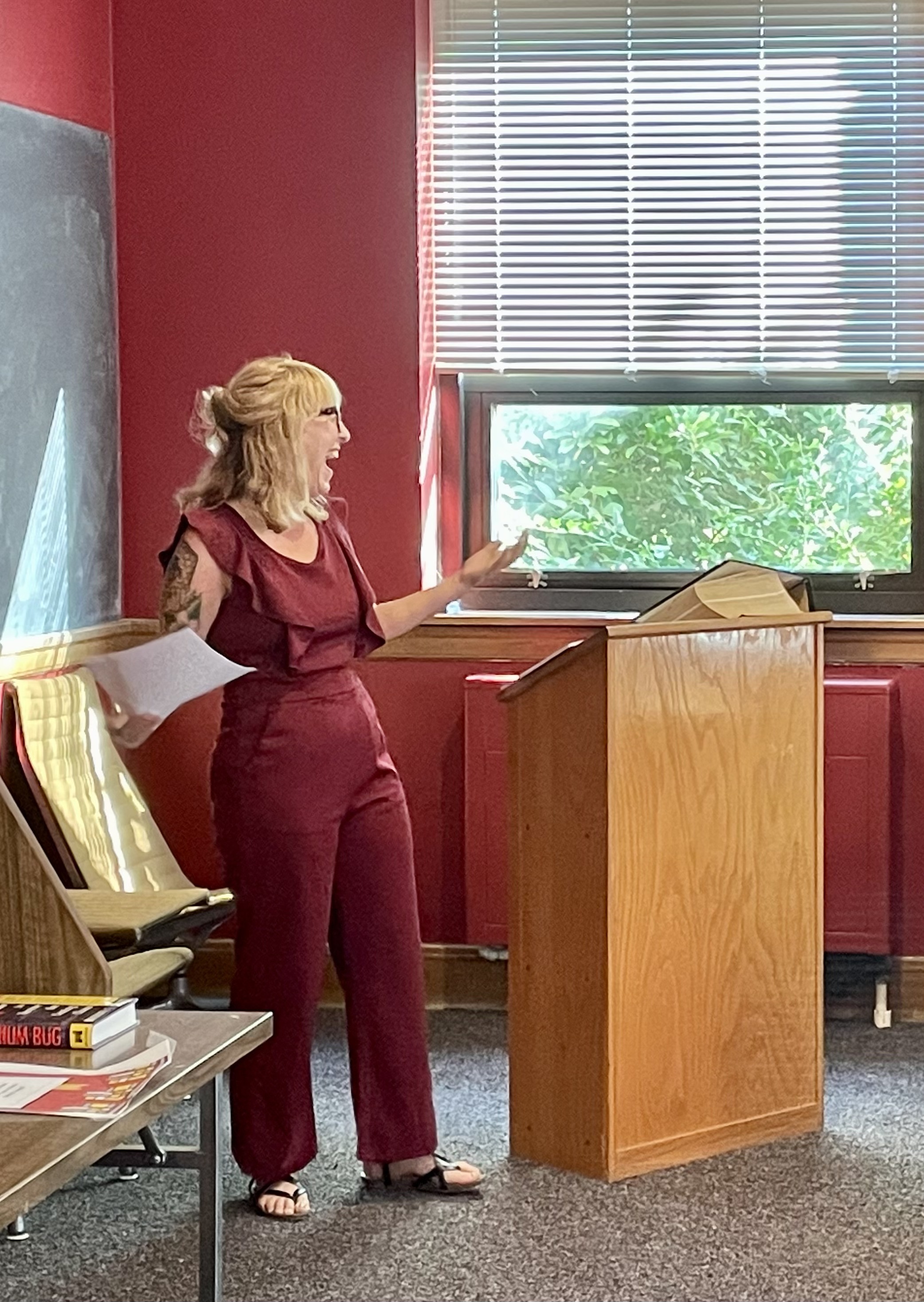
Barb Lawhorn (B.S.W. 1998) is a Western alumna, earning her bachelor’s degree in Social Work and a minor in Women’s Studies, but she also took almost all the creative writing courses offered by the department and went on to earn her M.F.A. in Creative Writing from Purdue University (2002), so here at M&L we consider her a major! Today, she teaches Creative Writing, composition, and literature courses in the department. The Mirror & the Lamp reached out to ask her what everyday life was like in her undergraduate days.
M&L: What was your weekday routine like as a major?
BL: I lived for creative writing workshops, which, back in my day (1994-1998), were often once a week night classes or mid afternoon. I took classes primarily in Simpkins and Memorial. I worked on campus at the Women’s Center, and I had a talent grant at Audio Information Center, reading newspapers, magazines and novels for the sight impaired twice a week. I also worked at McDonough District Hospital, first as a dietary aide, line cook, and supervisor, and then as a PBX phone switchboard Operator. I was really active in theatre too, so I was often rehearsing in Simpkins. When I wasn’t doing these things I was reading and writing, or eating or sleeping.
M&L: What were your weekends like?
BL: I worked, honestly. I worked 24-36 hours a week as a college student. I worked from 6:30 a.m.-3:30 p.m. or 11:00 a.m.-7:00 p.m. every weekend while in dietary, and when I transferred to the switchboard, I worked the split shift from 8:30 a.m.-1:00 p.m. and 4:00-7:00 p.m., or 3:00-11:00 p.m., or even 11:00 p.m.-7:00 a.m. answering phones. I loved 3:00-11:00 and 11:00-7:00 because I could read and write during those shifts.
I lived off campus with my roommate, Becky, who was a music major. We had a piano in our shack that we’d rescued from a curb, and she played beautifully. She’s in Berkley now and has a piano studio where she teaches. We were both obsessed with The Beatles too, and we were doing work on the house we lived in to reduce rent, so we listened and sang along to the Beatles while we worked. We loved live music, and at that time, there were so many college bands playing primarily at The Cafe on the square. Becky’s brother lived in Iowa City, and if I ever asked for a weekend off, we’d go there or to Columbia, MO to the Blue Note to see live shows and larger acts.
M&L: What book were all the majors reading beyond what was assigned for class?
BL: My friend Corey was into the transcendentalists. Kevin was way into horror. My graduate student friend, Monica, had just discovered Proust. The two Marks were into the Beats.
M&L: What book changed your undergraduate life?
BL: The Bone People by Keri Hulme, Confederacy of Dunces by John Kennedy O’Toole, Cold Snap by Thom Jones, and Geek Love by Katherine Dunn
M&L: Where did you hang out on campus?
BL: There used to be open mics in the Writing Center, on the third floor of Simpkins, with faculty and students. There were campus wide open mics in the downstairs of the union, in a room that had a river boat mural and false riverboat deck. I hung out in Simpkins and Horabin hall for theater rehearsals too. My main hang out was the Women’s Center, in Memorial Hall. Becky and I were founding members of Feminist Action Alliance, and we were really active on campus. Seriously, I look back and I do not know how we did it. She worked two jobs—at the public library and at Malpass library.
Where did you hang out off campus?
BL: There was this amazing coffee house called The Turning Point Cafe on the square—three stories of rooms to read in, write in, drink coffee and talk in. Every Tuesday, they had the best open mic in town. Seriously. It was owned and operated by two Biology graduate students with a passion for the arts. They hosted live music, showcased local and emerging art in their spaces, and booked local and traveling musical acts. It was an all ages venue on the downtown square that was truly inclusive, but primarily it was a place for college students. It was a magical place, for real, but the owners, a couple, graduated, sold the business, and it hung on for another year. The Cafe on the square was a place that was all about live music, and listening to live acts, and dancing. Most of my friends were in a band or dating someone in a band.
M&L: What was your biggest adventure as an undergraduate English major?
BL: The two Marks, Mark Farnsworth and Mark Campbell, were senior English majors when I was a freshman the Spring of 1994. We met in a poetry class, when, I kid you not, I took out a pocket copy of Howl, from my literal back pocket, and Mark Farnsworth, watching me, stood, and did the same. Then, Mark Campbell reached into his bookbag, wordlessly, and held up, humbly, his copy. We’d been instructed to bring our favorite poem to class. I resisted the urge to touch copies with them like in E.T., where they touch fingers. Silently, we pulled our desks closer to one another, no longer strangers. Mark Farnsworth, who I had just met, told me they were going to a Beat Conference at NYU at the end of the semester and I should also attend. Although I had just met them, that afternoon, I asked for the dates off, and I purchased my Amtrak tickets and tickets to the conference. It emptied my meager savings.
In May, I traveled with the two young poets from Iowa, who wore sunglasses the entire trip to New York in order to hide their “Iowa eyes”, sharing a closet sized hotel room. We met poets Lawrence Ferlinghetti, Greogory Corso and Anne Waldman, all by skipping a session and eating a bagel in the park, and we also ran into the great Ginsberg himself, who stopped long enough to sign their copies of Howl. I wasn’t fast enough getting my copy out of my skin tight, midwestern jeans, and followed behind beseeching, “Wait, please” to which he proclaimed, not bothering to glance back at me, “No time!” It stopped me in my tracks. “No time!” we’d exclaim to one another the remainder of the trip.
When we finally got back to Chicago, we were elated when we ran into Dr. John Mann, our poetry professor, in the Great Hall of the Union station waiting for the train back to Macomb, and our stories somersaulted—the joy of being truly taken for a ride by a NY cabbie! Ray Manzerik from The Doors was full of himself, wore lots of scarves and talked too much between songs. On the last day of the conference, running late to our last session, we found ourselves standing next to Neal Cassady’s wife, Carolyn. She was talking to an official from the conference, her hair in a modified ash blonde beehive that was sprayed into place. We were close enough to see all the bobby pins that crisscrossed to keep it up. She wore shoes I had only ever seen nurses wear, white and thick soled. She was still lovely, and so slight we all agreed later we felt protective of her. We were there to hear her speak, imagining the raucous tales of married life to Neal, and instead we heard her say, “I can’t do this. I can’t.” She could have been our grandma. We did not talk much on the last leg back to Macomb, but I know we all felt as though a circle had closed after we’d regaled Dr. Mann with our adventures. During COVID, I got an email from Mark Campbell. It was a relief to know that trip was equally astonishing for him.



Leave a Reply