
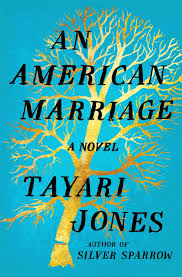
A review of An American Marriage, by Tayari Jones. Algonquin Books of Chapel Hill, 2018.
Life is hard. No one can deny that kernel of truth. It can be heartbreaking — soul-crushing — yet beautiful. Tayari Jones presents a gut-wrenching tale of a young black couple in this book. One of the main characters, named Roy, is wrongly convicted of rape. His life and family are forever changed by this situation. Roy’s wife, Celestial, and parents know that he did not do it, but they have no other choice but to wait for Roy’s return. This story is not a typical court-style narrative, but it is about the devastation that these actions have on the family and the people involved. Their routines are completely uprooted, and their family dynamics are strained because of this claim made against Roy.
Tayari Jones had three novels prior to An American Marriage (Leaving Atlanta [2002], The Untelling [2005], and Silver Sparrow [2011], the most popular of which is Silver Sparrow). An American Marriage is number seventy-seven on the New York Times “100 Best Books of the 21st Century.” Jones lives in Atlanta, Georgia, like the main characters in the newest of her works. She also teaches Creative Writing at Emory University.
Roy admits at the end of the first chapter of An American Marriage that “[…] this was the last happy evening I would experience for a very long time” (Jones 27). This describes not only how Roy is feeling, but also foreshadows the journey that the novel’s characters will go on. Roy is sentenced to twelve years in prison, which feels like a lifetime to these characters, and Celestial builds a new life without him. This couple is only married for a year before their lives are turned upside down, and they hardly see each other. He is released on good behavior after serving half of his twelve-year sentence and gets to go back to Atlanta, but Celestial had continued her life and improved her career while he was away. She also managed to get herself involved in a love triangle.
The book goes back and forth between the perspectives of different characters, which adds to the storyline and depth of the characters. Most of the book, the characters (Roy and Celestial) are not physically together, and being stuck in one point of view (for this style of book) would not have worked. The reader is not stuck in Roy’s point of view, or Celestial’s, or Andre’s (a longtime friend of Celestial’s and the third party in the love triangle, whose chapters come further into the book). However, as much as I enjoyed the different points of view, I do think that Jones should have made the characters’ voices more distinct or given them a focus other than Celestial. This really became an issue when Andre’s chapters were introduced, and I had to keep Andre and Roy separate. They both want Celestial, which made it muddy for me while reading. In one of Andre’s chapters, he says, “I’ve known Celestial Davenport all my life, and I have loved her at least that long. This is the truth as natural and unvarnished as Old Hickory, the centuries-old tree that grows between two houses. My affection for her is etched onto my body like the Milky Way birthmark scoring my shoulder blades” (95). Jones knows how to write a yearning man, and readers can feel how Andre feels like he needs Celestial to help him breathe. Roy’s internal dialogue and actions come off as desperation. He feels that he is about to lose his wife after he had everything taken away from him; he doesn’t want to lose his wife, too. Both of these feelings are valid and understandable, but what are Andre’s and Roy’s private arcs without Celestial?
Jones might even consider writing from the third person to do the characters justice. It might have been cleaner and easier to navigate through the characters, especially after Roy gets out of prison. I understand why she would choose to write in first person, though, as it makes the reader have a more intimate connection to the characters and story.
After Roy gets out of prison, he seems like a completely different character, and I stopped rooting for him and Celestial because of the things he was saying and thinking. He finally gets home to his wife, and their connection is strained after all those years being separated. Roy expects sex from his wife and even thinks about forcing her when she is not sure of where she stands with him, as she has also entangled herself with Andre. This part was not pleasing to read, but I believe this was Jones’s intent. Life is not perfect, and neither are her characters.
Jones also uses letters sent back and forth between the couple while Roy is in jail, and at the end of the book. The way that Jones uses the letters to highlight the cracks beginning to form in their relationship is brilliant, yet heartbreaking. Roy begins to question everything about his marriage, and in some letters, he makes it obvious that there is a part deep inside him that he does not trust while he is away. Nevertheless, if you choose to read this poetic take on life and its hardships, you will find yourself rooting for this couple, hoping that they come out the other end stronger than before.
Jones puts life into perspective: the next day is not guaranteed. This couple was only married for around a year before this accusation turned their world upside down, possibly ruining their lives. Her writing is devastatingly beautiful, especially when the wronged couple is writing to one another. Roy writes about offering support to his wife in one of his many letters:
But now all I have is this paper and this raggedy ink pen. It’s a ballpoint, but they take away the casing so you just have the nib and this plastic tube of ink. I’m looking at it, thinking, This is all I have to be a husband with?
But here I am trying.
Love,
Roy (43)
Jones does a wonderful job portraying the difficult emotions that are brought up within Roy and Celestial throughout the book, and as the tensions rise with Roy and Andre, but just like her portrayal of an American marriage, nothing is perfect. I enjoyed the plot and the concept that life is not black and white; however, I feel that Jones could have given us the bigger picture of the black experience. She really focuses on the state of Roy and Celestial’s failing relationship after he gets out of jail, but seems to abandon bigger concepts that I feel she could have gone through with. Perhaps that was never her intention, and she wanted to focus only on representation, which is important — especially because of what the main characters go through in An American Marriage.





Leave a Reply