
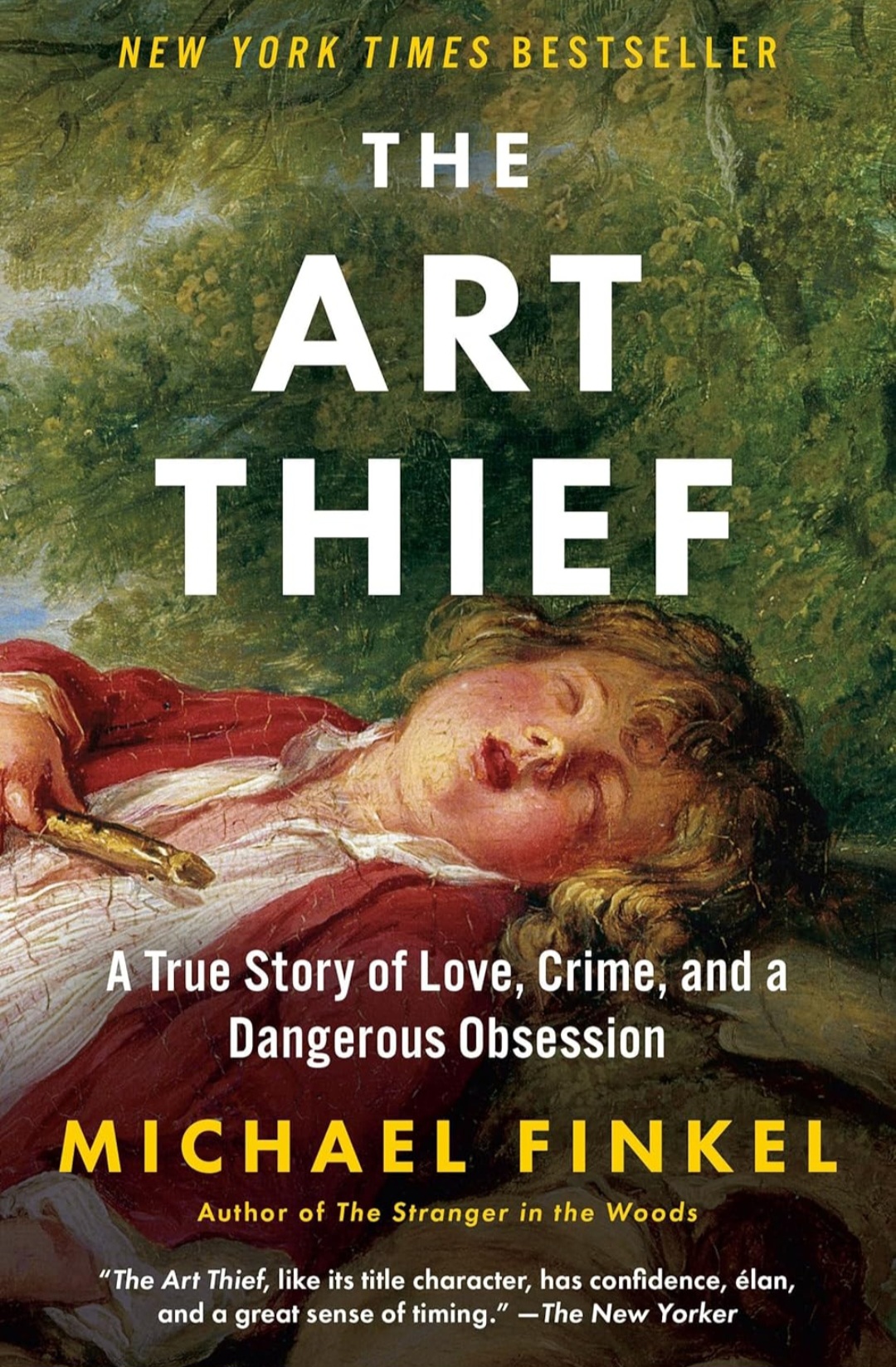
A review of The Art Thief, by Michael Finkel. Random House, 2023.
Michael Finkel’s latest non-fiction book, The Art Thief: A True Story of Love, Crime, and a Dangerous Obsession (2023), takes us through the adventures of Stéphane Breitwieser, an old museum security guard, and his girlfriend, Anne-Catherine Kleinklaus, as they steal over two hundred priceless items from museums across Europe. However, these thieves are different. They never sell anything that they steal, but truly love it and keep it as trophies. Finkel is a journalist and a memoirist who focuses on criminals and marginals. He is the author of The Stranger in the Woods (2017) and True Story: Murder, Memoir, Mea Culpa (2005), which was turned into a film.
In The Art Thief, Finkel takes us through the happy couple’s first years and their first heist together:
The access panel on the display case with the pistol, Breitweiser pointed out to Anne-Catherine, did not have a lock. Three years had passed since his brief, post-high-school stint as a museum security guard, but he’s retained an eye for such details. There were no other visitors around, no alarm, no cameras, no guards. . . “Go ahead,” said Anne-Catherine. “Take it.” (Finkel 31)
They look like a normal couple, enjoying their date at the museum, but little does everyone else know that they have their own version of Bonnie and Clyde on the scene:
It’s lunchtime, stealing time, on a busy Sunday in Antwerp, Belgium, in February 1997. The couple blends in with the tourists at the Rubens House, pointing at and nodding at sculptures and oils. Anne-Catherine is tastefully dressed in Chanel and Dior bought in secondhand shops, a bug Yves Saint Laurent bag on her shoulder. Breitwieser wears a button-down shirt tucked into stylish pants, topped by an overcoat that’s sized a little too roomy, a Swiss Army knife stashes in a pocket. (1)
The Art Thief was recommended to me by my sister, who works at my local library, and I devoured this book in two days, like a starved dog. I could have read it in one sitting. It was a mind-boggling read, and exploring the narrative of so many heists was fascinating. Going into the book, you know that the thieves are caught; it’s just a matter of when and how. I was always on the edge of my seat while reading, wondering when Breitwieser was inevitably going to get caught and have his dreams end. The Art Thief has short chapters and fast pacing, so it made me feel like I was flying through the book.
After the couple completes a heist, Finkel notes, they always find it in their newspaper and put it in their scrapbook; “The articles are added to the couple’s scrapbook, which they store on top of the canopy over the four-poster bed. Breitwieser often brings the book down to reread the pieces and gloat. He imagines that any police officer inspecting their crimes would consider them aristocratic and honorable thieves” (47). This couple is smart for keeping track of the reports, as this is how they know if the police are onto them. This was a time before the internet, and newspapers were the main form of receiving information. If the couple was at risk, the newspaper would be the first place to look. Finkel explains that the police never communicated with each other as the couple went across multiple borders for their crimes, which is why they did not connect the crimes until after Breitwieser was in custody.
This book is written in tandem with the “present” lives of the couple and with the narrator (Finkel) having the current information about the couple’s thefts and their lives after they are caught. There are multiple thefts explained throughout the book, and one that changes Breitwieser’s life forever, but you will have to read the book yourself to learn more about that one!
The most expensive item that Breitweiser stole was Sybille, Princess of Cleves, by Lucas Cranach the Elder, in 1995, from a castle in Baden-Baden, Germany. This oil painting was estimated at over €5 million (roughly $8.7 million) in 2003. His entire stolen collection was worth approximately $1.4 billion.
Finkel doesn’t just explain the logistics of Breitweiser and Anne-Catherine’s heists; he goes over a few other famous heists and criminals and how they differ from the wanted couple. Many thieves steal so that they can resell the works for millions of dollars, but this couple doesn’t sell their stolen items, unlike, say, Vincenzo Peruggia, who stole the famous Mona Lisa in 1911. Peruggia was only caught because he finally tried to sell it; Breitweiser does not make the same mistake. Finkel sets the culture around art and its unfortunate history of being pilfered and sold. Usually, when valuable items are stolen, especially art pieces, the thief will sell them to the highest bidder on the black market. What makes this couple so interesting is their emotional connection to the works or items that they steal. They don’t always steal the most expensive items; they steal what they feel connected to. They keep everything in their apartment and have everything on display so that they can see their growing collection.
The Art Thief is a book that everyone needs to read. There is love, action, and mystery. The way that Finkel wrote it makes it seem like a slow build to the climax, even though it felt like a quick read to me. There was so much fascinating information, and I think it shows us that the higher you are, the harder you fall.






Leave a Reply