
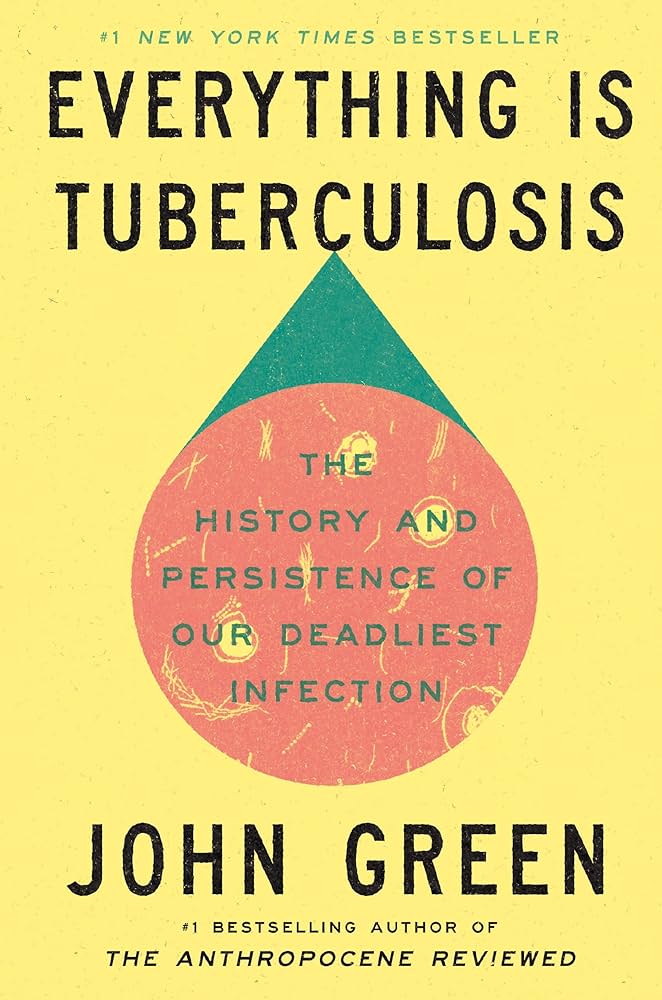
A review of Everything is Tuberculosis by John Green. Penguin Random House, 2025. 184 pages
Everyone is familiar with John Green; he is most well-known for writing The Fault in our Stars, Looking for Alaska, and Paper Towns. Green and his brother, Hank, co-created the educational YouTube channel Crash Course. These previous works paved the way for Green’s most recent book: Everything is Tuberculosis. Going into his newest publication, I knew very little about tuberculosis (TB). The way this disease is described makes it sound like it’s not a huge threat to society anymore… it’s a disease of the past, but Green proves that this assumption is flat out wrong and that society must do something about it. The first step is being informed.
Going into this read with as little information as I did, I was shocked that TB had so many names throughout the years: consumption, the white plague, phthisis (wasting disease). This is just the tip of the informative iceberg that Green explains throughout Everything is Tuberculosis. There is so much in this book; Green connects everything to tuberculosis. Green discusses tuberculosis’s influence on making New Mexico–a U.S territory at this time–the forty-seventh state. After multiple attempts to join the Union–none of which were successful–New Mexico needed to requit, “a larger white and English-speaking population, and thus began New Mexico’s quest to woo consumptives from the American Northeast and South with the promise of desert air, open skies, and world-class consumption care. That plan worked—by 1910, around 10 percent of all New Mexicans were tuberculosis patients, and with these new white residents, the U.S Congress finally acquiesced” (Green 16-17).
In Everything is Tuberculosis, Green goes through his intimate experiences with patients at the Lakka Government Hospital in Sierra Leone. Throughout the book, Green focuses on a young boy named Henry (who is plagued with TB), his journey, and grueling recovery. I grew very fond of Henry and his mother while learning bits and pieces about his chronic illness. Having Henry’s story in Everything is Tuberculosis gave the disease a face in way I would have missed if Green had not put real people’s stories in this book.
Despite being infected with drug-resistant tuberculosis (which I also had learned existed), Henry was still full of life and hope. I had no idea how the disease developed and that it required so many other factors for it to form like malnutrition, close connections with others that are infected, and geographic factors.
Green explains the odd history and romanticization of tuberculosis, which was interesting to read! Many famous poets and writers suffered from TB and some even yearned to be infected with it, as they believed that it would give them the ability to write the most beautiful literature, and that was how they would be remembered. Green goes through many historical authors that suffered from TB and succumbed to its cruelty, “ the Bronte sisters, after all, died of TB, and Elizbeth Barrett Browing likely did as well—but the focus was on men and how TB enhanced their talents” (58-59). This belief was called spes phthisica (consumptive spirit) and was defined as “a condition believed peculiar to consumptives in which physical wasting led to euphoric flowering of the passionate and creative aspects of the soul” (59). Green just kept throwing information bomb after bomb and there was so much that we just don’t learn or don’t think to learn about unless it’s brought to our attention.
I cannot stress how much I learned from this book: the history of the disease, how it has affected different generations, Green’s own investigation and tuberculosis’ current status as a disease. Knowing what I know now, I have more questions that pushed me to do my own research and made me wonder why we don’t take this disease more seriously. Green’s advocacy for increased access to treatment and awareness of TB has helped people suffering and it provides hope… something that seems to be fleeting in our world. We can only try to do better by educating ourselves to help others and in Green’s words, “We must also address the root cause of tuberculosis, which is injustice. In a world were everyone can eat, and access healthcare, and be treated humanely, tuberculosis has no chance. Ultimately, we are the cause. We must also be the cure” (184).






Leave a Reply